Sanitary Flowmeter
Sanitary Flowmeter
In the processing of food, beverages, pharmaceuticals, and biotechnological products, maintaining a sterile environment is the primary engineering requirement. A sanitary flowmeter is a specialized instrument designed to measure the volume or mass flow rate of liquids while adhering to strict hygienic standards. Unlike standard industrial flowmeters, these devices must feature crevice-free internal geometries, high-grade surface finishes, and materials that can withstand rigorous cleaning cycles without degrading or harboring bacterial growth.
Selecting the appropriate sanitary flowmeter requires a deep understanding of fluid dynamics, material science, and the specific regulatory standards governing hygienic processes. This guide examines the core measurement principles, selection criteria, and installation best practices essential for process engineers and system integrators.
Understanding Sanitary Flow Measurement Principles
Before selecting a meter, it is necessary to understand how different technologies interact with the process fluid. In sanitary environments, the most common technologies are electromagnetic, ultrasonic, and Coriolis, each offering distinct advantages depending on the fluid properties.
Electromagnetic Flowmeters (Mag Meters)
Electromagnetic flowmeters operate based on Faraday’s Law of Induction. When a conductive liquid flows through a magnetic field generated by the meter, it produces a voltage proportional to the velocity of the liquid.
In a sanitary flowmeter configuration, the flow tube is lined with an FDA-approved insulating material, such as PFA (Perfluoroalkoxy) or PTFE (Polytetrafluoroethylene). These liners are smooth and resistant to the high temperatures found in sterilization cycles. Because there are no moving parts or obstructions in the flow path, mag meters are ideal for liquids containing solids, such as fruit pulps or dairy products with particulates.
Ultrasonic Flowmeters
Ultrasonic meters typically use the "transit-time" principle. Two transducers send and receive ultrasonic signals through the fluid. The difference in time taken for the signal to travel upstream versus downstream is used to calculate the flow velocity.
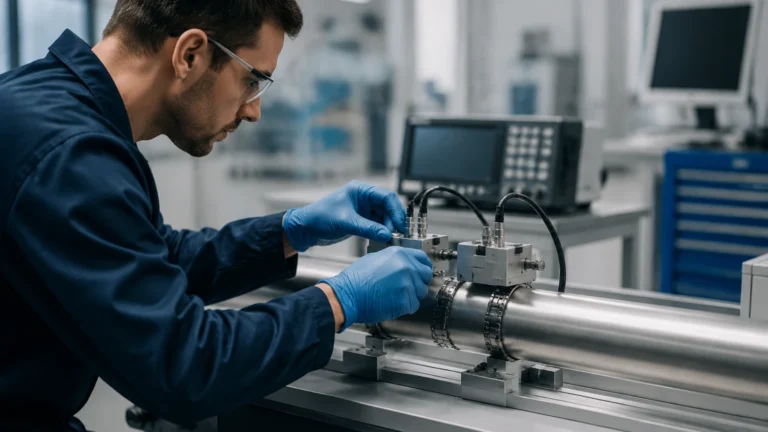
For sanitary applications, ultrasonic meters are often preferred because they can be designed as "clamp-on" devices that never touch the process fluid, or as full-bore inline meters with no internal protrusions. This eliminates any risk of contamination and simplifies the cleaning process.
Coriolis Mass Flowmeters
Coriolis meters measure mass flow directly by detecting the inertia created by fluid flowing through vibrating tubes. As the fluid moves, it causes the tubes to twist slightly; the degree of twist is directly proportional to the mass flow.
These meters are highly valued in the pharmaceutical industry because they provide high accuracy (often ±0.1%) and can measure mass, density, and temperature simultaneously. Sanitary versions use single or dual curved tubes made of polished stainless steel, designed to be self-draining to prevent fluid stagnation.
Key Technical Specifications for Hygienic Applications
To be classified as a sanitary flowmeter, the instrument must meet specific material and design criteria that distinguish it from general-purpose industrial hardware.
Materials of Construction
The wetted parts—those in direct contact with the product—must be non-reactive and non-corrosive. Stainless steel 316L (low carbon) is the industry standard due to its resistance to corrosion from cleaning agents and acids. High-performance plastics like PFA are used for liners because they offer a non-stick surface that prevents protein or sugar buildup.
Surface Finish (Ra Value)
The internal surface roughness, measured as Ra, is a critical specification. A lower Ra value indicates a smoother surface. Most sanitary standards require an internal finish of Ra ≤ 0.8 μm (32 micro-inches), often achieved through mechanical polishing or electropolishing. This smoothness ensures that bacteria cannot find "valleys" in the metal to hide during cleaning cycles.
CIP and SIP Compatibility
Sanitary processes rely on Clean-in-Place (CIP) and Steam-in-Place (SIP) protocols.
* CIP: Involves circulating hot water and chemical detergents (caustics/acids) at velocities around 1.5 to 3.0 m/s (4.9 to 9.8 ft/s).
* SIP: Involves the use of saturated steam at temperatures typically reaching 121°C to 140°C (250°F to 284°F) for sterilization.
A sanitary flowmeter must be rated to withstand these thermal and chemical shocks without losing calibration or damaging the seals and liners.
Selecting the Right Sanitary Flowmeter for Your Process
Choosing the correct technology depends on the fluid's conductivity, viscosity, and the required precision. The following table provides a comparison of common sanitary flow measurement technologies.
Selection Comparison Table
| Technology | Accuracy | Fluid Conductivity Required? | Pressure Drop | Ideal Applications |
| :— | :— | :— | :— | :— |
| Electromagnetic | ±0.5% | Yes (>5 μS/cm) | Negligible | Milk, juice, beer, yogurt |
| Ultrasonic | ±1.0% | No | Zero (Clamp-on) | Purified water, oils, chemicals |
| Coriolis | ±0.1% | No | Moderate | Pharma dosing, high-value oils |
| Sanitary Turbine| ±0.5% | No | High | Water, low-viscosity solvents |
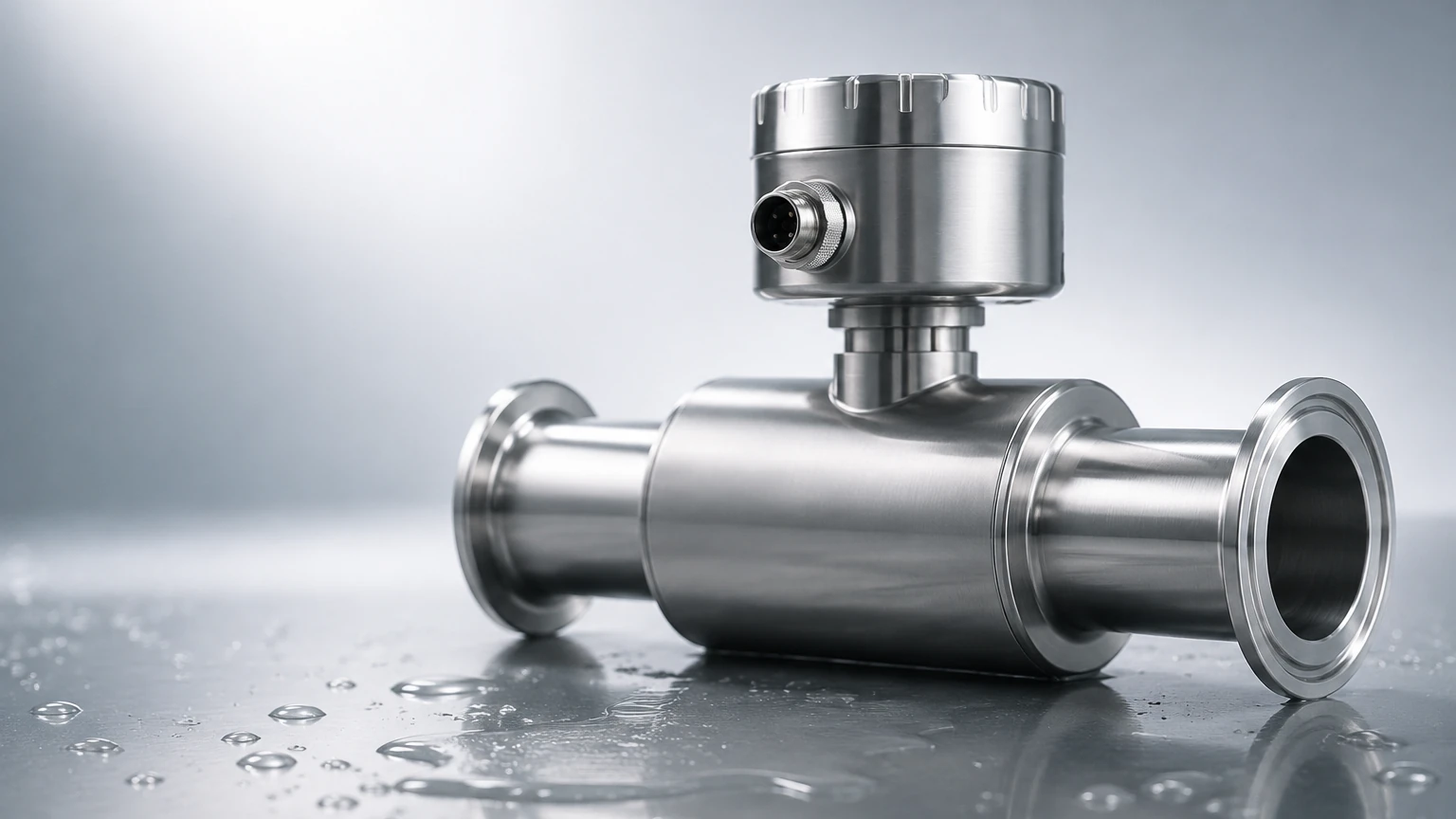
When evaluating options, engineers should also consider the connection type. Sanitary meters almost exclusively use Tri-Clamp or DIN 11851 hygienic couplings, which allow for quick disassembly and ensure a flush internal seal between the meter and the piping.
For comprehensive technical data on integrated level and flow instrumentation, engineers should visit the Main Page to review product options and application support provided by specialized manufacturers like Welk.
Installation Best Practices for Clean-in-Place (CIP) Systems
Even the highest quality sanitary flowmeter will fail if installed incorrectly. Proper orientation and piping layout are essential to maintain hygiene and accuracy.
1. Self-Draining Orientation: In sanitary systems, the meter must be installed so that it can drain completely by gravity when the system is shut down. For Coriolis and Mag meters, this often means a vertical installation with the flow moving upward. This ensures the pipe is always full during measurement and empty during maintenance.
2. Straight Pipe Runs: Most flowmeters require a specific length of straight pipe before (upstream) and after (downstream) the meter to stabilize the flow profile. A common rule is 5D (five times the pipe diameter) upstream and 2D downstream. However, check the specific manufacturer guidelines, as some modern mag meters require less.
3. Grounding: For electromagnetic flowmeters, proper grounding is critical to prevent electrical noise from interfering with the low-voltage signal. In sanitary stainless steel piping, grounding rings or specialized grounding electrodes within the meter are used to ensure the fluid and the meter are at the same potential.
4. Avoid Air Entrainment: Air bubbles or foam can cause significant errors in both ultrasonic and electromagnetic meters. Ensure the meter is placed at a low point in the piping system or in a vertical rise to prevent air pockets from forming at the top of the sensor.
Common Risks and Operational Limitations
While sanitary flowmeters are robust, certain conditions can compromise their performance or longevity.
* Vacuum Conditions: During CIP cycles, rapid cooling after a steam cycle can create a vacuum. If the meter's liner (like PTFE) is not vacuum-rated, it may collapse or pull away from the stainless steel housing, destroying the meter.
* Conductivity Limits: Electromagnetic meters will not work with non-conductive fluids like deionized water or pure oils. In these cases, an ultrasonic or Coriolis meter is required.
* Cavitation: If the pressure drops too low near the meter, the liquid may vaporize (cavitate), creating bubbles that erode the internal surfaces and cause erratic readings. Maintaining a backpressure of at least 0.1 MPa (15 psi) above the vapor pressure is a standard precaution.
* Coating and Scaling: In applications like chocolate or heavy syrups, fluid can build up on the electrodes of a mag meter. Regular CIP is necessary, and sometimes "electro-scrubbing" features or non-contacting electrodes are required to maintain signal integrity.
Frequently Asked Questions (FAQ)
Q: Can I use a standard industrial flowmeter for a food-grade application?
A: No. Standard meters often have threaded connections or internal pockets where bacteria can grow. They also may use materials that leach chemicals into the product. Only meters certified with 3-A, EHEDG, or FDA-compliant materials should be used.
Q: What is the difference between 3-A and EHEDG?
A: 3-A is a US-based sanitary standard focused on the design and fabrication of equipment. EHEDG (European Hygienic Engineering & Design Group) is a European organization that focuses on the cleanability and testing of equipment. Many global manufacturers comply with both.
Q: How often should a sanitary flowmeter be calibrated?
A: In the pharmaceutical industry, annual calibration is standard. In food and beverage, the frequency depends on the criticality of the process, but bi-annual checks are common to ensure dosing accuracy and waste reduction.
Q: Are there sanitary flowmeters for steam measurement?
A: Yes, vortex flowmeters are often used for steam. However, while the meter body may be stainless steel, the "sanitary" requirement is usually less stringent for the steam line itself than for the lines carrying the actual food or drug product.
Conclusion
Implementing a sanitary flowmeter is a critical step in ensuring both process efficiency and consumer safety. By understanding the physics of the measurement—whether it be the electromagnetic induction of a mag meter or the mass-inertia of a Coriolis meter—engineers can select a solution that withstands the rigors of CIP/SIP while providing the accuracy needed for modern industrial automation.
When planning a system, always confirm the chemical compatibility of the liners and seals with your specific cleaning agents and ensure the installation geometry supports full drainage. For those seeking customized OEM/ODM services or integrated measurement solutions, consulting with a professional manufacturer ensures that the selected hardware meets all regulatory and operational demands.