Distillation Thermometer
Distillation Thermometer
In industrial process engineering, distillation remains one of the most critical unit operations for separating liquid mixtures into their component parts based on differences in volatility. At the heart of this process is the distillation thermometer, a precision instrument designed to monitor the temperature of vapors and liquids at various stages of the column. Accurate temperature measurement is not merely a matter of monitoring; it is the primary method for identifying the composition of the distillate and ensuring that the separation occurs at the correct boiling points.
While temperature provides the data necessary for chemical separation, it must work in tandem with other process variables. For instance, maintaining the correct liquid level in the reboiler and the reflux drum is equally vital for column stability. Engineers often consult the Main Page of specialized instrumentation providers to find level measurement solutions that complement their temperature control systems, ensuring a holistic approach to distillation column automation.
Measurement Principles of Distillation Thermometers
To select the right distillation thermometer, one must first understand the underlying physical principles used to convert thermal energy into a readable value. In industrial and laboratory distillation, four primary principles are utilized:
1. Liquid-in-Glass (Thermal Expansion)
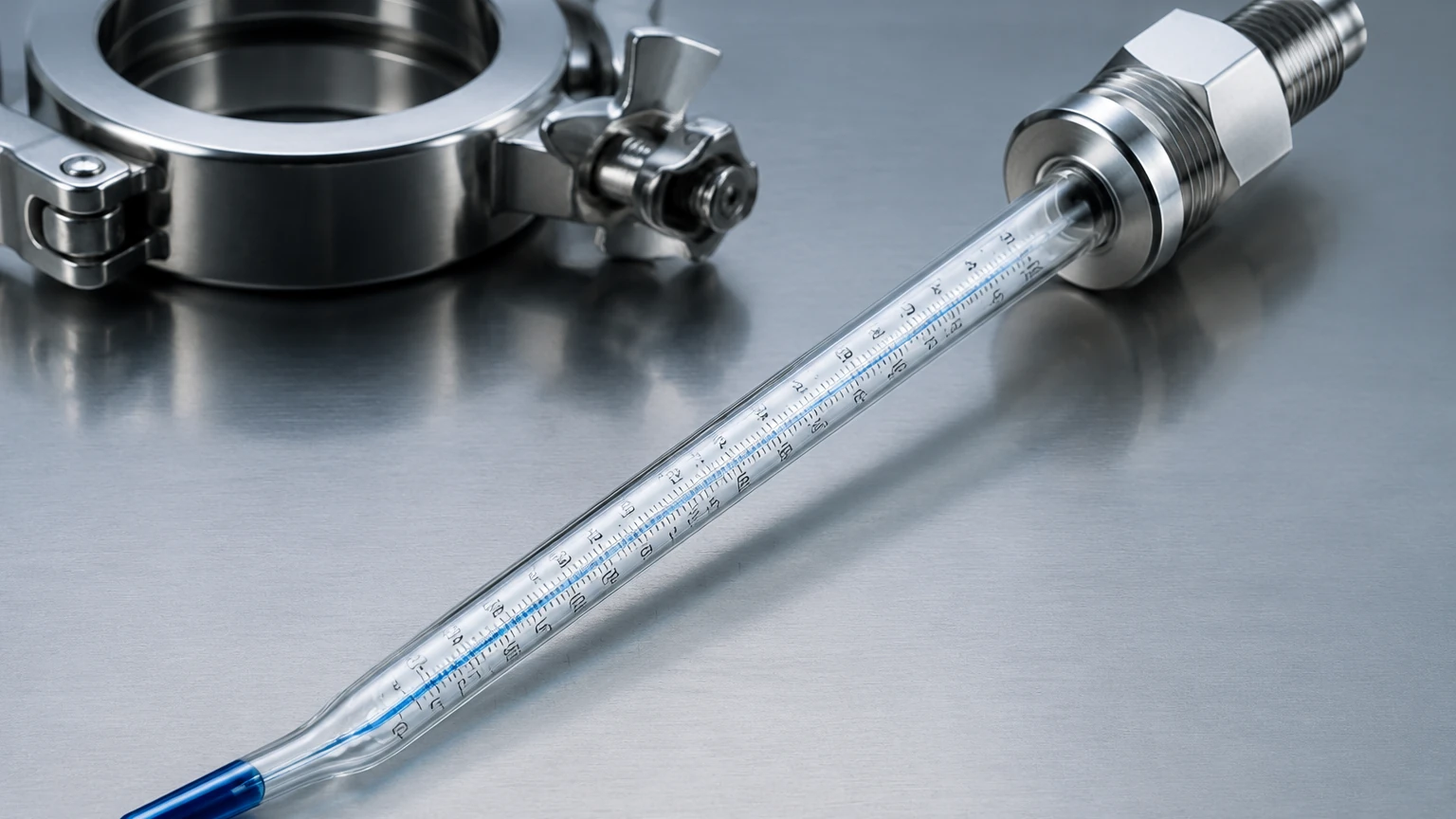
This is the most traditional form of distillation thermometer. It operates on the principle of the thermal expansion of a liquid (historically mercury, but now more commonly alcohol or organic spirits for safety). As the temperature rises, the liquid expands up a calibrated capillary tube. In distillation, these are often "partial immersion" or "total immersion" types, which require specific installation depths to remain accurate.
2. Bimetallic Expansion
Used primarily for local indicators on industrial tanks, bimetallic thermometers consist of two different metals bonded together. Because the metals have different coefficients of thermal expansion, the strip bends when heated. This mechanical movement is linked to a pointer on a dial. While robust, they generally offer lower precision than electronic sensors.
3. Resistance Temperature Detectors (RTDs)
RTDs, typically Pt100 or Pt1000 sensors, operate on the principle that the electrical resistance of a metal (platinum) increases predictably as temperature rises. RTDs are the gold standard for industrial distillation due to their high accuracy, stability, and repeatability over long periods. They are essential when the temperature data must be fed into a Distributed Control System (DCS).
4. Thermocouples
Thermocouples function based on the Seebeck effect, where a voltage is generated at the junction of two dissimilar metals when subjected to a temperature gradient. They are favored in high-temperature distillation processes or applications where extremely fast response times are required, though they are generally slightly less accurate than RTDs.
Key Selection Criteria for Industrial Distillation
Selecting a distillation thermometer requires a balance between precision, durability, and integration capabilities. The following factors are critical for B2B procurement and engineering specifications:
Temperature Range and Accuracy
The thermometer must cover the entire boiling range of the mixture being processed. For high-purity applications, such as pharmaceutical or fine chemical distillation, an accuracy of ±0.1°C may be required. In standard petrochemical applications, ±0.5°C to ±1.0°C is often sufficient.
Immersion Depth
In a distillation column, the thermometer must be placed where it can accurately sense the vapor temperature without being influenced by the cooler walls of the vessel. For glass thermometers, the "immersion line" must be strictly observed. For industrial electronic probes, the insertion length must be calculated to reach the center of the vapor stream.
Response Time
Distillation is a dynamic process. If the reflux ratio changes, the temperature at the top of the column will shift. A thermometer with a slow response time (often caused by a heavy-duty thermowell) can lead to "hunting" in the control loop, resulting in off-specification products.
Selection Comparison Table
| Feature | Liquid-in-Glass | Bimetallic Dial | RTD (Pt100) | Thermocouple (Type K) |
| :— | :— | :— | :— | :— |
| Accuracy | High | Moderate | Very High | Moderate/High |
| Response Time | Slow | Moderate | Moderate | Fast |
| Data Logging | No | No | Yes | Yes |
| Durability | Fragile | Robust | Robust (in well) | Very Robust |
| Typical Range | -20 to 300°C | -50 to 500°C | -200 to 600°C | -200 to 1200°C |
Installation Considerations in Distillation Columns
The placement of the distillation thermometer is as important as the instrument itself. Incorrect installation is the most common cause of measurement error in chemical processing.
Vapor Phase Placement
To identify the fraction being collected, the thermometer bulb or sensor tip must be located just below the side-arm of the distillation head. This ensures it is measuring the temperature of the vapor that is actually moving into the condenser. If placed too high, it will read low; if placed too low, it may measure the temperature of the boiling liquid rather than the vapor.
Thermowells and Protection
In industrial scale columns, sensors cannot be exposed directly to high-velocity vapors or corrosive fluids. Thermowells—protective metal tubes—are used. However, the thermowell adds thermal mass, which slows the response time. Using a heat-conductive paste inside the thermowell can help mitigate this lag.
Integration with Level Measurement
In a functioning distillation column, temperature and level are inextricably linked. For example, if the level in the column base (the bottoms) rises too high, it can cause "flooding," which disrupts the temperature gradient across the trays. Conversely, an accurate temperature profile helps engineers understand the density of the fluid, which is a critical variable for certain types of level measurement, such as hydrostatic transmitters. For comprehensive information on managing these fluid dynamics, engineers often refer to the Main Page to select radar or ultrasonic level sensors that can withstand the high-temperature environments typical of distillation.
Limitations and Potential Risks
While distillation thermometers are essential, they are subject to several limitations that can compromise process safety and product quality:
1. Stem Emergence Error: In glass thermometers, if the stem is not immersed to the correct depth, the air surrounding the exposed stem will cool the liquid inside, leading to a lower-than-actual reading. This requires a "stem correction" calculation.
2. Calibration Drift: Electronic sensors, especially thermocouples, can drift over time due to thermal cycling and oxidation. Regular calibration against a reference standard is mandatory in regulated industries.
3. Chemical Compatibility: The materials of the thermometer or its thermowell must be compatible with the process media. For instance, in acidic distillation, specialized alloys like Hastelloy or Tantalum may be required instead of standard 316 stainless steel.
4. Lag Time: In automated systems, a lag in temperature reporting can lead to a delay in adjusting the reboiler steam or reflux pump, potentially causing a pressure spike or a safety relief valve discharge.
Practical Maintenance and Calibration
To maintain the integrity of a distillation process, a rigorous maintenance schedule for thermometers must be established:
* Visual Inspection: For glass thermometers, check for separations in the liquid column. For industrial probes, inspect the thermowell for signs of erosion or corrosion.
* Ice Point Check: A simple way to verify the accuracy of a distillation thermometer is the ice point test (0°C). While this does not calibrate the full range, it identifies significant zero-shift errors.
* Annual Laboratory Calibration: Industrial RTDs should be removed annually and calibrated in a dry-block calibrator or a stirred liquid bath against a NIST-traceable standard.
Frequently Asked Questions (FAQ)
Q: Why is my distillation thermometer reading lower than the expected boiling point?
A: The most common reasons are insufficient immersion depth, where the sensor is not fully enveloped by the vapor, or "stem cooling." Additionally, if the distillation is being performed under vacuum, the boiling point will be significantly lower than the standard atmospheric boiling point.
Q: Can I use an infrared (IR) thermometer for distillation?
A: Generally, no. IR thermometers measure surface temperature. In distillation, you need to measure the internal vapor temperature. Glass or metal walls will interfere with IR readings, providing inaccurate data for process control.
Q: What is the difference between a partial immersion and a total immersion thermometer?
A: A partial immersion thermometer is calibrated to be accurate when immersed to a specific mark on the scale (usually 76mm). A total immersion thermometer is designed to be submerged up to the temperature reading itself. In most distillation setups, partial immersion is more practical.
Q: How does temperature affect level measurement in the column?
A: High temperatures change the density of the liquid and the dielectric constant of the vapor space. This can affect the accuracy of hydrostatic level sensors and certain radar level meters. It is essential to use temperature-compensated level instruments, which can be explored on the Main Page of industrial instrument providers.
Conclusion
The distillation thermometer is a foundational tool in chemical engineering, providing the critical data needed to manage phase changes and component separation. Whether utilizing a simple glass instrument for bench-scale testing or a high-precision Pt100 RTD for an industrial refinery, understanding the measurement principles and installation requirements is key to process success. By integrating accurate temperature data with reliable level measurement and flow control, operators can ensure maximum throughput, high product purity, and safe operating conditions.