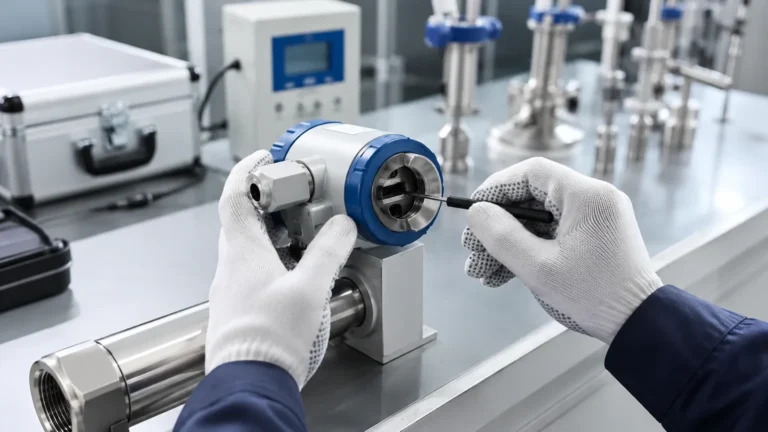
Sanitary Processing Equipment for Cosmetics Manufacturing
Sanitary Processing Equipment for Cosmetics Manufacturing
In the cosmetics industry, the transition from laboratory formulation to full-scale production requires a rigorous focus on hygiene, precision, and repeatability. The production of lotions, creams, shampoos, and perfumes involves complex mixtures of oils, waxes, water-based emulsions, and active ingredients. Because many of these products are susceptible to microbial contamination and oxidation, the selection of sanitary processing equipment for cosmetics manufacturing is a critical decision for process engineers.
Reliable level measurement is a cornerstone of this equipment suite. Whether managing raw material bulk storage or monitoring the precise filling of high-value serums, the choice of instrumentation impacts both product safety and the efficiency of the manufacturing line. This guide explores the technical principles of sanitary level measurement and provides a framework for selecting the appropriate technology for cosmetic applications.
Regulatory and Sanitary Requirements in Cosmetic Processing
Cosmetic products, while not always held to the same stringent pharmaceutical standards, must comply with Good Manufacturing Practices (GMP) and standards such as ISO 22716. The equipment used must prevent the accumulation of product residue, which can lead to bacterial growth or cross-contamination between batches.
Material Selection and Surface Finish
The primary material for sanitary processing equipment for cosmetics manufacturing is 316L stainless steel. This grade offers superior corrosion resistance against the surfactants and acidic components often found in cosmetic formulations. A critical specification is the surface roughness (Ra). For sanitary applications, internal surfaces are typically polished to an Ra of < 0.8 µm (32 micro-inches) or better, often via electropolishing, to ensure that microorganisms cannot adhere to microscopic pits in the metal.
Sanitary Fittings and Dead Legs
Standard NPT or BSP threaded connections are avoided in sanitary environments because the threads create "dead legs"—areas where the product can become trapped and remain untouched by cleaning solutions. Instead, equipment utilizes hygienic fittings such as Tri-Clamp (ISO 2852) or DIN 11851. These connections use a gasket and a clamp to create a flush, crevice-free seal between the sensor and the vessel wall.
Principles of Level Measurement Technologies
Before selecting a specific instrument, it is essential to understand the physics behind the most common measurement principles used in the industry. Each method has distinct advantages depending on the physical properties of the cosmetic product.
1. Radar Level Measurement (Non-Contact)
Radar transmitters, particularly those operating on the Frequency Modulated Continuous Wave (FMCW) principle, are widely regarded as the gold standard for sanitary processing.
* The Principle: The sensor emits a continuous high-frequency microwave signal (often at 80 GHz). This signal reflects off the surface of the liquid and returns to the sensor. By measuring the frequency difference between the emitted and received signal, the device calculates the distance to the product surface with millimeter precision.
* Advantages: Since the sensor does not touch the product, there is no risk of contamination. Radar is unaffected by changes in pressure, temperature, or the presence of vapors and dust. It is particularly effective in tanks with internal agitators, as advanced software can filter out reflections from moving mixer blades.
2. Ultrasonic Level Measurement
Ultrasonic sensors are a cost-effective non-contact alternative for many water-based cosmetic liquids.
* The Principle: The sensor sends out a pulse of sound waves at a frequency above the human hearing range. These waves bounce off the liquid surface and return to the transducer. The "time-of-flight" is used to determine the distance.
* Advantages: Like radar, it is non-contact. However, the speed of sound is influenced by air temperature and the composition of the gas phase above the liquid. Therefore, most high-quality ultrasonic sensors include integrated temperature compensation.
3. Hydrostatic Level Measurement
Hydrostatic transmitters are contact-based sensors that measure the pressure exerted by a liquid column.
* The Principle: The pressure at the bottom of a tank is directly proportional to the height of the liquid and its density ($P = \rho \cdot g \cdot h$). For sanitary applications, a flush-mounted diaphragm is used to ensure no product buildup occurs in the sensing port.
* Advantages: This technology is highly reliable for viscous liquids like heavy creams or gels, provided the density of the product remains constant. It is easy to install and provides a direct measurement of the head pressure.
4. Point Level Detection (Level Switches)
While the above technologies provide continuous measurement (0–100%), level switches are used for point detection, such as high-level alarms to prevent overfills or low-level alarms to protect pumps from running dry.
* Vibrating Fork Principle: A tuning fork vibrates at its resonant frequency in the air. When the fork is submerged in the liquid, the frequency changes, triggering the switch.
* Capacitive Principle: The sensor measures the change in capacitance between the probe and the tank wall as the liquid covers the sensor head.
Selecting Sanitary Processing Equipment for Cosmetics Manufacturing
Choosing the right instrument depends on the physical state of the product (liquid, cream, or powder) and the process conditions (agitation, vacuum, or steam cleaning). For a comprehensive range of industrial instrumentation, engineers can Review product options and application support to match specific sensor models with their process requirements.
Technology Selection Table
| Application Type | Recommended Technology | Key Reason |
| :— | :— | :— |
| Storage Silos (Alcohol/Solvents) | Non-contact Radar | Safety in volatile environments; high accuracy. |
| Mixing Tanks with Agitators | 80 GHz Radar | Ability to ignore mixer blades and handle turbulence. |
| Viscous Creams/Lotions | Hydrostatic (Flush Diaphragm) | Unaffected by surface foam or high viscosity. |
| Small Batch Vessels (< 2m) | Ultrasonic | Cost-effective for simple, non-foaming liquids. |
| Filling Machine Buffers | Radar or Capacitive Switch | Fast response time for high-speed filling lines. |
| Dry Powder Hoppers (Talcs) | Radar or Vibrating Rod | Reliable measurement of solids with dust clouds. |
Installation Considerations for Sanitary Level Sensors
Proper installation is as important as the technology itself. Even the most advanced sensor will fail if it is mounted incorrectly or creates a hygiene risk.
1. Nozzle Height and Diameter: For radar and ultrasonic sensors, the mounting nozzle should be as short as possible. If a nozzle is too long and narrow, the signal may reflect off the nozzle walls before reaching the product, causing "near-zone" interference.
2. Orientation and Position: Sensors should be mounted away from the tank's inlet flow to avoid measuring the incoming stream rather than the bulk liquid level. For tanks with agitators, the sensor should be positioned such that the beam path is parallel to the shaft, minimizing interference.
3. Diaphragm Protection: For hydrostatic sensors, the flush diaphragm is a thin, sensitive component. During installation, it must be handled with extreme care to avoid dents or scratches that could compromise the accuracy or create a site for bacterial growth.
4. Gasket Compatibility: Ensure that the gaskets used in the Tri-Clamp fittings are compatible with the chemicals used in the cosmetic product and the cleaning agents. EPDM, FKM (Viton), and PTFE are common choices.

Limitations and Challenges in Cosmetic Level Control
Despite the advancements in sensor technology, certain factors in cosmetics manufacturing present persistent challenges:
* Surface Foam: Many shampoos and soaps generate thick foam during mixing. Ultrasonic signals are often absorbed by foam, leading to a loss of signal. Radar is more resilient but may still experience signal attenuation. In cases of extremely dense foam, hydrostatic pressure sensors or guided wave radar (GWR) may be required.
* Dielectric Constant ($ε_r$): Radar relies on the dielectric constant of the material to reflect the signal. Oil-based products have lower dielectric constants than water-based products. Modern 80 GHz radar can detect materials with $ε_r$ as low as 1.1, but this must be verified during the design phase.
* Temperature Shocks: During Clean-in-Place (CIP) cycles, the temperature can rise from 20 °C to 90 °C in seconds. Sensors must be designed to handle this thermal shock without losing calibration or suffering mechanical failure.
Maintenance and Cleaning Protocols (CIP and SIP)
Sanitary processing equipment for cosmetics manufacturing must be designed for automated cleaning.
* Clean-in-Place (CIP): This involves circulating water and chemical detergents through the system. Level sensors must be able to withstand the spray from CIP balls and the chemical corrosivity of caustic soda or phosphoric acid solutions.
* Steam-in-Place (SIP): For products requiring high sterility, the system may be sterilized with saturated steam at temperatures up to 140 °C (2.8 bar). Sensors must be rated for these temperatures to ensure longevity.
Routine maintenance should include a visual inspection of the sanitary seals and a verification of the sensor's zero-point. In many B2B environments, annual calibration is recommended to ensure that the precision of the batching process remains within the specified tolerance (often ±2 mm for high-value products).
Frequently Asked Questions
Q: Can a single sensor be used for both liquid and cream batches?
A: Yes, non-contact radar is versatile enough to handle both, provided the dielectric constant of the oil-based creams is within the sensor's detection range. However, the signal processing settings may need to be adjusted for the different surface profiles.
Q: How do I prevent "false echoes" from the tank agitator?
A: Most modern radar transmitters feature an "echo mapping" or "false signal suppression" function. During a commissioning cycle with an empty tank, the sensor records all static and moving reflections (like the mixer) and subtracts them from the measurement calculation.
Q: Why is 80 GHz radar preferred over 26 GHz radar in cosmetics?
A: 80 GHz radar has a much narrower beam angle (typically 3° to 6°). This allows the signal to avoid internal tank obstructions like heating coils, baffles, and agitators more effectively than the wider beam of a 26 GHz sensor.
Q: Are plastic sensors acceptable for sanitary processing?
A: While some high-performance plastics (like PVDF or PTFE) are used for sensor faces, the housing and process connection should ideally be 316L stainless steel to meet the durability and hygiene requirements of a professional cosmetics production facility.
By integrating the right level measurement technology into the Main Page of their process design, cosmetics manufacturers can ensure product consistency, reduce waste, and maintain the highest standards of sanitary safety.
Download Sanitary Processing Equipment for Cosmetics Manufacturing as a PDF