Thermocouple for High Temperature Measurement
Thermocouple for High Temperature Measurement
In industrial process control, high temperature measurement—typically defined as temperatures exceeding 1,000°C (1,832°F)—presents significant challenges for instrumentation. While various technologies exist for thermal sensing, the thermocouple remains the industry standard for high-temperature applications due to its ruggedness, wide temperature range, and relatively low cost. Selecting the correct thermocouple for high temperature measurement requires a deep understanding of metallurgy, atmospheric conditions, and the physical constraints of the installation site.
This guide provides a technical overview of thermocouple principles, material selection, and practical application guidance for engineering professionals managing high-temperature industrial environments.
Measurement Principles of High-Temperature Thermocouples
A thermocouple operates based on the Seebeck effect, a phenomenon where a temperature gradient across two dissimilar electrical conductors produces a voltage difference. When these two conductors are joined at one end (the "hot junction" or measuring junction) and kept at a known temperature at the other end (the "cold junction" or reference junction), a predictable electromotive force (EMF) is generated.
The magnitude of this EMF is proportional to the temperature difference between the junctions. For high-temperature applications, the choice of metals used in the conductors is critical. At elevated temperatures, materials undergo physical and chemical changes—such as oxidation, recrystallization, and alloy depletion—which can alter the EMF output and lead to measurement drift.
In high-temperature measurement, the relationship between temperature and voltage is non-linear. Modern transmitters and controllers use standardized lookup tables (such as those defined by IEC 60584 or ASTM E230) to linearize the signal and provide accurate readings. For comprehensive process control solutions including level and temperature integration, engineers often refer to the Main Page of specialized instrumentation providers to ensure system compatibility.
Types of Thermocouples for High Temperature Measurement
Thermocouples are categorized into two primary groups: Base Metal and Noble Metal. While base metal types are common in general industry, noble metal types are essential for extreme heat and precision.
Base Metal Thermocouples (Types K and N)
Base metal thermocouples are cost-effective but have limitations at the upper end of the temperature scale.
* Type K (Chromel/Alumel): The most common industrial thermocouple. It can measure up to 1,260°C in intermittent use. However, in the range of 800°C to 1,050°C, it is susceptible to "green rot"—a form of preferential oxidation—if used in reducing or marginally oxidizing atmospheres.
* Type N (Nicrosil/Nisil): Developed to overcome the instabilities of Type K. It offers superior oxidation resistance and better stability at temperatures up to 1,300°C. It is often the preferred choice for vacuum furnaces and high-temperature oxidation environments.
Noble Metal Thermocouples (Types S, R, and B)
These utilize Platinum and Rhodium. They are highly stable and resistant to oxidation but are expensive and sensitive to contamination.
* Type S (Platinum / Platinum-10% Rhodium): Used for temperatures up to 1,480°C. It is the international standard for temperature calibration between 630°C and 1,064°C.
* Type R (Platinum / Platinum-13% Rhodium): Similar to Type S but offers slightly higher stability and a slightly higher output signal. It is used up to 1,600°C.
* Type B (Platinum-30% Rhodium / Platinum-6% Rhodium): Designed for extreme heat, capable of measuring up to 1,700°C continuously and 1,800°C intermittently. Unlike R and S, Type B has a very low output at room temperature, making cold-junction compensation less critical in some specific setups.
Refractory Metal Thermocouples (Type C)
* Type C (Tungsten-5% Rhenium / Tungsten-26% Rhenium): Used for ultra-high temperatures up to 2,315°C. These must never be used in oxidizing atmospheres; they are strictly for vacuum, inert gas, or hydrogen atmospheres, as tungsten oxidizes rapidly.
Technical Selection Table
| Thermocouple Type | Max Continuous Temp (°C) | Max Intermittent Temp (°C) | Atmosphere Suitability | Typical Applications |
| :— | :— | :— | :— | :— |
| Type K | 1,100°C | 1,260°C | Oxidizing / Inert | Heat treating, kilns |
| Type N | 1,200°C | 1,300°C | Oxidizing / Vacuum | Gas turbines, smelting |
| Type S | 1,450°C | 1,480°C | Oxidizing / Inert | Glass, Bio-pharm |
| Type R | 1,450°C | 1,600°C | Oxidizing / Inert | Steel production |
| Type B | 1,700°C | 1,800°C | Oxidizing / Inert | High-temp furnaces |
| Type C | 2,315°C | 2,500°C | Vacuum / Reducing | Aerospace, Nuclear |
Key Evaluation Criteria for High-Temperature Applications
When specifying a thermocouple for high temperature measurement, engineers must evaluate several factors beyond just the maximum temperature rating.
1. Atmospheric Conditions
The chemical environment is often more destructive than the heat itself.
* Oxidizing Atmospheres: Contain oxygen (e.g., air). Noble metals and Type N perform well here.
* Reducing Atmospheres: Lack oxygen and may contain hydrogen or carbon monoxide. Type K fails quickly here. Refractory metals (Type C) are required for very high temperatures in these conditions.
* Vacuum: Requires materials with low vapor pressure to prevent evaporation of the alloy components.
2. Protection Tube (Thermowell) Material
At high temperatures, the thermocouple wires must be protected from physical damage and chemical contamination. Common materials include:
* Stainless Steels (310/316): Limited to approximately 1,100°C.
* Inconel 600: Excellent for high-temperature oxidation up to 1,150°C.
* Ceramic (Alumina/Sillimanite): Essential for noble metal thermocouples. High-purity alumina (99.7%) prevents silica contamination, which can embrittle platinum wires.
* Silicon Carbide: Used in harsh environments like aluminum smelting or waste incineration.
3. Response Time vs. Durability
A thicker wire gauge (e.g., 8 AWG or 3.25 mm) lasts longer at high temperatures but has a slower response time. Conversely, thin-gauge wires respond rapidly but succumb to oxidation and drift much faster. In most industrial furnace applications, durability is prioritized over millisecond response times.
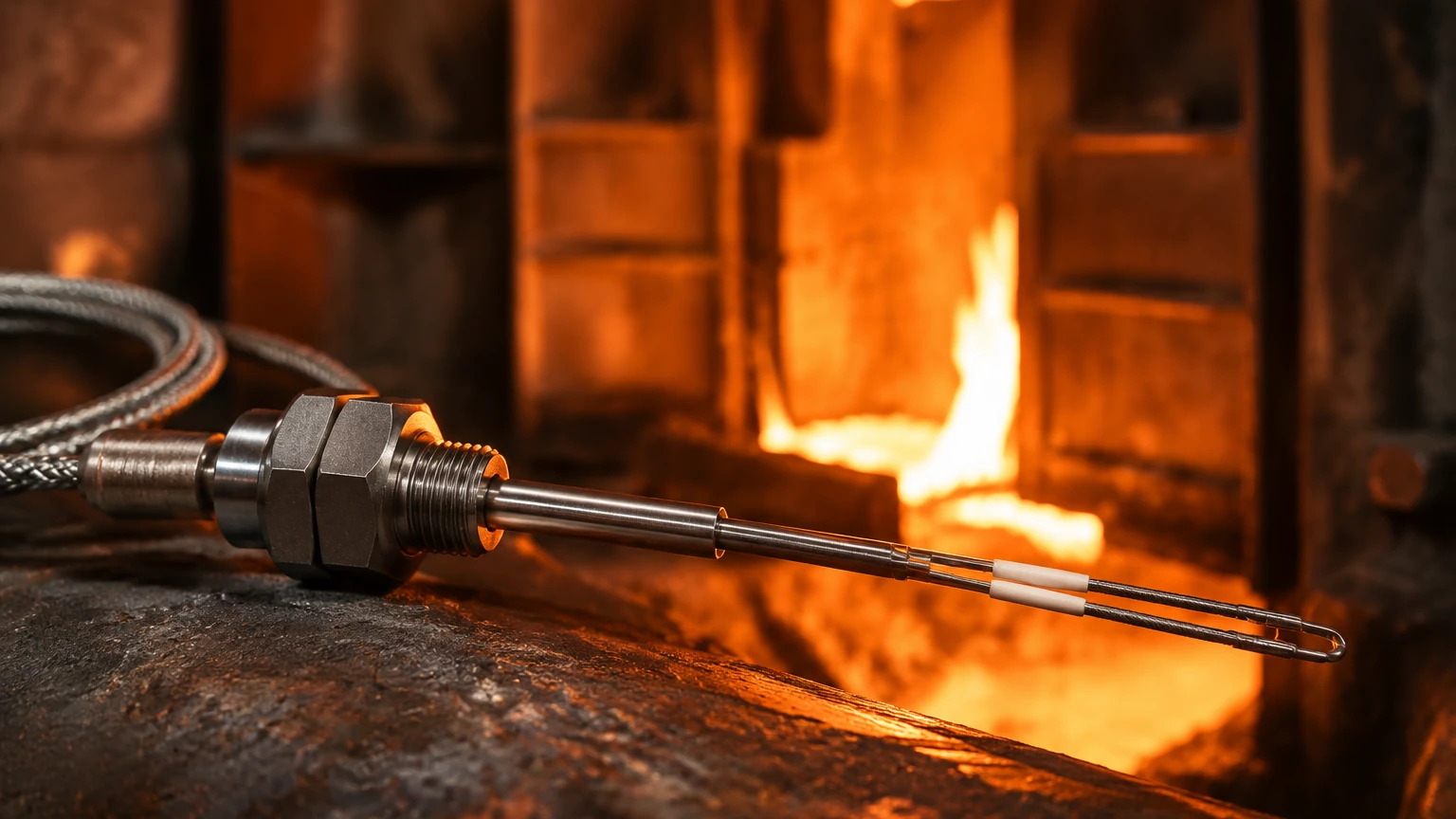
Installation Considerations
Proper installation is as critical as sensor selection. High-temperature environments introduce specific mechanical and electrical challenges.
* Immersion Length: To avoid conduction errors (heat traveling up the protection tube and cooling the junction), the sensor should be immersed to a depth at least 10 times the diameter of the protection tube.
* Expansion Allowance: Materials expand significantly at 1,000°C+. Mounting systems must allow for the thermal expansion of the protection tube to prevent cracking or bending.
* Extension Wire Matching: The wire connecting the thermocouple head to the controller must be the correct "extension grade" or "compensating grade" wire for that specific thermocouple type. Using standard copper wire will introduce significant errors at the connection point.
* Cold Junction Compensation (CJC): The instrument measuring the voltage must accurately know the temperature of the terminals where the thermocouple wires connect. In high-temperature plants, these terminals can get quite warm, making accurate CJC vital.
Common Risks and Limitations
Drift and Decalibration
High temperatures cause the alloys in the thermocouple to migrate or oxidize. This changes the chemical composition of the wire over time, leading to "drift," where the sensor reports a temperature lower or higher than the actual value. In critical processes, thermocouples should be replaced on a schedule rather than waiting for failure.
Contamination
At temperatures above 1,000°C, many materials become porous or release vapors. For example, even trace amounts of iron or silica can contaminate a Type S thermocouple, causing it to lose accuracy within hours. Using high-purity ceramic insulators and sheaths is the only way to mitigate this.
Shunt Errors
At extremely high temperatures (above 1,500°C), the electrical insulation resistance of ceramic materials drops significantly. This can create a "virtual junction" or a shunt, where the voltage signal is generated at a point other than the tip, resulting in false low readings.
Frequently Asked Questions (FAQ)
Q: Why can't I use Type K for all high-temperature needs?
A: While Type K is versatile, it is prone to hysteresis and oxidation above 1,000°C. In many industrial applications, Type N provides much better long-term stability for only a marginal increase in cost.
Q: How often should a high-temperature thermocouple be calibrated?
A: This depends on the temperature and environment. For continuous use above 1,200°C, monthly checks or quarterly replacements are common. In regulated industries like aerospace (AMS2750), calibration intervals are strictly mandated.
Q: Can I use a thermocouple for high temperature measurement in a liquid metal bath?
A: Yes, but the protection tube is the limiting factor. You need a sheath material that will not dissolve in the specific metal (e.g., cast iron, aluminum, or zinc). Specialized ceramic or coated metallic sheaths are required.
Conclusion
Selecting a thermocouple for high temperature measurement involves balancing the thermal limits of the metals with the chemical realities of the process atmosphere. For temperatures up to 1,200°C, Type N is often the most reliable base-metal choice. Beyond that, noble metal Types R, S, and B are necessary, provided they are protected by high-purity ceramic sheathing.
Understanding these technical boundaries ensures process safety and product quality. For engineers looking to integrate temperature data with other process variables like fluid levels or pressure, visiting the Main Page of an experienced instrumentation manufacturer can provide the necessary context for building a robust, high-accuracy measurement system. Proper selection, combined with a rigorous maintenance and replacement schedule, remains the most effective strategy for managing extreme thermal processes.
Download Thermocouple for High Temperature Measurement as a PDF