Single Use Flow Meter
Single Use Flow Meter
In the rapidly evolving landscape of biopharmaceutical manufacturing and high-purity chemical processing, the shift from traditional stainless-steel infrastructure to single-use technology (SUT) has redefined operational efficiency. Central to this transition is the single use flow meter, a specialized instrument designed to provide accurate liquid flow measurement within a disposable flow path. Unlike conventional meters that require extensive Cleaning-in-Place (CIP) and Steam-in-Place (SIP) cycles, single-use sensors are integrated into disposable tubing assemblies, used for a single production batch, and then discarded.
This guide explores the technical principles, selection criteria, and practical application of single-use flow measurement technologies, providing engineering professionals with the necessary framework to integrate these sensors into automated fluid handling systems.
Measurement Principles of Single Use Flow Meters
To maintain the integrity of a sterile process, a single use flow meter must provide high accuracy without compromising the closed nature of the system. Several physical principles are employed to achieve this, each with specific advantages regarding sensitivity and fluid compatibility.
Ultrasonic Transit-Time Technology
Ultrasonic flow meters are the most prevalent choice in single-use applications. These sensors typically utilize the transit-time principle. Two transducers, located on opposite sides of the flow path, send and receive ultrasonic signals. When fluid is moving, the signal traveling in the direction of the flow moves faster than the signal traveling against it. The difference in transit time is directly proportional to the flow velocity.
In single-use systems, this is often implemented in two ways:
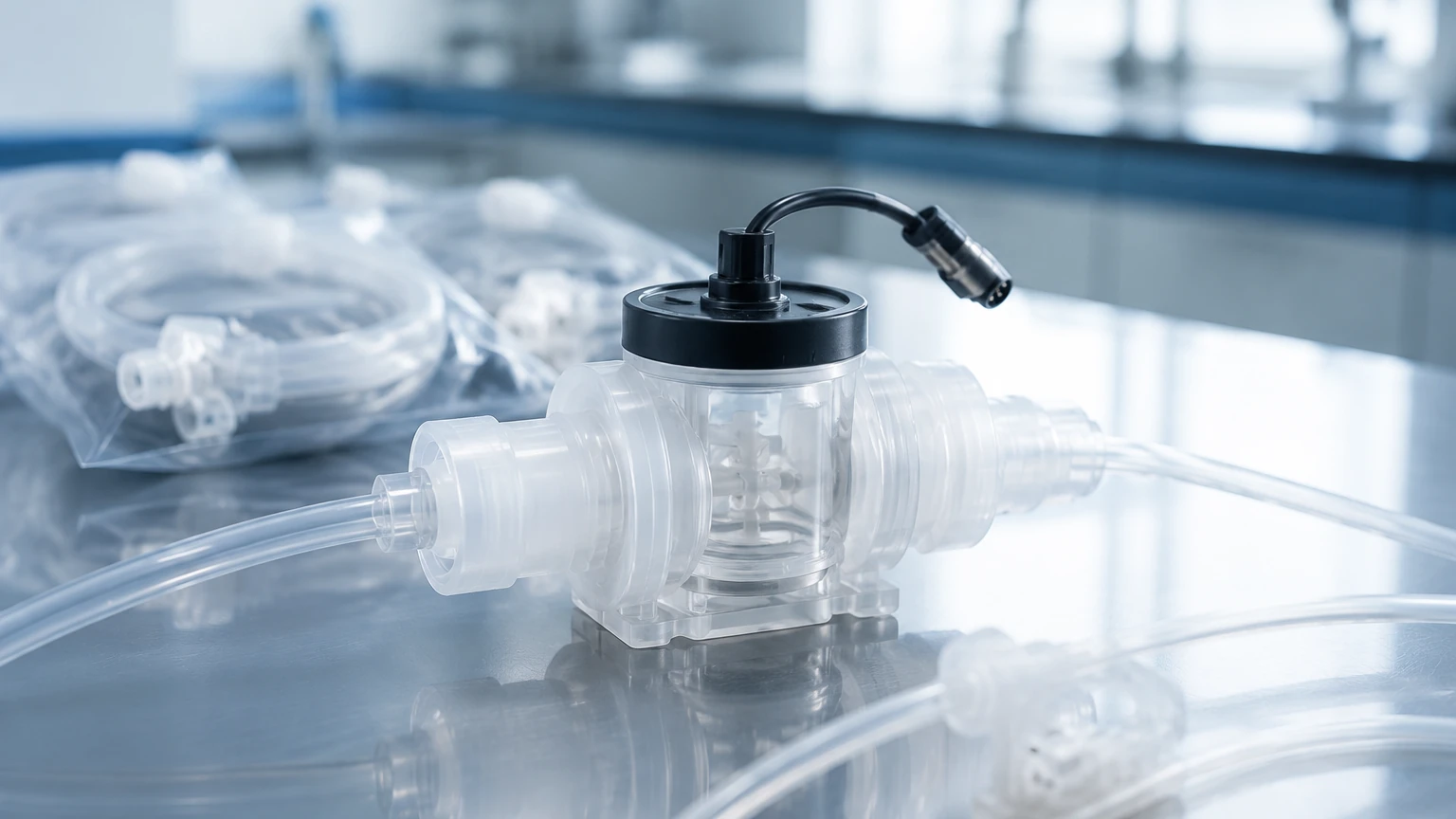
1. Inline Disposable Sensors: The flow cell containing the transducers (or windows for the transducers) is part of the disposable plastic manifold.
2. Clamp-on Sensors: The ultrasonic transducers are housed in a reusable clamp that attaches to the outside of a specific grade of flexible tubing. While the sensor is reusable, the measurement path is technically "single-use" as the tubing is replaced.
Coriolis Mass Flow
Coriolis meters are the gold standard for accuracy because they measure mass flow directly rather than volume. In a single-use Coriolis meter, the fluid passes through a vibrating tube within a disposable plastic housing. The mass flow of the fluid causes a phase shift in the tube's vibration due to the Coriolis effect. This phase shift is measured by sensors and converted into a highly accurate mass flow reading. This technology is particularly valued in fill-finish applications where precise dosing by weight is critical.
Turbine and Mechanical Principles
Single-use turbine meters utilize a small, lightweight rotor suspended within a disposable plastic flow body. As fluid passes through, the rotor spins at a speed proportional to the flow velocity. An external pickup (usually optical or magnetic) detects the rotation speed. While cost-effective, these are less common in shear-sensitive bioprocessing due to the mechanical contact with the fluid.
Key Evaluation Criteria for Selection
Selecting the correct single use flow meter requires a balance between process requirements and the physical limitations of disposable materials. Engineers should evaluate the following parameters before procurement.
Material Compatibility and Gamma Stability
Single-use components are typically sterilized using gamma irradiation (usually 25–45 kGy). It is essential that the flow meter materials—often Polycarbonate, PEEK, or specialized fluoropolymers—can withstand this radiation without leaching extractables or becoming brittle. All wetted materials must meet USP Class VI standards and be animal-derived component-free (ADCF).
Flow Range and Turn-down Ratio
Different processes require vastly different scales. A bench-top chromatography system might require measurements as low as 1 mL/min, while a large-scale production bioreactor harvest might exceed 50 L/min. The turn-down ratio (the ratio between the maximum and minimum measurable flow) determines how versatile a single sensor can be across different stages of a process.
Accuracy and Repeatability
For critical dosing or filtration steps, an accuracy of ±1% of the reading is often required. For less critical transfer steps, ±3% to ±5% may be acceptable. It is important to distinguish between "of rate" (percentage of the actual flow) and "of full scale" (percentage of the maximum capacity), as the latter can lead to significant errors at low flow rates.
Technical Comparison Table
The following table summarizes the primary technologies used in single-use flow measurement to assist in the initial selection process.
| Technology | Typical Accuracy | Flow Range | Best For | Limitations |
| :— | :— | :— | :— | :— |
| Ultrasonic (Inline) | ±1% to ±3% | 0.01 – 100 L/min | General bioprocessing, buffer prep | Sensitive to air bubbles |
| Coriolis (Single-Use) | ±0.5% | 0.1 – 20 kg/min | High-precision filling, mass balance | Higher cost, pressure drop |
| Turbine (Single-Use) | ±1% to ±2% | 0.5 – 50 L/min | Low-viscosity fluids, water | Mechanical wear, shear risk |
| Clamp-on Ultrasonic | ±2% to ±5% | Dependent on tubing | Non-invasive monitoring | Requires specific tubing calibration |
Installation and Integration Considerations
Successful implementation of a single use flow meter depends on proper physical installation and digital integration into the facility's control architecture.
1. Orientation and Flow Direction: Most single-use sensors are directional. Ensure the flow arrow on the disposable body matches the process flow. For ultrasonic meters, vertical installation with upward flow is preferred to prevent air entrapment, which can cause signal loss.
2. Upstream and Downstream Piping: To ensure a fully developed flow profile, maintain straight tubing runs before and after the sensor. A general rule is 10 times the inner diameter (10D) upstream and 5 times the inner diameter (5D) downstream.
3. Calibration Factors: Many single-use sensors come with a calibration constant (K-factor) specific to that individual disposable unit. This value must be entered into the transmitter or PLC to maintain accuracy. Some advanced systems use RFID tags on the disposable part to automatically communicate this data to the controller.
4. Connectivity: Modern single-use transmitters support industrial protocols such as 4-20mA, Modbus, or EtherNet/IP. When designing a system, ensure the flow data can be synchronized with other process variables like pressure and liquid level.
For those managing broader industrial automation projects, it is helpful to Review product options and application support to understand how flow data integrates with total tank management and level control systems.
Limitations and Common Risks
While single-use flow meters offer significant advantages in terms of sterility and reduced downtime, they are not without limitations.
* Pressure Limits: Disposable plastic flow cells typically have lower pressure ratings than stainless steel. Most are rated for 3 to 5 bar (43 to 72 psi). Exceeding these limits can lead to housing deformation or catastrophic failure.
* Air Sensitivity: Ultrasonic and turbine meters are highly sensitive to entrained air. In bioprocessing, bubbles can lead to "noise" in the signal or a complete measurement failure. Degassing or the use of air-trap assemblies is often required.
* Environmental Impact: The use of disposable sensors increases the plastic waste stream of a facility. Organizations must weigh the environmental cost of plastic disposal against the energy and water savings gained by eliminating CIP/SIP processes.
* Cost Per Use: For high-frequency, long-term production of a single product, the cumulative cost of disposable sensors may eventually exceed the capital and maintenance costs of a permanent stainless-steel flow meter.
The Relationship Between Flow and Level Measurement
In many industrial and pharmaceutical applications, flow measurement and level measurement are used in tandem to ensure process safety and efficiency. For example, in a buffer preparation tank, a single use flow meter might control the rate of addition, while a hydrostatic or radar level sensor provides the primary data for the Main Page of the control interface, ensuring the tank does not overflow or run dry. Monitoring the flow rate into a vessel allows for the calculation of theoretical level (mass balance), which serves as a critical redundant check against the physical level sensor readings.
Frequently Asked Questions (FAQ)
Q: Can a single use flow meter be recalibrated by the user?
A: Generally, no. Most single-use sensors are factory-calibrated. The user enters a provided calibration factor into the transmitter. If the accuracy is in question, the disposable component is usually replaced rather than recalibrated in the field.
Q: Are these sensors compatible with high-viscosity fluids?
A: It depends on the technology. Ultrasonic meters can handle moderate viscosity changes, but Coriolis meters are much better suited for fluids with varying or high viscosities. Turbine meters should only be used with water-like viscosities.
Q: How does gamma sterilization affect the electronics within a single-use sensor?
A: In most designs, the sensitive electronics (transducers and chips) are either housed in the reusable part of the system (clamp-on) or are specifically designed with radiation-hardened components if they are part of the disposable assembly.
Q: What is the typical shelf life of a single-use flow sensor?
A: Most manufacturers specify a shelf life of 2 to 3 years, provided the sensor remains in its original, unopened sterile packaging and is stored away from direct UV light and extreme temperatures.
Conclusion
The integration of a single use flow meter into a process workflow offers a path toward faster batch turnover and reduced cross-contamination risks. By understanding the underlying measurement principles—whether ultrasonic, Coriolis, or mechanical—and adhering to strict installation guidelines regarding straight pipe runs and calibration factors, engineers can achieve high-precision results within a disposable framework. As the industry continues to move toward modular and flexible manufacturing, these instruments will remain a cornerstone of modern fluid management, working alongside reliable level measurement solutions to maintain total process control.