Sodium Analyzer
Sodium Analyzer
In the realm of industrial process control and water chemistry, the sodium analyzer stands as a critical sentinel for protecting high-value assets. While physical parameters such as pressure, temperature, and liquid level are fundamental to plant operation, the chemical purity of process water—specifically the concentration of sodium ions—is a primary indicator of system health in power generation, semiconductor manufacturing, and high-pressure steam applications. Sodium is often the first ion to breakthrough in a failing water treatment system, making its detection essential for preventing stress corrosion cracking and deposition in turbines and boilers.
This guide examines the technical principles, selection criteria, and installation requirements for industrial sodium analyzers, providing engineers with the necessary framework to integrate these instruments into a comprehensive monitoring strategy.
Measurement Principles of Sodium Analyzers
To effectively select a sodium analyzer, one must understand the underlying electrochemical principles that allow for the detection of trace sodium levels, often in the parts-per-billion (ppb) range. The most common method used in modern B2B industrial applications is the Potentiometric Ion-Selective Electrode (ISE) method.
Ion-Selective Electrode (ISE) Technology
An ISE-based sodium analyzer operates similarly to a pH meter but uses a glass membrane specifically formulated to be sensitive to sodium ions ($Na^+$). The system typically consists of a sensing electrode and a reference electrode (often silver/silver chloride). When the sensing electrode is immersed in a sample, a potential difference develops across the membrane that is proportional to the logarithm of the sodium ion activity.
This relationship is governed by the Nernst Equation:
$$E = E^0 + (2.303 RT / nF) \log(a)$$
Where:
* E is the measured potential.
* E0 is a constant specific to the electrode system.
* R is the gas constant.
* T is the absolute temperature.
* n is the ion charge.
* F is the Faraday constant.
* a is the activity of the sodium ion.
The Necessity of pH Adjustment
One of the most significant challenges in sodium measurement is the interference of hydrogen ions ($H^+$). Because sodium electrodes are somewhat sensitive to $H^+$, a sample with a low pH (high acidity) will produce a falsely high sodium reading. To counteract this, industrial sodium analyzers incorporate a reagent addition step.
Before the sample reaches the electrode, it is mixed with an alkaline reagent—typically diisopropylamine (DIPA), ammonia, or dimethylamine. This raises the pH of the sample to approximately 11.0 or higher. At this highly alkaline level, the concentration of $H^+$ ions is reduced to a point where they no longer interfere with the sodium measurement, allowing for accurate detection of sodium even at levels as low as 0.1 ppb.
Key Industrial Applications
Sodium analyzers are not general-purpose tools; they are precision instruments deployed where even minute contamination can lead to catastrophic mechanical failure.
1. High-Pressure Boiler Feedwater
In power plants, sodium is a primary contaminant that leads to corrosion in boiler tubes. Monitoring sodium in the feedwater ensures that the water entering the steam cycle meets stringent purity standards. If sodium levels rise, it indicates a problem in the upstream water treatment plant or a leak in the condenser.
2. Condensate Polishing
Condensate polishers are ion-exchange systems designed to remove impurities from returned steam condensate. A sodium analyzer installed at the outlet of a polisher acts as an early warning system. Sodium is typically the first ion to "slip" through the ion-exchange resin when it becomes exhausted. Detecting this slip early allows operators to regenerate the resin before other, more harmful contaminants pass into the boiler.
3. Steam Quality Monitoring
Sodium carryover in steam can lead to deposits on turbine blades. These deposits cause aerodynamic imbalances and can lead to stress corrosion cracking. By measuring sodium in the saturated steam or the main steam line, engineers can verify the efficiency of the steam separation equipment in the boiler drum.
Technical Selection Criteria
When evaluating a sodium analyzer for a specific facility, several technical factors must be compared to ensure the instrument meets the process requirements. For facilities that also require robust physical monitoring, such as tank levels or chemical storage volumes, it is advisable to Review product options and application support to ensure all instrumentation suites are compatible.
Performance Specifications Table
| Feature | Trace Level Analyzer | Standard Process Analyzer |
| :— | :— | :— |
| Measurement Range | 0.01 ppb to 10 ppm | 0.1 ppm to 1,000 ppm |
| Accuracy | ±5% of reading or 0.1 ppb | ±2% of full scale |
| Response Time (T90) | < 3 minutes | < 5 minutes |
| Reagent Type | Diisopropylamine (DIPA) | Ammonia or Liquid Reagents |
| Calibration Method | Automatic Standard Addition | Manual or Single-Point |
| Typical Application | Turbine Steam, Boiler Feed | Industrial Process Water |
Reagent Consumption and Maintenance
Operational costs are largely driven by reagent consumption. High-quality analyzers use capillary dosing or precise peristaltic pumps to minimize the amount of reagent required. Furthermore, the frequency of electrode replacement and the ease of manual calibration should be factored into the Total Cost of Ownership (TCO).
Installation and Engineering Considerations
Proper installation is paramount for the accuracy of a sodium analyzer. Because these instruments measure at the parts-per-billion level, the sample delivery system must be designed to prevent contamination and maintain sample integrity.
1. Sample Conditioning: Most industrial samples are too hot or under too much pressure for direct measurement. A Sample Conditioning System (SCS) must be used to reduce the temperature to a stable range, typically between 20°C and 30°C (68°F to 86°F). Temperature fluctuations can cause measurement drift, despite electronic compensation.
2. Materials of Construction: Only high-purity materials should be used for sample lines. Stainless steel (316L) is standard, but some ultra-trace applications may require PFA or specialized polymers to prevent leaching of sodium from the tubing walls.
3. Flow Regulation: ISE sensors are flow-sensitive. The analyzer should include a flow controller or constant-head reservoir to ensure a steady, non-pulsating flow across the electrode membrane. Typical flow rates range from 50 to 200 mL/min.
4. Drain Considerations: Since the sample is treated with alkaline reagents, the effluent from the analyzer must be handled according to local environmental regulations. It cannot always be returned to the process and may require a dedicated chemical drain.
Limitations and Potential Risks
While highly accurate, sodium analyzers have limitations that must be managed by the engineering team:
* Electrode Fouling: In systems with high organic content or suspended solids, the glass membrane can become coated, leading to sluggish response times. Regular cleaning cycles are necessary.
* Reagent Depletion: If the reagent runs out, the pH adjustment fails, and the analyzer will report erroneous data. Modern units include low-reagent alarms to prevent this.
* Calibration Drift: Like all electrochemical sensors, sodium electrodes drift over time. Automatic calibration using a known standard solution is highly recommended for unmanned or critical installations.
Integration with Level Measurement Systems
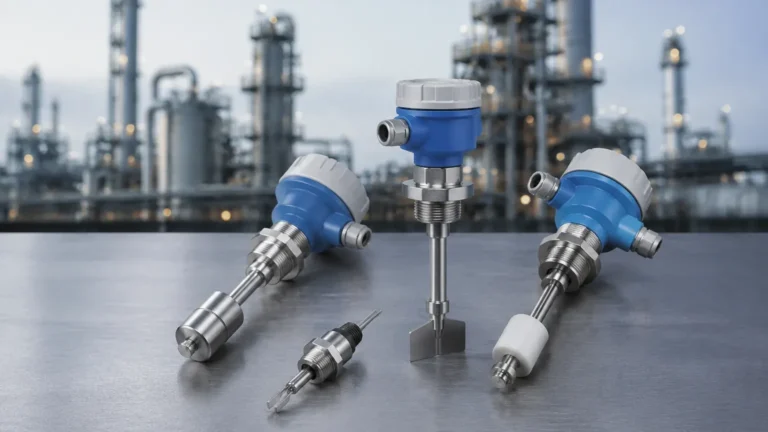
In a holistic B2B industrial environment, chemical analysis and level measurement are two sides of the same coin. For example, in a demineralized water storage tank, a Welk ultrasonic or radar level transmitter provides the quantity data, while the sodium analyzer provides the quality data.
If the level in a chemical reagent tank drops too low, it can lead to a failure in the water treatment process, subsequently causing a sodium spike in the boiler feed. Integrating these signals into a central PLC or SCADA system allows for automated interlocks. For instance, a high sodium alarm can trigger the closure of a feed valve, while a low-level alarm on a reagent tank can alert maintenance to refill the supply before the sodium analyzer's accuracy is compromised.
Frequently Asked Questions (FAQ)
Q: How often should a sodium analyzer be calibrated?
A: For high-pressure power applications, a weekly automatic calibration is standard. In less critical applications, a monthly manual calibration may suffice, provided the electrode is stable.
Q: Can I use a sodium analyzer to detect sea water intrusion?
A: Yes. Sodium analyzers are the most sensitive tool for detecting condenser leaks where seawater or cooling water enters the condensate stream. They react much faster than conductivity sensors in these scenarios.
Q: What is the lifespan of a sodium electrode?
A: Typically, a sodium-sensing electrode lasts between 6 to 18 months, depending on the sample's purity and the consistency of the pH adjustment.
Q: Why not just use a conductivity sensor?
A: Conductivity measures all ions in the water. In high-purity water, the background conductivity is already very low, and small changes in sodium might be masked by other ions or dissolved $CO_2$. A sodium analyzer is specific and much more sensitive to trace contamination.
For engineers seeking to optimize their facility's instrumentation, the integration of precise chemical analysis with reliable level monitoring is essential. To explore the physical measurement side of this equation, you can Review product options and application support to find the right level sensors for your water treatment and storage infrastructure.