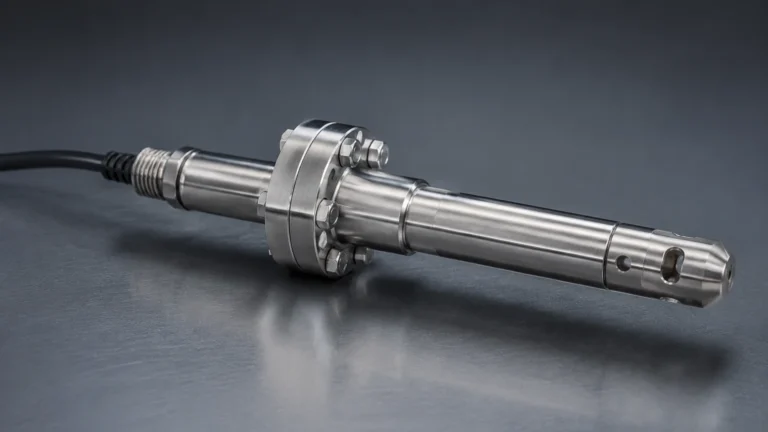
Temperature Sensors for Industrial Automation
Temperature Sensors for Industrial Automation
In the landscape of modern process control, temperature is the most frequently measured physical parameter. From chemical reactors and food processing lines to water treatment facilities, maintaining thermal stability is essential for product quality, equipment longevity, and operational safety. Temperature sensors for industrial automation provide the critical data required for Programmable Logic Controllers (PLCs) and Distributed Control Systems (DCS) to make real-time adjustments.
For engineers and plant managers, selecting the right sensor involves more than just identifying a temperature range. It requires an understanding of measurement principles, environmental compatibility, and how temperature fluctuations impact other process variables, such as fluid level and pressure. This guide explores the primary technologies used in industrial temperature sensing and their integration into broader automation frameworks.
Fundamental Principles of Temperature Measurement
Industrial temperature sensing is generally divided into two categories: contact and non-contact measurement. Contact sensors rely on thermal equilibrium, where the sensor reaches the same temperature as the medium it is touching. Non-contact sensors measure the infrared energy emitted by an object.
Resistance Temperature Detectors (RTDs)
RTDs operate on the principle that the electrical resistance of a metal increases as its temperature rises. This relationship is highly predictable and repeatable. Most industrial RTDs use platinum (Pt) due to its chemical stability and linear resistance-temperature relationship. The most common type is the PT100, which has a resistance of 100 ohms at 0°C (32°F).
Thermocouples
Thermocouples function based on the Seebeck Effect. When two dissimilar metals are joined at one end (the sensing junction) and there is a temperature difference between that end and the other (the reference junction), a small voltage (millivolts) is generated. This voltage is proportional to the temperature difference. Different metal combinations define the thermocouple "type" (e.g., Type K, J, or T), each suited for specific temperature ranges and environments.
Thermistors
Thermistors are ceramic-like semiconductors that exhibit a significant change in resistance with temperature. Most industrial thermistors have a Negative Temperature Coefficient (NTC), meaning resistance decreases as temperature increases. While highly sensitive over narrow ranges, they are less linear than RTDs.
Types of Temperature Sensors for Industrial Automation
Choosing between these technologies depends on the specific requirements of the automation cycle, including accuracy, durability, and response speed.
1. RTDs: The Standard for Precision
RTDs are preferred in applications where high accuracy and stability over long periods are required. They are widely used in the pharmaceutical and food industries where even a 0.5°C deviation can ruin a batch.
- Pros: High accuracy (up to ±0.1°C), excellent long-term stability, and high immunity to electrical noise.
- Cons: Slower response time than thermocouples, more expensive, and susceptible to mechanical vibration.
2. Thermocouples: The Robust Choice
Thermocouples are the workhorses of heavy industry, particularly in high-temperature applications like furnaces or glass manufacturing.
- Pros: Extremely wide temperature range (-200°C to +1800°C), fast response times, and highly durable in high-vibration environments.
- Cons: Lower accuracy than RTDs, prone to drift over time, and require specialized extension wires to prevent measurement errors.
3. Infrared (IR) Sensors: Non-Contact Monitoring
IR sensors are essential when the target is moving (e.g., a conveyor belt), in a vacuum, or is chemically aggressive. They measure the thermal radiation emitted by the surface.
- Pros: No contact required, instantaneous response, and capable of measuring extremely high temperatures.
- Cons: Accuracy is heavily dependent on the "emissivity" of the surface; atmospheric dust or steam can interfere with the signal.
The Role of Temperature in Level Measurement Accuracy
In the context of industrial automation, temperature measurement is rarely an isolated task. It is often a critical compensation factor for other instruments, particularly level meters. As a professional manufacturer, Welk integrates temperature compensation into many of its level measurement solutions to ensure accuracy under varying process conditions.
Impact on Ultrasonic Level Sensors
Ultrasonic sensors measure level by calculating the time it takes for a sound pulse to travel to the liquid surface and back. However, the speed of sound in air changes by approximately 0.17% for every 1°C change in temperature. Without an integrated temperature sensor for industrial automation to provide real-time compensation, an ultrasonic level meter could report errors of several centimeters as the ambient or process temperature shifts.
Impact on Hydrostatic Level Transmitters
Hydrostatic level measurement relies on the formula $P = \rho gh$ (Pressure = Density × Gravity × Height). Since the density ($\rho$) of most liquids changes with temperature, a hydrostatic transmitter must account for thermal expansion or contraction to provide an accurate level reading. In automated chemical blending, failing to compensate for temperature-induced density changes can lead to incorrect mixing ratios.
Impact on Radar Level Meters
While radar waves (electromagnetic) are largely unaffected by temperature changes in the vapor space, extreme temperatures can affect the electronics and the physical seal of the antenna. High-precision radar systems often monitor their internal temperature to ensure the stability of the high-frequency signal processing components.
To see how these technologies are integrated into comprehensive process control systems, you can review product options and application support on the Welk Main Page.
Selection Criteria for Industrial Applications
When specifying temperature sensors for industrial automation, engineers should use the following table to compare the primary contact technologies:
| Feature | RTD (PT100/PT1000) | Thermocouple (Type K/J) | Thermistor (NTC) |
| :— | :— | :— | :— |
| Temperature Range | -200°C to 850°C | -200°C to 1800°C | -100°C to 300°C |
| Accuracy | Excellent | Moderate | High (Narrow Range) |
| Long-term Stability | High | Low to Moderate | Low |
| Response Time | Slow (1 to 10 seconds) | Fast (0.1 to 5 seconds) | Medium (1 to 5 seconds) |
| Linearity | Excellent | Fair | Poor (Exponential) |
| Cost | Moderate to High | Low | Low |
Key Evaluation Factors:
1. Process Environment: Is the medium corrosive? If so, a thermowell or specialized sheath material (like Hastelloy or PTFE) is required.
2. Vibration: High-vibration environments (near pumps or motors) usually favor thermocouples or thin-film RTDs over wire-wound RTDs.
3. Distance to Controller: RTDs are sensitive to lead-wire resistance. For long distances, a 3-wire or 4-wire configuration, or a 4-20mA temperature transmitter, is necessary to maintain accuracy.
Installation Guidelines and Best Practices
Proper installation is as important as sensor selection. Incorrect placement can lead to "stem conduction" errors, where the sensor measures the temperature of the pipe wall rather than the process fluid.
Thermowell Usage
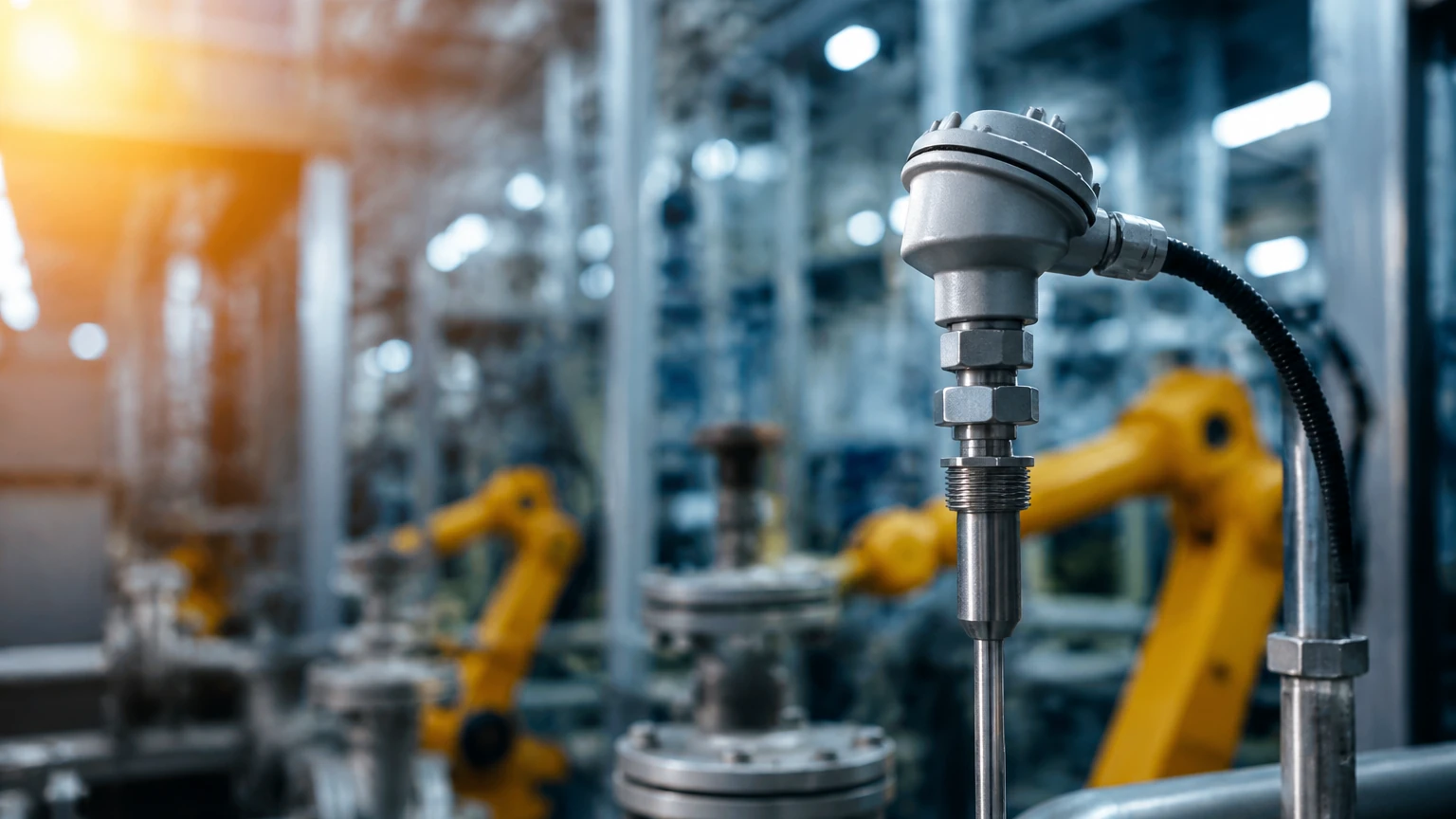
In most industrial automation setups, sensors are installed inside a thermowell. A thermowell is a cylindrical fitting that protects the sensor from pressure, high flow velocities, and corrosion. It also allows for the removal of the sensor for calibration without breaking the process seal.
- Insertion Depth: As a rule of thumb, the sensor should be immersed to a depth of at least 10 times the diameter of the protection tube to minimize heat loss through the sensor stem.
- Thermal Paste: Using a heat-conductive compound inside the thermowell can improve response times by reducing the air gap between the sensor and the well wall.
Wiring and Signal Conditioning
In automated systems, the raw signal from a temperature sensor (ohms or millivolts) is often converted into a standardized 4-20mA signal or a digital protocol like HART or Modbus.
- 2-Wire RTDs: Only suitable for very short distances because the resistance of the lead wires adds directly to the measurement error.
- 3-Wire RTDs: The industrial standard. It uses a third wire to measure and subtract the lead-wire resistance.
- 4-Wire RTDs: Used for laboratory-grade accuracy in automation, completely eliminating the effect of lead-wire resistance.
Common Limitations and Troubleshooting
Despite their reliability, temperature sensors for industrial automation are subject to specific failure modes:
1. Sensor Drift: Over time, the physical properties of the sensor material change due to thermal cycling or contamination. Regular calibration against a reference standard is necessary.
2. Self-Heating: RTDs require an excitation current. If the current is too high, the sensor will generate its own heat, leading to a falsely high reading. Automation controllers typically limit this current to less than 1mA.
3. Sensor Lag: In fast-moving processes, the time it takes for heat to transfer through a thermowell can cause the control system to react too slowly. This can be mitigated by using tapered thermowells or direct-immersion sensors where pressure allows.
4. Electromagnetic Interference (EMI): Thermocouple signals are very small (microvolts) and can be easily distorted by nearby high-voltage cables or variable frequency drives (VFDs). Shielded cabling and proper grounding are essential.
Frequently Asked Questions (FAQ)
Q: When should I choose a PT1000 over a PT100?
A: PT1000 sensors have a higher resistance (1000 ohms at 0°C), which makes the resistance of the lead wires less significant relative to the total measurement. They are often used in 2-wire configurations for battery-powered or remote automation devices to save power and reduce wiring complexity.
Q: How often should industrial temperature sensors be calibrated?
A: This depends on the industry. In critical pharmaceutical applications, calibration may occur every six months. In general industrial water treatment, an annual check is often sufficient unless a drift is detected by the automation system.
Q: Can I use a thermocouple for cryogenic measurements?
A: Yes, Type T (Copper-Constantan) thermocouples are specifically designed for stable performance at sub-zero temperatures, down to -200°C, making them suitable for liquefied gas automation.
Q: What is the benefit of a head-mounted transmitter?
A: A head-mounted transmitter converts the sensitive RTD or thermocouple signal into a robust 4-20mA signal right at the point of measurement. This significantly reduces the impact of electrical noise and lead-wire resistance over long cable runs to the PLC.
By understanding these technical nuances, engineers can ensure that their temperature sensors for industrial automation provide the reliable data necessary for efficient process control. Whether used as a standalone measurement or as a compensation factor for advanced level measurement instruments, the right temperature sensor is the foundation of a stable automated system. For further technical specifications and engineering support regarding sensor integration, please visit the Welk Main Page.
Download Temperature Sensors for Industrial Automation as a PDF