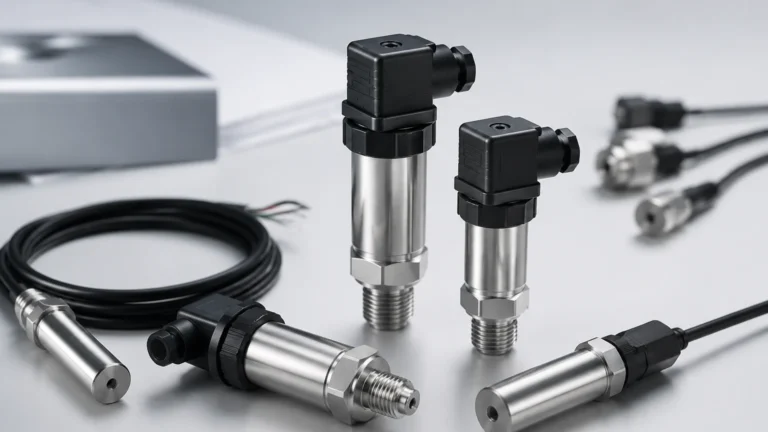
Temperature Transducer Application
Temperature Transducer Application
In the realm of industrial process control, the accurate measurement of thermal energy is as critical as monitoring pressure or flow. A temperature transducer is a sophisticated device that converts a physical temperature reading into a standardized electrical signal, such as 4-20mA, 0-10V, or a digital protocol like Modbus or HART. This conversion allows for seamless integration into Programmable Logic Controllers (PLCs) and Distributed Control Systems (DCS). Understanding the nuances of temperature transducer application is essential for engineers working in water treatment, chemical processing, and oil and gas industries, where temperature fluctuations directly impact product quality, safety, and the accuracy of other measurements like liquid level.
Measurement Principles of Temperature Transducers
Before selecting a device for a specific application, it is vital to understand the underlying physical principles that govern temperature sensing. Industrial transducers typically utilize one of three primary sensing elements: Resistance Temperature Detectors (RTDs), Thermocouples, or Thermistors.
Resistance Temperature Detectors (RTDs)
RTDs operate on the principle that the electrical resistance of a metal increases as its temperature rises. The most common material used is platinum, specifically the Pt100 sensor, which has a resistance of 100 ohms at 0°C. RTDs are prized for their high accuracy, excellent stability, and linearity over a wide temperature range, typically from -200°C to 850°C. They are the preferred choice for applications requiring precision, such as laboratory environments and high-end chemical processing.
Thermocouples
Thermocouples function based on the Seebeck effect: when two dissimilar metals are joined at one end (the sensing junction) and there is a temperature difference between that junction and the other end (the reference junction), a small voltage is produced. Different metal combinations define the thermocouple "type" (e.g., Type K, J, T, or S). Thermocouples are exceptionally rugged, have a very fast response time, and can measure extreme temperatures up to 1700°C or higher. However, they are generally less accurate than RTDs and require cold-junction compensation.
Thermistors
Thermistors are semiconductor-based resistors that exhibit a large change in resistance for a small change in temperature. Most industrial thermistors are Negative Temperature Coefficient (NTC), meaning resistance decreases as temperature increases. While they offer extremely high sensitivity and fast response times, their range is limited (usually -50°C to 150°C), and their resistance-temperature relationship is highly non-linear.
The Role of Temperature in Level Measurement
One of the most critical aspects of temperature transducer application is its role in compensating for errors in other industrial instruments. In level measurement, temperature is a primary variable that can induce significant errors if not properly managed.
Ultrasonic Level Sensors
Ultrasonic level meters calculate distance by measuring the time it takes for a sound pulse to travel to the liquid surface and back. The speed of sound in air is highly dependent on temperature. For every 1°C change in temperature, the speed of sound changes by approximately 0.6 m/s. Without an integrated temperature transducer to provide real-time compensation, an ultrasonic sensor would report inaccurate levels as the ambient or headspace temperature fluctuates. For high-precision requirements, reviewing professional equipment on the Main Page can provide insights into how integrated temperature compensation is handled in modern radar and ultrasonic systems.
Hydrostatic Level Transmitters
Hydrostatic pressure sensors measure the weight of the liquid column above the sensor. Because the density of a liquid changes with its temperature, the pressure exerted by a fixed volume of liquid will vary as it heats or cools. In applications involving large storage tanks or volatile chemicals, a temperature transducer is used to calculate the corrected density, ensuring the level reading remains accurate regardless of thermal expansion or contraction.
Key Evaluation Criteria for Application
Selecting the right temperature transducer requires a balance between technical requirements and environmental constraints. Engineers should evaluate the following criteria:
1. Temperature Range: Determine the normal operating temperature as well as potential process excursions. RTDs are ideal for mid-range precision, while thermocouples handle extremes.
2. Accuracy and Precision: In custody transfer or sensitive chemical reactions, high-accuracy RTDs (Class AA or A) are necessary. For general monitoring, a standard thermocouple may suffice.
3. Response Time: If the process involves rapid temperature changes (e.g., a heat exchanger), a small-diameter sensor or a direct-immersion probe without a heavy thermowell may be required.
4. Environmental Conditions: Consider the presence of corrosive chemicals, high pressure, or mechanical vibration. These factors dictate the material of the sensor sheath and the need for protective thermowells.
5. Output Signal: Ensure the transducer output (e.g., 4-20mA) is compatible with the control system and can be transmitted over the required distance without signal degradation.
Selection Table: Transducer Technology Comparison
| Feature | RTD (Pt100) | Thermocouple (Type K) | Thermistor (NTC) |
| :— | :— | :— | :— |
| Measurement Range | -200°C to +850°C | -200°C to +1260°C | -50°C to +150°C |
| Accuracy | High (±0.1°C to ±0.5°C) | Medium (±1.1°C to ±2.2°C) | High (±0.05°C to ±1.5°C) |
| Stability | Excellent | Fair | Poor (Drifts over time) |
| Linearity | Good | Fair | Poor (Exponential) |
| Response Time | Slow to Moderate | Fast | Very Fast |
| Cost | Moderate | Low | Low |

Practical Installation Considerations
Proper installation is as important as sensor selection. Even the most accurate temperature transducer will provide false data if installed incorrectly.
Thermowell Usage
In most industrial temperature transducer applications, the sensor is not placed directly in the fluid. Instead, it is inserted into a thermowell—a pressure-tight receptacle that stays in the process. This allows the sensor to be removed for calibration or replacement without draining the tank or pipe. However, the thermowell adds thermal mass, which slows the response time. Using a thermal conductive paste inside the thermowell can help mitigate this lag.
Immersion Depth
To avoid errors caused by heat conduction along the sensor sheath (stem conduction), the transducer must be immersed deeply enough into the process. A general rule of thumb is an immersion depth of at least 10 times the diameter of the sensor protection tube. In small-diameter pipes, the sensor should be installed at an elbow or at an angle to ensure sufficient immersion.
Wiring and Interference
Temperature signals, particularly from thermocouples, are low-voltage and susceptible to Electromagnetic Interference (EMI). Use shielded twisted-pair cables and ensure that signal wires are kept away from high-power motor cables or frequency inverters. For long-distance transmission, a head-mounted transmitter that converts the signal to 4-20mA at the point of measurement is highly recommended.
Limitations and Common Risks
While temperature transducers are reliable, they are not without limitations. Engineers must be aware of the following risks:
* Self-Heating: In RTDs and thermistors, the current used to measure resistance generates a small amount of heat. If the excitation current is too high, it can bias the reading upward, especially in stagnant fluids or gases.
* Calibration Drift: Over time, the physical properties of the sensing element can change due to thermal cycling or contamination. Regular calibration intervals are necessary to maintain system integrity.
* Thermal Lag: In fast-moving processes, the time it takes for the heat to penetrate the thermowell and reach the sensor can result in the control system reacting to "old" data.
* Vibration Fatigue: In high-flow applications, the wake created by fluid moving past a thermowell can cause vibration, leading to mechanical failure of the well or the sensor inside.
Frequently Asked Questions (FAQ)
Q: When should I choose a 3-wire or 4-wire RTD?
A: A 3-wire RTD is the industrial standard, as it compensates for lead wire resistance. A 4-wire RTD provides the highest precision by completely eliminating the effect of lead wire resistance, making it ideal for laboratory or high-accuracy calibration tasks.
Q: Can I use a temperature transducer in hazardous areas?
A: Yes, but you must select a transducer with the appropriate explosion-proof or intrinsically safe certifications (such as ATEX or IECEx). This often involves using a zener barrier or galvanic isolator in the control cabinet.
Q: How often should a temperature transducer be calibrated?
A: Calibration frequency depends on the criticality of the process and the environment. For most industrial applications, an annual calibration check is standard. However, in high-precision chemical or pharmaceutical processes, semi-annual or quarterly checks may be required.
Q: What is the benefit of a 4-20mA transmitter over a direct sensor connection?
A: A transmitter converts the weak sensor signal into a robust 4-20mA current loop. This signal is much more resistant to electrical noise and can be transmitted over hundreds of meters without the signal loss or resistance errors associated with long RTD or thermocouple extension wires.
Conclusion
Temperature transducer application is a cornerstone of modern industrial automation. Whether it is ensuring the safety of a chemical reactor, maintaining the efficiency of a boiler, or providing vital compensation data for ultrasonic level measurement, selecting the correct technology is paramount. By understanding the principles of RTDs and thermocouples, adhering to strict installation guidelines, and accounting for environmental limitations, engineers can ensure reliable and accurate thermal monitoring across their operations. For those seeking integrated solutions that combine temperature and level sensing, exploring technical specifications on the Main Page can assist in finding the ideal hardware for complex industrial environments.