Thermometer Industrial
Thermometer Industrial
In the landscape of industrial process control, temperature measurement is as fundamental as pressure or flow. A thermometer industrial grade instrument is designed to withstand the rigors of harsh environments, providing the thermal data necessary for safety, quality control, and efficiency. Whether it is monitoring a chemical reactor, a water treatment facility, or a storage tank, understanding the thermal profile of a medium is often a prerequisite for accurate level measurement and overall process stability.
Industrial temperature sensors are rarely standalone components; they are integrated into complex automation loops. For engineers and plant managers, selecting the right thermometer industrial solution requires a deep understanding of measurement principles, material compatibility, and the specific requirements of the application. This guide explores the technology behind industrial thermometers and their critical relationship with level measurement systems.
Core Principles of Industrial Temperature Measurement
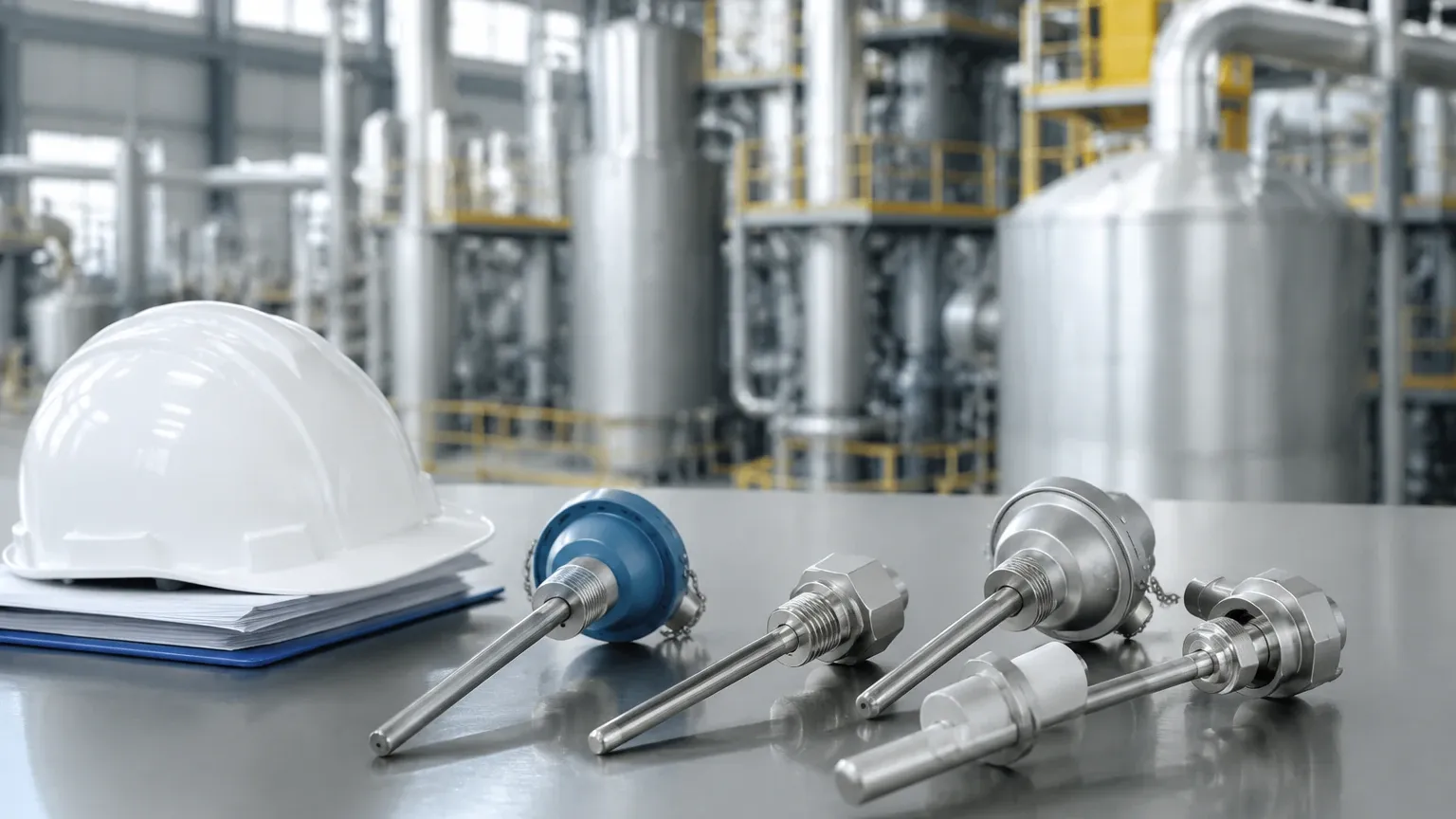
To select the appropriate instrument, one must first understand the physical principles used to convert thermal energy into a readable signal. Industrial thermometers generally fall into three categories: mechanical, electrical, and non-contact.
Resistance Temperature Detectors (RTDs)
RTDs operate on the principle that the electrical resistance of a metal increases as temperature rises. The most common material used is platinum, leading to the industry-standard Pt100 and Pt1000 sensors. These instruments are prized for their high accuracy, excellent stability, and repeatability over a range of -200°C to 600°C (-328°F to 1112°F). In B2B applications where precision is paramount, such as pharmaceutical or food processing, RTDs are the preferred choice.
Thermocouples
A thermocouple consists of two dissimilar metal wires joined at one end (the sensing junction). When there is a temperature difference between the sensing junction and the reference junction, a small voltage (Seebeck effect) is generated. Thermocouples are exceptionally rugged and can measure much higher temperatures than RTDs—up to 1700°C (3092°F) or higher depending on the calibration type (Type K, J, S, etc.). They offer faster response times but generally lower accuracy and stability compared to RTDs.
Bimetallic Thermometers
These are mechanical devices consisting of two strips of different metals bonded together. Because the metals expand at different rates when heated, the strip bends, moving a pointer on a dial. These require no power and are used primarily for local indication in piping or tanks where electronic transmission is not immediately necessary.
Infrared (IR) Thermometers
Non-contact IR sensors measure the thermal radiation emitted by an object. These are ideal for moving parts, extremely high temperatures, or corrosive media where a physical probe cannot be inserted. However, they require a clear line of sight and accurate knowledge of the material's emissivity.
The Interplay Between Temperature and Level Measurement
In the context of industrial automation, temperature and level measurement are deeply intertwined. As a professional manufacturer, Welk recognizes that temperature fluctuations can significantly impact the accuracy of level sensors. This is why many advanced Main Page solutions incorporate temperature compensation.
Hydrostatic Level and Density
Hydrostatic level transmitters calculate the height of a liquid based on the pressure exerted by the liquid column. However, the density of a liquid changes with temperature. If a thermometer industrial probe is not used to monitor the liquid, a rise in temperature will cause the liquid to expand (decreasing density), leading the pressure sensor to report a lower level than actually exists. Integrated temperature data allows the control system to correct for these density shifts in real-time.
Ultrasonic Level and the Speed of Sound
Ultrasonic level sensors measure the time it takes for a sound pulse to travel to the surface and back. The speed of sound in air or gas is highly dependent on temperature, changing approximately 0.17% for every 1°C (1.8°F) change. Without a built-in or external thermometer industrial sensor to provide compensation, an ultrasonic meter can experience significant errors in outdoor tanks subject to solar heating or in processes involving steam.
Radar Level Measurement
While radar level meters (both guided wave and non-contact) are largely unaffected by gas-phase temperature changes, the dielectric constant of some liquids can shift with temperature. In high-precision applications, monitoring the thermal state of the medium ensures that the radar reflections are interpreted correctly by the signal processor.
Practical Selection Table for Industrial Thermometers
Choosing the right thermometer industrial instrument involves balancing cost, range, and durability. The following table provides a comparison for common B2B applications.
| Feature | RTD (Pt100) | Thermocouple (Type K) | Bimetallic Dial | Infrared (Non-contact) |
| :— | :— | :— | :— | :— |
| Temperature Range | -200 to 600°C | -200 to 1260°C | -70 to 540°C | -50 to 3000°C |
| Accuracy | Very High (±0.1°C) | Moderate (±1.1°C) | Low (±1% of span) | Variable (Emissivity dependent) |
| Long-term Stability | Excellent | Fair | Good | Fair |
| Response Time | Moderate | Fast | Slow | Instantaneous |
| Durability | Moderate | Excellent | High | Moderate |
| Typical Application | Lab, Food, Pharma | Power, Metal, Kilns | Local Tank Monitoring | Moving Belts, High Heat |
Installation Considerations and Best Practices
Proper installation is critical to ensure that a thermometer industrial probe reflects the true temperature of the process rather than the ambient environment or the vessel wall.
1. Thermowells: In most industrial settings, the sensor should not be in direct contact with the process fluid. A thermowell—a pressure-tight receptacle—is installed into the pipe or tank. This allows the sensor to be removed for calibration or replacement without draining the system. Materials like 316 Stainless Steel, Monel, or Hastelloy are chosen based on the chemical compatibility of the medium.
2. Insertion Depth: To avoid conduction errors (where heat travels up the probe to the cooler ambient air), the sensor must be inserted deep enough. A general rule of thumb is an insertion length of at least 10 times the diameter of the thermowell.
3. Vibration and Stress: In high-flow pipelines, the thermowell is subject to wake frequency vibrations. Engineers should perform a Wake Frequency Calculation (per ASME PTC 19.3 TW) to ensure the thermowell will not snap under the fluid's force.
4. Transmitter Mounting: For long-distance signal transmission, a temperature transmitter should be used to convert the RTD or thermocouple signal into a 4-20mA or digital (HART/Modbus) signal. This prevents signal degradation caused by lead wire resistance or electromagnetic interference.
Limitations and Common Risks
While industrial thermometers are robust, they are not infallible. Users should be aware of the following risks:
* Calibration Drift: Over time, the internal elements of RTDs and thermocouples can degrade due to thermal cycling or contamination. Regular calibration against a traceable standard is necessary to maintain accuracy.
* Self-Heating: In RTDs, the current used to measure resistance can generate a small amount of heat within the sensor, leading to a slightly higher reading. This is typically minimized by using low excitation currents.
* Lag Time: Because of the mass of the thermowell and the sensor, there is always a delay between a process temperature change and the sensor's response. In fast-moving thermal processes, this lag must be accounted for in the PID control loops.
* Cold Junction Compensation: For thermocouples, the accuracy of the measurement depends on knowing the temperature at the point where the thermocouple wires connect to the copper wires of the instrument (the cold junction). If the transmitter's internal compensation fails, the entire reading will be offset.
Frequently Asked Questions (FAQs)
Why use an RTD instead of a thermocouple?
RTDs are generally chosen when accuracy and stability are the primary concerns. They are less prone to drift over time and provide a more linear signal. Thermocouples are chosen for their wider temperature range and their ability to withstand extreme vibration and physical abuse.
How does a thermowell affect the response time?
A thermowell adds thermal mass and creates an air gap between the sensor and the process. This increases the time constant of the measurement. To improve response time, engineers can use a tapered thermowell or fill the gap with a thermal conductive paste.
Can industrial thermometers be used in hazardous areas?
Yes, for environments with explosive gases or dust, thermometers must be certified as Intrinsically Safe (IS) or Explosion-Proof (Ex). This often involves using specific enclosures and barriers to limit the electrical energy available to cause a spark.
What is the difference between a 2-wire, 3-wire, and 4-wire RTD?
This refers to the lead wire compensation. A 2-wire RTD does not account for the resistance of the wires leading to the instrument, which can cause errors. A 3-wire RTD (the most common in industry) uses a third wire to cancel out the lead resistance. A 4-wire RTD provides the highest precision by completely isolating the measurement circuit from the current source.
Why is temperature measurement necessary for level control?
Beyond volume correction (density), temperature monitoring is vital for safety. In chemical storage, an unexpected rise in temperature can indicate an exothermic reaction or the risk of boiling, which could lead to tank overpressurization regardless of the liquid level.
By integrating high-quality thermometer industrial components with advanced level measurement technologies, industrial operators can achieve a higher degree of process transparency. Welk continues to provide the engineering support and hardware necessary to navigate these complex thermal and fluid dynamics in global industrial applications.