Total Nitrogen Analyzer
Total Nitrogen Analyzer
Total Nitrogen (TN) is a critical parameter in environmental monitoring and industrial process control, representing the sum of all nitrogen forms present in a water sample, including organic nitrogen, ammonia ($NH_3$), nitrite ($NO_2^-$), and nitrate ($NO_3^-$). In industrial wastewater treatment and chemical manufacturing, the ability to accurately quantify nitrogen levels is essential for regulatory compliance, process optimization, and environmental protection. A total nitrogen analyzer is the specialized instrument designed to automate this complex measurement process.
Effective nitrogen management prevents eutrophication in natural water bodies and ensures that industrial discharge meets stringent local and international standards. This guide examines the underlying measurement principles, selection criteria, and technical considerations for integrating total nitrogen analyzers into industrial workflows.
Measurement Principles of Total Nitrogen Analysis
Because nitrogen exists in various oxidation states and chemical forms, a total nitrogen analyzer must first convert all nitrogenous compounds into a single, measurable species—typically nitric oxide ($NO$) or nitrate ($NO_3^-$). This is achieved through two primary methods: oxidative digestion or high-temperature combustion.
1. Alkaline Persulfate Digestion
In this wet-chemical method, the sample is mixed with an alkaline potassium persulfate solution. Under high temperature (typically 120°C to 140°C) and pressure, or under ultraviolet (UV) irradiation, all nitrogen compounds are oxidized to nitrate.
$$Organic N + NH_3 + NO_2^- + S_2O_8^{2-} \xrightarrow{\Delta, OH^-} NO_3^-$$
Once the conversion is complete, the nitrate concentration is measured using UV spectrophotometry or colorimetric methods. This approach is common in laboratory settings and online analyzers handling relatively clean water or municipal wastewater.
2. High-Temperature Catalytic Combustion
The sample is injected into a furnace heated to between 720°C and 1,200°C in an oxygen-rich environment, often in the presence of a catalyst (such as platinum). All nitrogen-containing compounds are thermally decomposed and oxidized to nitric oxide ($NO$).
$$Total N + O_2 \xrightarrow{720-1200^\circ C} NO + H_2O + CO_2$$
The resulting gas is cooled, dried, and then analyzed using a Chemiluminescence Detector (CLD). In the CLD, nitric oxide reacts with ozone ($O_3$) to produce excited-state nitrogen dioxide ($NO_2^*$), which emits light as it returns to a ground state. The intensity of this light is directly proportional to the nitrogen concentration.
Key Components of an Online Total Nitrogen Analyzer
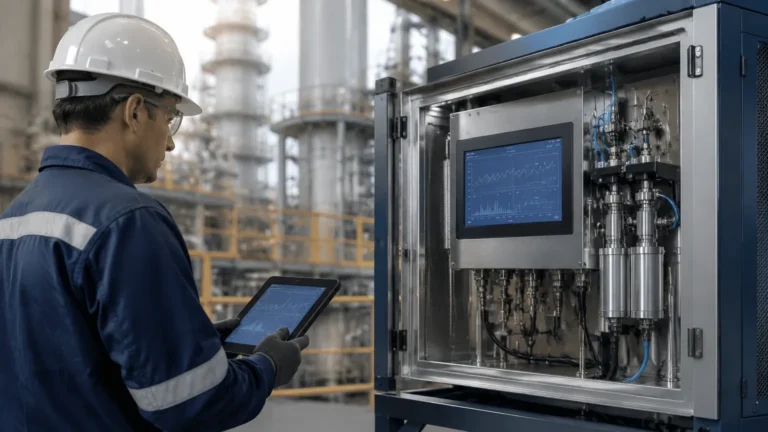
Industrial-grade analyzers are designed for continuous operation and typically consist of several integrated modules:
* Sampling System: Includes pumps and filtration units to deliver a representative, particle-free (or size-limited) sample to the reaction chamber.
* Reagent Delivery: Precision dosing pumps (often peristaltic or syringe-style) manage the addition of oxidants, acids, or bases.
* Reaction Chamber: The core where digestion or combustion occurs. In combustion systems, this is a high-grade quartz or ceramic tube.
* Detection Unit: A spectrophotometer for liquid-phase nitrate measurement or a chemiluminescence/NDIR sensor for gas-phase measurement.
* Control and Communication: A PLC or dedicated microprocessor that manages the measurement cycle, performs calibrations, and outputs data via 4-20mA, Modbus, or Profibus.
Selection Criteria for Industrial Applications
Choosing the right total nitrogen analyzer depends on the specific characteristics of the process stream and the required measurement frequency. The following table compares the two primary industrial technologies:
| Feature | Alkaline Persulfate (Wet Chemical) | High-Temperature Combustion |
| :— | :— | :— |
| Measurement Range | 0.05 – 100 mg/L (typical) | 0.1 – 10,000 mg/L |
| Sample Complexity | Best for low-turbidity water | Handles high organic loads and salts |
| Analysis Time | 30 – 60 minutes | 3 – 10 minutes |
| Maintenance | High (reagent replacement) | Moderate (catalyst/combustion tube) |
| Detection Method | UV Spectrophotometry | Chemiluminescence (CLD) |
Factors to Consider
1. Salt Content: High salinity can interfere with wet chemical oxidation and may cause buildup in combustion tubes. Specialized "salt-resistant" combustion analyzers are required for brine or seawater applications.
2. Particle Size: If the sample contains large suspended solids, a robust filtration or homogenization system is necessary to prevent clogging of the analyzer’s internal capillaries.
3. Required Sensitivity: For ultra-pure water or highly diluted effluents, persulfate digestion often provides better lower-limit detection.
Installation and Engineering Considerations
Successful deployment of a total nitrogen analyzer requires careful attention to the installation environment and the auxiliary systems supporting the instrument.
Sample Conditioning
The analyzer should be installed as close to the sampling point as possible to minimize lag time. If the sample temperature exceeds 40°C, a sample cooler must be installed. Furthermore, because nitrogen compounds can be volatile or prone to biological degradation, sample lines should be opaque to prevent algae growth and as short as possible.
Reagent and Waste Management
Wet chemical analyzers require a steady supply of reagents. These chemicals must be stored in a temperature-controlled environment to maintain stability. Additionally, the analyzer generates chemical waste that may require neutralization before disposal. Automated systems should include level monitoring for reagent tanks to prevent the analyzer from running dry.
Integration with Level Measurement
In B2B industrial environments, total nitrogen analyzers do not operate in isolation. They are part of a broader instrumentation ecosystem. For instance, in a wastewater treatment plant, the nitrogen analyzer provides the data needed to control aeration blowers, but the physical management of the process depends on accurate level control.
Reliable tank level monitoring ensures that the reaction basins are operating within their design capacity and that reagent storage tanks are replenished on time. For engineers seeking to optimize these integrated systems, selecting high-quality sensors is paramount. You can Review product options and application support to find the appropriate radar or ultrasonic level sensors that complement your analytical instrumentation.

Maintenance and Operational Reliability
Total nitrogen analyzers are sophisticated instruments that require a structured maintenance program to ensure data integrity.
* Calibration: Periodic calibration using certified standard solutions (e.g., Potassium Hydrogen Phthalate for TOC and Potassium Nitrate for TN) is essential. Many modern online analyzers offer automated calibration sequences.
* Catalyst Replacement: In combustion-based systems, the catalyst gradually loses activity due to surface contamination. Regular inspection and replacement (typically every 3–6 months depending on sample load) are required.
* Tubing and Seals: Peristaltic pump tubing and O-rings are wear items. A failure in a seal can lead to reagent leaks or air ingress, both of which will skew measurement results.
* Cleaning Cycles: Automated cleaning cycles using dilute acid or deionized water help prevent the buildup of scale or biofilms within the fluidic pathways.
Limitations and Potential Interference
While highly accurate, total nitrogen analyzers face certain technical limitations:
1. Incomplete Digestion: In wet chemical systems, very complex organic nitrogen molecules (like certain heterocyclic compounds) may not fully oxidize, leading to an underestimation of TN.
2. Nitrogen Gas Interference: In combustion systems, if the carrier gas (usually oxygen or synthetic air) contains traces of $N_2$, it can interfere with the measurement if the system is not properly blanked.
3. High Turbidity: Excessive suspended solids can scatter light in spectrophotometric detectors. Effective pre-filtration is the standard solution, though it must be balanced against the need to measure the nitrogen contained within those solids.
Frequently Asked Questions (FAQ)
Q: What is the difference between TKN and TN?
A: Total Kjeldahl Nitrogen (TKN) measures only organic nitrogen and ammonia. It does not include nitrite ($NO_2^-$) or nitrate ($NO_3^-$). Total Nitrogen (TN) includes TKN plus these inorganic oxidized forms. For many modern regulatory permits, TN is the required parameter.
Q: Can a Total Nitrogen analyzer also measure Total Organic Carbon (TOC)?
A: Yes, many industrial analyzers are "TOC/TN" dual-parameter systems. Since both measurements can utilize high-temperature combustion, a single injection can be analyzed for $CO_2$ (for TOC) and $NO$ (for TN) using different detectors in series.
Q: How often should an online TN analyzer be calibrated?
A: For most industrial applications, a weekly validation against a known standard is recommended, with a full multi-point calibration performed monthly or after major maintenance (like a catalyst change).
Q: Is filtration always necessary?
A: If the analyzer uses small-bore tubing (less than 1 mm), filtration is necessary to prevent blockages. However, if the nitrogen is bound to the solids, the filter must be designed to allow a representative portion of the solids through, or a macerator must be used.
Conclusion
The implementation of a total nitrogen analyzer is a significant investment in process transparency and environmental responsibility. By understanding the chemical principles of digestion and combustion, and by carefully selecting an instrument that matches the specific matrix of the process water, industrial operators can achieve reliable, real-time insights into their nitrogen discharge. When combined with robust process instrumentation—such as the level measurement solutions found on the Main Page—these analyzers form the backbone of modern, automated industrial water management.