Tri State Seminar Las Vegas 2025
Tri State Seminar Las Vegas 2025
The Tri State Seminar Las Vegas 2025 stands as a pivotal event for water and wastewater professionals across the Western United States. As regulatory requirements for water conservation and discharge quality become increasingly stringent, the demand for high-precision instrumentation has never been higher. For engineers, operators, and managers attending the seminar, understanding the evolution of level measurement technology is essential for optimizing plant operations and ensuring environmental compliance.
In the context of modern industrial automation, level measurement is no longer just about knowing if a tank is full or empty. It is about real-time data integration, chemical dosage accuracy, and the prevention of costly overflows or pump cavitation. This guide explores the core technologies that will be at the forefront of discussions during the Tri State Seminar Las Vegas 2025, providing a technical foundation for selecting the right instruments for diverse process conditions.
Fundamental Principles of Industrial Level Measurement
Before selecting a specific device, it is necessary to understand the physics behind the most common measurement methodologies used in the industry today. Each principle offers unique advantages depending on the physical properties of the media and the environmental conditions of the installation site.
Radar Level Measurement (Time of Flight)
Radar level meters operate on the "Time of Flight" (ToF) principle. The device emits high-frequency electromagnetic waves (typically in the 26GHz or 80GHz range) toward the surface of the medium. These waves are reflected back to the sensor. By measuring the time interval between transmission and reception, the instrument calculates the distance to the product surface.
Modern 80GHz radar technology, such as that found on the Welk Main Page, offers a significantly narrower beam angle compared to older 6GHz or 26GHz models. This precision allows the radar to ignore internal tank obstructions like agitators, ladders, or heating coils, making it the gold standard for complex industrial vessels.
Ultrasonic Level Sensing
Ultrasonic sensors use sound waves rather than electromagnetic waves. The transducer emits an ultrasonic pulse that travels through the air, hits the liquid surface, and returns. Because the speed of sound is affected by air temperature, these sensors include an integrated temperature probe to compensate for changes in the atmosphere above the liquid. While cost-effective, ultrasonic measurement is sensitive to heavy foam, steam, and significant dust, which can absorb or scatter the sound signal.
Hydrostatic Pressure Measurement
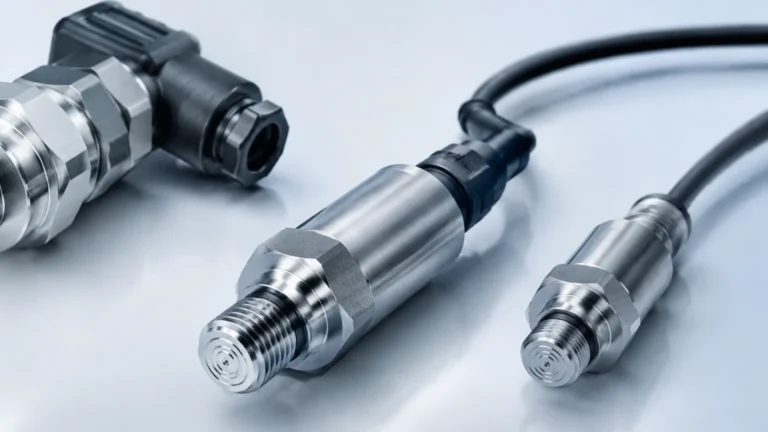
Hydrostatic transmitters measure the pressure exerted by a liquid column at a specific point. Based on the principle that pressure is proportional to the height of the liquid and its density (P = ρgh), these sensors are often submerged at the bottom of a tank or well. This method is highly reliable for deep-well monitoring and atmospheric tanks where the density of the liquid remains constant. However, if the liquid density changes due to temperature fluctuations or chemical mixing, the level reading must be mathematically corrected.
Magnetic Level Gauges
Magnetic level gauges utilize a float containing a permanent magnet that moves with the liquid level inside a bypass chamber. Outside the chamber, a series of magnetic flaps or a continuous transmitter reacts to the float's position. This provides both a highly visible local indication and an electronic signal for remote monitoring. This technology is preferred for hazardous or corrosive chemicals where a clear physical barrier between the process and the observer is required.
Technology Selection for Water and Wastewater Applications
During the Tri State Seminar Las Vegas 2025, a major focus will be on selecting the most resilient technology for specific water cycle stages. The following table provides a practical comparison for engineering selection.
Level Measurement Selection Table
| Technology | Typical Media | Accuracy | Max Range | Environmental Considerations |
| :— | :— | :— | :— | :— |
| 80GHz Radar | Chemicals, Sludge, Water | ±1 mm | 120 m | Excellent in vapor, dust, and vacuum |
| Ultrasonic | Open Channels, Sumps | ±0.25% FS | 15 m | Affected by wind, foam, and high steam |
| Hydrostatic | Deep Wells, Reservoirs | ±0.1% FS | 200 m | Requires vented cable for atmospheric compensation |
| Magnetic Gauge | Acids, Caustics, Fuel | ±5 mm | 6 m | Best for high-pressure or toxic storage |
| Level Switch | Overfill Protection | N/A | Point | Used as a redundant safety backup |
Application Recommendations
1. Chemical Storage: For aggressive chemicals like sodium hypochlorite or sulfuric acid, non-contact radar or magnetic level gauges are recommended to prevent sensor corrosion.
2. Open Channel Flow: Ultrasonic sensors remain the industry standard for flumes and weirs due to their ease of installation and integrated flow algorithms.
3. Lift Stations: Hydrostatic transmitters or non-contact radar are preferred here. Radar is particularly useful if the lift station is prone to heavy turbulence or floating debris that might damage a submerged sensor.
4. Sludge Digesters: High-frequency radar is the only reliable choice for digesters where foam and thick crusts often cause ultrasonic sensors to fail.
Installation Guidelines and Engineering Best Practices
Even the most advanced instrument will fail to provide accurate data if installed incorrectly. Attendees of the Tri State Seminar Las Vegas 2025 should confirm the following installation parameters during their project planning phases.
Radar and Ultrasonic Positioning
* Beam Path: Ensure the signal beam does not intersect with the filling stream or internal tank structures. For an 80GHz radar, the beam angle is typically around 3°, allowing for installation very close to tank walls.
* Dead Zone (Blanking Distance): Every non-contact sensor has a minimum distance it cannot measure (usually 50mm to 300mm / 2 to 12 inches). Mount the sensor high enough so the maximum liquid level never enters this zone.
* Nozzle Geometry: For radar, the nozzle height should be kept as short as possible to prevent signal ringing within the pipe. If a long nozzle is unavoidable, a radar with a horn antenna or specialized software filtering is required.
Hydrostatic Sensor Mounting
* Stilling Wells: In turbulent tanks or fast-moving streams, hydrostatic sensors should be installed inside a stilling well (a perforated pipe) to prevent the sensor from moving and to dampen wave action.
* Vented Cables: Ensure the atmospheric vent tube in the cable is protected by a desiccant cartridge. Moisture entering this tube will cause the sensor to drift and eventually fail.

Limitations and Operational Challenges
No single technology is a universal solution. Engineering teams must recognize the physical limitations of each method to avoid common risks.
* Foam Interference: Heavy, thick foam acts as an insulator for ultrasonic waves and can even dampen radar signals. In such cases, a guided wave radar (GWR) or a hydrostatic transmitter is often a more stable choice.
* Temperature Extremes: In the desert environment typical of the Tri-State region, solar radiation can heat outdoor sensor housings to over 70°C (158°F). Using sunshades and selecting instruments with high-temperature ratings is vital for longevity.
* Dielectric Constants: Radar relies on the dielectric constant (εr) of the material. While water has a high εr (~80) and reflects signals well, some oils or solids have very low εr, requiring more sensitive radar electronics or specialized antennas.
Frequently Asked Questions (FAQ)
Q: How does the Tri State Seminar Las Vegas 2025 address the transition to IIoT in level measurement?
A: The seminar highlights the shift toward HART, Modbus, and Bluetooth-enabled sensors. These protocols allow operators to configure sensors and view diagnostics from a smartphone, reducing the need for technicians to climb onto high tanks or enter confined spaces.
Q: Why choose 80GHz radar over 26GHz radar for wastewater applications?
A: 80GHz radar provides a much narrower focus. In wastewater plants, tanks are often crowded with pipes and brackets. The narrow beam of the 80GHz unit can "see" between these obstacles to reach the water surface, whereas a 26GHz beam might hit an obstruction and report a false level.
Q: Can hydrostatic sensors be used in pressurized tanks?
A: Standard hydrostatic sensors measure relative pressure (gauge pressure). In a pressurized tank, you must use a differential pressure (DP) transmitter to subtract the headspace pressure from the total bottom pressure to get an accurate level reading.
Q: What maintenance is required for non-contact level meters?
A: Generally, very little. However, in applications with high condensation or crystallization, the sensor face should be inspected periodically. Many modern radar units feature a "drip-off" antenna design that sheds condensation automatically to maintain signal strength.
For those seeking specific product specifications or technical support for upcoming projects discussed at the Tri State Seminar Las Vegas 2025, visiting the Welk Main Page provides access to comprehensive data sheets and application engineering resources. Selecting the right level measurement solution is a balance of performance, cost, and maintenance requirements, and staying informed on the latest technical standards is the first step toward operational excellence.