Tunable Diode Laser Absorption Spectroscopy Tdlas
Tunable Diode Laser Absorption Spectroscopy Tdlas
In the landscape of modern industrial process control, the ability to measure gas concentrations with high precision, speed, and selectivity is paramount. Tunable Diode Laser Absorption Spectroscopy (TDLAS) has emerged as a leading technology for gas analysis, particularly in environments where traditional sensors fail due to contamination, high temperatures, or corrosive conditions. While companies like Welk specialize in direct level measurement instruments—such as radar level meters and ultrasonic sensors—TDLAS serves as a critical complementary technology, often used to monitor the gas phase or headspace within the same vessels where level measurement is occurring.
Understanding the mechanics and application of tunable diode laser absorption spectroscopy tdlas allows engineers to optimize process safety and efficiency, ensuring that both the liquid levels and the gas compositions above them remain within specified safety and quality parameters.
Measurement Principles of TDLAS
TDLAS is based on the principle of absorption spectroscopy. Every gas molecule has a unique "fingerprint" of absorption lines—specific wavelengths of light that it absorbs. By utilizing a laser that can be precisely tuned to these specific wavelengths, TDLAS can identify and quantify the concentration of a target gas in a mixture.
The Beer-Lambert Law
The fundamental physics behind TDLAS is governed by the Beer-Lambert Law. This law describes the relationship between the attenuation of light as it passes through a substance and the properties of that substance. The formula is generally expressed as:
**I = I₀ * e^(-α * L * C)**
Where:
* I is the intensity of the light after passing through the gas.
* I₀ is the initial intensity of the light.
* α is the absorption coefficient (specific to the gas and wavelength).
* L is the path length (the distance the light travels through the gas).
* C is the concentration of the target gas.
By measuring the ratio of I to I₀, and knowing the path length and absorption coefficient, the instrument can calculate the concentration (C) with extreme accuracy.
Wavelength Tuning and Scanning
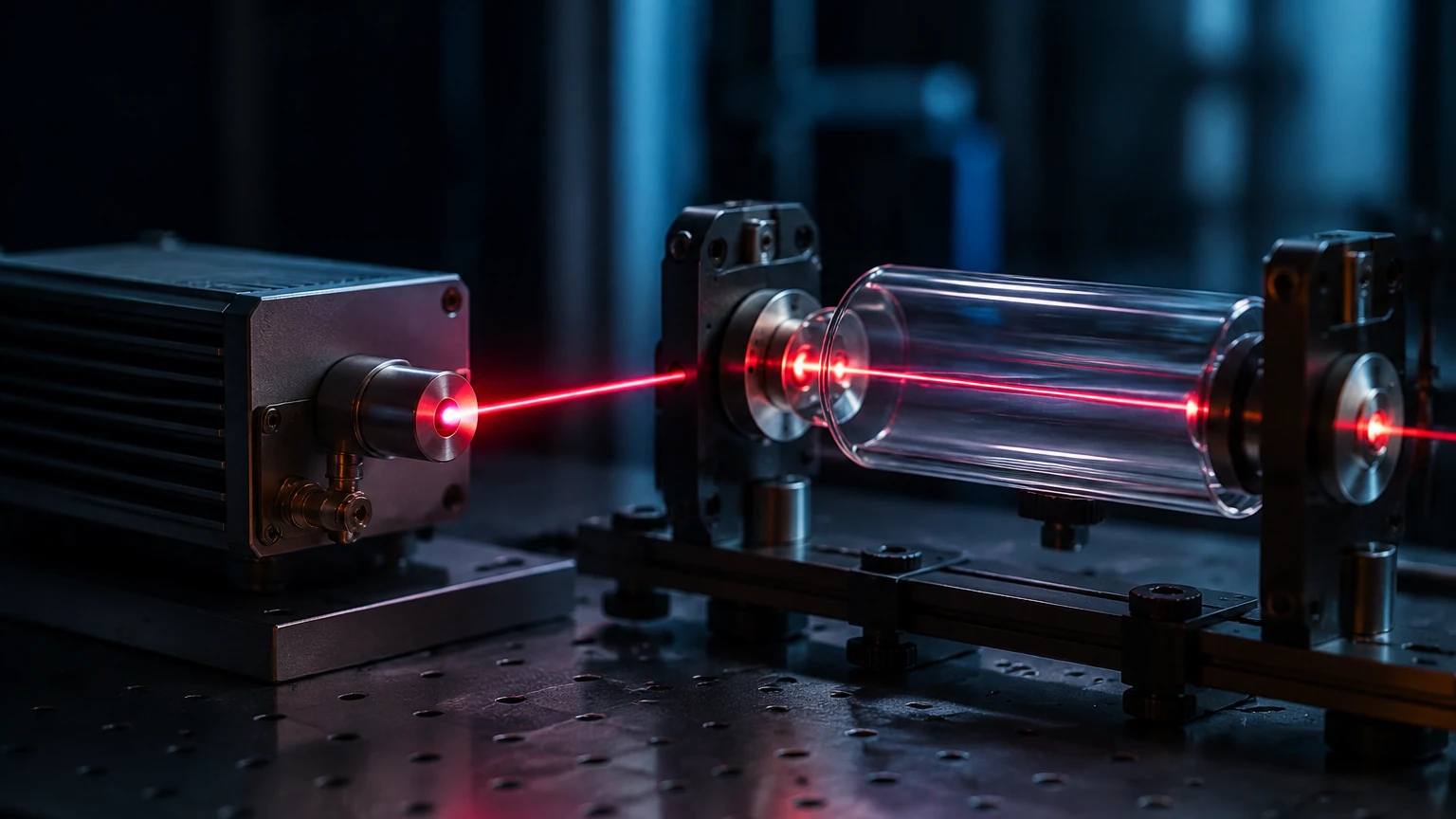
What makes TDLAS "tunable" is the use of a semiconductor diode laser. By varying the temperature and the injection current of the diode, the emission wavelength can be shifted across a narrow range. In a typical measurement cycle, the laser scans across a specific absorption line of the target gas. This scanning technique allows the system to account for background noise and the presence of other gases, as it can differentiate the specific shape of the target gas's absorption peak from the baseline.
Integration with Level Measurement Systems
In many industrial applications, level measurement and gas analysis are two sides of the same coin. For instance, in a large chemical storage tank, a radar level meter provides the volume of the liquid, while a TDLAS system monitors the concentration of oxygen or moisture in the nitrogen blanket above the liquid. This dual monitoring is essential for preventing explosions or product degradation.
When selecting instrumentation for a facility, engineers often consult a Main Page of technical resources to ensure that the chosen level sensors (like those from Welk) are compatible with the physical constraints of the vessel, such as the mounting ports required for TDLAS cross-stack analyzers.
Practical Selection Criteria for TDLAS Systems
Choosing the right TDLAS configuration requires an evaluation of the process environment and the specific gas being measured. Unlike contact-based electrochemical sensors, TDLAS is non-contact, which significantly reduces maintenance but increases the importance of optical path planning.
Selection Table: TDLAS vs. Alternative Gas Sensing Technologies
| Feature | TDLAS | Electrochemical | Paramagnetic (O2) | NDIR (Infrared) |
| :— | :— | :— | :— | :— |
| Selectivity | Excellent (No interference) | Moderate (Cross-sensitivity) | High | Moderate |
| Response Time | < 2 seconds | 30–60 seconds | 10–30 seconds | 5–15 seconds |
| Maintenance | Low (Optical cleaning) | High (Sensor replacement) | Moderate | Moderate |
| Calibration | Stable (Annual) | Frequent (Monthly) | Monthly | Quarterly |
| Cost | High Initial / Low OpEx | Low Initial / High OpEx | Moderate | Moderate |
| Process Temp | Up to 1500°C | < 50°C | < 100°C | < 150°C |
Key Considerations for Engineers
1. Target Gas: Common gases measured via TDLAS include H2O (moisture), NH3 (ammonia), CO, CO2, CH4 (methane), and O2. Ensure the laser diode used is rated for the specific absorption line of your target gas.
2. Path Length: The sensitivity of the measurement is directly proportional to the path length (L). For very low concentrations (ppm or ppb), a longer path length or a multi-pass cell may be required.
3. Dust and Particulates: While TDLAS can handle some level of dust, extreme particulate loading can attenuate the laser signal to the point of failure. In such cases, extractive TDLAS (where gas is pulled into a clean cell) is preferred over cross-stack (in-situ) measurement.
Installation Considerations and Best Practices
Proper installation is the single most important factor in the long-term reliability of a TDLAS system. Because the technology relies on a precise optical beam, physical stability is mandatory.
Alignment and Stability
For cross-stack installations, the transmitter and receiver must be perfectly aligned across the diameter of the pipe or vessel. Thermal expansion of the vessel or mechanical vibration can cause the beam to drift. High-quality mounting flanges with fine-adjustment screws are necessary to maintain signal integrity. If the vessel is prone to significant movement, a self-aligning system or a probe-style TDLAS (where the laser and detector are on the same side with a reflecting mirror) may be more appropriate.
Window Fouling and Purging
To prevent the process gas from condensing on or fouling the optical windows, a purge system is usually employed. Clean, dry instrument air or nitrogen is injected at the window interface to create a protective curtain. The flow rate of this purge must be carefully controlled; too little and the windows get dirty, too much and it might dilute the gas sample being measured, leading to inaccurate readings.
Temperature and Pressure Compensation
The shape and intensity of gas absorption lines change with temperature and pressure. Modern TDLAS analyzers include integrated sensors to measure these variables in real-time, allowing the software to apply compensation algorithms. If your process has extreme fluctuations, ensure the analyzer's compensation range matches your operating window.
Limitations and Common Risks
While tunable diode laser absorption spectroscopy tdlas is a robust technology, it is not a universal solution. Engineers should be aware of the following limitations:
* Optical Obstructions: Any physical object (like an internal agitator or a level probe) blocking the laser path will prevent measurement. This requires careful coordination with the placement of other instruments, such as the level meters found on the Welk Main Page.
* Gas Phase Only: TDLAS cannot measure concentrations within a liquid. It is strictly a gas-phase analytical tool.
* Spectral Overlap: While rare due to the narrow linewidth of diode lasers, in extremely complex gas mixtures, the absorption lines of a non-target gas might overlap with the target gas. This must be vetted during the engineering phase by providing a full gas composition profile to the manufacturer.
* Cost: The initial capital expenditure for TDLAS is significantly higher than for simple electrochemical sensors. The ROI is typically found in reduced maintenance costs and the avoidance of process downtime.
Frequently Asked Questions (FAQs)
Q: How often does a TDLAS system need calibration?
A: TDLAS is inherently stable because it is a fundamental physical measurement. Most systems only require a calibration check once a year. Many units feature an internal reference cell that allows the system to verify its own calibration automatically without being removed from the process.
Q: Can TDLAS measure multiple gases simultaneously?
A: A single laser diode is usually dedicated to one gas. However, multi-channel analyzers exist that house multiple diodes and share a single optical path, allowing for the measurement of two or three gases (e.g., CO and H2O) in one unit.
Q: What is the maximum distance a TDLAS beam can travel?
A: In clean gas, a cross-stack TDLAS can easily span 10 to 20 meters. In high-dust environments, this distance is significantly reduced, often to less than 2 meters, to ensure enough light reaches the detector.
Q: Is TDLAS suitable for hazardous areas?
A: Yes, most industrial TDLAS analyzers are available with ATEX, IECEx, or Class/Division certifications. Since the laser power is very low (typically Class 1), it does not pose an ignition risk itself, but the electronics housing must meet the local zone requirements.
Conclusion
Tunable Diode Laser Absorption Spectroscopy (TDLAS) represents a pinnacle of gas sensing technology, offering unparalleled speed and reliability for critical industrial processes. By understanding the underlying principles of absorption and the practical requirements for installation and maintenance, engineers can successfully integrate these systems alongside traditional level measurement tools.
Whether you are monitoring moisture in a natural gas pipeline or ensuring the safety of a chemical reactor's headspace, TDLAS provides the data necessary for informed decision-making. For a comprehensive range of level measurement solutions that work in tandem with advanced analytical tools, visit the Welk Main Page to explore radar, ultrasonic, and hydrostatic options tailored for your specific industrial environment.
Download Tunable Diode Laser Absorption Spectroscopy Tdlas as a PDF