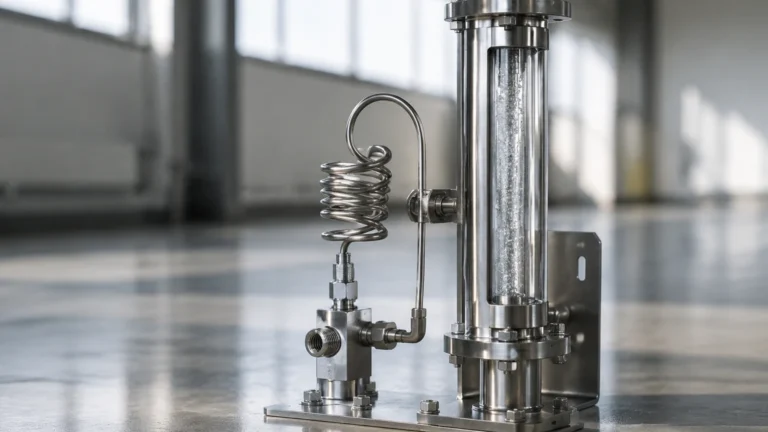
Turbosensor
Turbosensor
In industrial process control, the term "turbosensor" refers to high-performance level measurement devices engineered to maintain accuracy in environments characterized by surface agitation, rapid fluid movement, or heavy turbulence. Standard level sensors often struggle when liquid surfaces are not calm, leading to signal scattering, "lost echoes," or erratic readings. For engineers and plant managers, selecting a turbosensor-capable technology—such as advanced radar or ultrasonic systems—is critical for ensuring the stability of automated systems in chemical reactors, water treatment aeration tanks, and oil-water separators.
Welk, a professional manufacturer of industrial level measurement instruments, provides a range of solutions designed to overcome these dynamic challenges. By integrating sophisticated signal processing with robust hardware, these instruments function as reliable turbosensors, delivering real-time data even when process conditions are far from ideal. To explore the full range of available technologies, professionals can visit the Main Page for detailed product specifications.
Measurement Principles in Turbulent Environments
To understand how a turbosensor maintains accuracy, it is essential to examine the underlying measurement principles. Turbulence typically creates two problems: physical displacement of the liquid surface and the creation of foam or bubbles. Both can interfere with signal return.
Radar Level Measurement (FMCW and Pulse)
Radar level meters are the gold standard for turbulent applications. They operate by emitting electromagnetic waves toward the medium.
1. Pulse Radar: Sends short microwave pulses and measures the time-of-flight. While effective, standard pulse radar may lose the signal if the surface is too agitated.
2. FMCW (Frequency Modulated Continuous Wave): This technology is often the core of a high-end turbosensor. It emits a continuous signal with a changing frequency. By measuring the frequency difference between the emitted and received signal, the device can achieve much higher resolution and better noise filtering. FMCW radar is less sensitive to surface ripples and can "track" a moving surface more effectively than pulse-based systems.
Ultrasonic Level Sensing
Ultrasonic sensors use sound waves. While cost-effective, they are more susceptible to turbulence because air density changes and surface foam can absorb or deflect the sound. However, a turbosensor-grade ultrasonic unit utilizes advanced Digital Signal Processing (DSP) to filter out intermittent noise and focus on the true liquid level. These are best suited for open-channel flow or water tanks where turbulence is moderate.
Hydrostatic Pressure
For extreme turbulence where the surface is completely obscured by foam or violent splashing, hydrostatic level transmitters are often used. These measure the pressure exerted by the liquid column. Since they are submerged, they are largely unaffected by surface conditions, making them an excellent "contact" alternative to non-contact turbosensors.
Technical Comparison and Selection Table
Choosing the right turbosensor technology requires balancing accuracy, process conditions, and budget. The following table provides a comparison of the primary technologies used in agitated industrial environments.
| Technology | Accuracy | Turbulence Resistance | Foam Resistance | Typical Application |
| :— | :— | :— | :— | :— |
| FMCW Radar (80GHz) | High (±1mm) | Excellent | Good | Chemical reactors, high-precision tanks |
| Pulse Radar (26GHz) | Moderate (±3-5mm) | Good | Moderate | Large storage tanks, oil/water separators |
| Ultrasonic | Moderate (±0.25%) | Fair | Poor | Wastewater sumps, open channels |
| Hydrostatic | High (±0.1-0.5%) | Excellent | Excellent | Deep wells, pressurized vessels |
| Magnetic Gauge | Visual/High | Excellent | Excellent | Boiler drums, high-pressure bypass |
For a comprehensive review of these technologies and to find the specific model for your site, Review product options and application support.
Key Evaluation Criteria for Turbosensors
When specifying a turbosensor for a B2B industrial project, several technical factors must be confirmed to ensure the device will perform under stress.
Signal-to-Noise Ratio (SNR)
In turbulent applications, the "noise" is the reflected signal from splashes, agitator blades, or foam. A high-quality turbosensor must have a high SNR. 80GHz radar systems are particularly effective here because their narrow beam angle (often as small as 3 degrees) avoids hitting tank walls or internal obstructions, focusing purely on the liquid surface.
Response Time and Damping
Turbulence causes the level to fluctuate rapidly. A turbosensor must have adjustable damping settings. Damping allows the software to average the readings over a set period (e.g., 1 to 60 seconds), providing a stable output for the PLC or DCS rather than a jittery signal that could trigger false alarms.
Beam Angle and False Echo Suppression
Many industrial tanks contain agitators or heating coils. A turbosensor must feature "False Echo Suppression" or "Background Subtraction." This allows the engineer to map the tank while empty, telling the sensor to ignore reflections from fixed internal structures. This ensures that only the reflection from the (turbulent) liquid is tracked.
Practical Installation Considerations
Even the most advanced turbosensor will fail if installed incorrectly. Engineering teams should follow these guidelines to maximize performance in agitated vessels.
1. Avoid the Inflow: Never install a sensor directly above the pipe where liquid enters the tank. The falling stream creates localized turbulence and air entrainment that can block signals.
2. Stilling Wells and Bypass Pipes: In cases of extreme surface agitation, a stilling well (a vertical pipe submerged in the liquid) can be used. The turbosensor is mounted at the top of the pipe. The pipe acts as a mechanical filter, allowing the liquid level to rise and fall inside while shielding the surface from waves and foam.
3. Positioning Relative to Agitators: If the tank has a mixer, the sensor should be placed at a distance from the agitator shaft, ideally at a point where the vortex effect is minimized.
4. Mounting Nozzles: Ensure the mounting nozzle is short enough that it does not interfere with the sensor's beam angle. For radar turbosensors, the antenna should ideally extend slightly below the nozzle into the tank space.
Limitations and Common Risks
While turbosensor technology is highly advanced, there are physical limitations that engineers must acknowledge:
* Heavy Foam: While radar can penetrate some foam, extremely thick, dense foam (like shaving cream) can absorb the microwave signal entirely. In these specific cases, hydrostatic or capacitance probes may be required.
* Vapor and Condensation: High-temperature turbulent processes often produce steam. If condensation forms on the sensor face, it can cause "ringing" or signal loss. Selecting a sensor with a PTFE or PEEK face and integrated air purge can mitigate this.
* Vacuum Conditions: Some chemical reactions occur under vacuum. While radar works in a vacuum, ultrasonic sensors do not, as sound waves require a medium (air/gas) to travel.
Frequently Asked Questions (FAQ)
Q: Can a turbosensor distinguish between the liquid surface and an agitator blade?
A: Yes, through a process called "False Echo Storage." The user maps the internal obstructions of the tank. Advanced algorithms can also distinguish between the rhythmic, high-speed reflection of a blade and the slower, broader reflection of a liquid surface.
Q: Is 80GHz radar always better than 26GHz for turbulent liquids?
A: Generally, yes. The higher frequency allows for a narrower beam and better signal focus, which is crucial when the surface is uneven. However, 26GHz may be preferred in very dusty environments or where heavy steam is present, as the longer wavelength can sometimes penetrate those conditions better.
Q: How does a turbosensor handle "vortexing" in a tank?
A: A vortex creates a sloped surface. This can reflect the signal away from the sensor. By using a sensor with a wide dynamic range and installing it at the 1/2 or 2/3 radius of the tank (rather than the center), the system can usually maintain a stable reading.
Conclusion
Identifying the right turbosensor solution is a balance of understanding fluid dynamics and leveraging modern signal processing. Whether the application involves a wastewater treatment plant or a complex chemical reactor, the goal remains the same: reliable data for process safety and efficiency. Welk’s commitment to precision engineering and customized OEM/ODM services ensures that every industrial challenge is met with a robust, cost-effective measurement solution. For further technical guidance and to view our full catalog, please visit the Main Page.