Types of Pressure Sensors
Types of Pressure Sensors
In the realm of industrial automation and process control, pressure sensors serve as the primary sensory organs for monitoring system health and material quantities. For engineers and procurement specialists, selecting the correct technology from the various types of pressure sensors is critical to ensuring long-term accuracy, safety, and cost-effectiveness. Whether the application involves monitoring steam lines in a power plant or measuring the depth of a chemical storage tank via hydrostatic pressure, the underlying sensing technology dictates the instrument's performance envelope.
Pressure measurement is rarely a one-size-fits-all solution. Different environments—ranging from cryogenic temperatures to highly corrosive acid baths—require specific sensor architectures. This guide explores the fundamental principles, technological variations, and practical selection criteria for modern pressure sensing instruments.
Understanding Pressure Measurement Principles
Before diving into specific hardware, it is essential to understand how pressure is converted into a readable signal. At its core, a pressure sensor consists of two main components: a primary transducer and a secondary signal conditioner.
The primary transducer is typically a mechanical element, such as a diaphragm, bellows, or Bourdon tube, which deflects when force is applied. This physical displacement must then be converted into an electrical signal. The method of this conversion defines the sensor type.
In industrial level measurement, pressure sensors are frequently used to determine the height of a liquid. This is based on the principle of hydrostatic pressure, where the pressure at the bottom of a liquid column is proportional to the height of the liquid multiplied by its density and the force of gravity ($P =
ho gh$). Therefore, understanding the accuracy and stability of various types of pressure sensors is the first step in achieving precise level control.
Classification by Reference Pressure
Pressure is always measured relative to a reference point. Choosing the wrong reference can lead to significant errors, especially in low-pressure applications or environments with fluctuating weather conditions.
Gauge Pressure Sensors
Gauge pressure is measured relative to the local atmospheric pressure. These sensors feature a vent (often a small tube inside the cable) that allows the back side of the sensing diaphragm to "breathe" with the atmosphere. This ensures that changes in barometric pressure do not affect the reading. These are the most common sensors used in open-tank level measurement.
Absolute Pressure Sensors
Absolute pressure sensors measure pressure relative to a perfect vacuum sealed within the device. These are essential in vacuum distillation processes or high-altitude applications where atmospheric pressure is not a reliable constant.
Differential Pressure (DP) Sensors
DP sensors measure the difference between two pressure points. In level measurement, they are used for pressurized tanks. By measuring the pressure at both the bottom and the top (vapor space) of the tank, the sensor can subtract the head pressure of the gas to provide an accurate liquid level reading.
Sealed Pressure Sensors
Similar to absolute sensors, these are measured relative to a fixed reference pressure sealed within the unit (often 1 bar). They are used in high-pressure applications where venting to the atmosphere is impractical or where the sensor might be completely submerged in a way that prevents atmospheric venting.
Core Technologies in Pressure Sensing
The "type" of sensor is most often defined by the internal mechanism that detects the diaphragm's movement. Here are the most prevalent technologies used in modern industrial B2B applications.
1. Piezoresistive Strain Gauge Sensors
Piezoresistive sensors are the workhorses of the industry. They utilize the change in electrical resistance that occurs when a material is stretched or compressed. Typically, a silicon-based strain gauge is bonded to a diaphragm. As pressure deforms the diaphragm, the resistance of the gauge changes, which is measured using a Wheatstone bridge circuit.
* Advantages: High sensitivity, compact size, and excellent reliability in stable temperatures.
* Limitations: Sensitive to temperature fluctuations, requiring integrated compensation circuits.
2. Capacitive Pressure Sensors
Capacitive sensors measure the change in electrical capacitance between a flexible diaphragm and a fixed metal plate. As pressure moves the diaphragm, the gap between the plates changes, altering the capacitance. These are often used in high-end level transmitters, such as those found on the Welk Main Page.
* Advantages: Extremely high accuracy, excellent long-term stability, and high resistance to overpressure.
* Limitations: More complex electronics and can be sensitive to electromagnetic interference (EMI) if not properly shielded.
3. Piezoelectric Pressure Sensors
Unlike piezoresistive sensors, piezoelectric sensors generate an actual electric charge when subjected to mechanical stress. These are primarily used for dynamic pressure measurements, such as detecting water hammer in pipes or explosions.
* Advantages: Very fast response times; capable of measuring rapid pressure changes.
* Limitations: They cannot measure static pressure (the charge leaks away), making them unsuitable for standard tank level measurement.
4. Resonant Wire Sensors
These sensors use a wire vibrating at its resonant frequency. As pressure is applied to a diaphragm, the tension on the wire changes, which shifts its resonant frequency. This frequency shift is then converted into a digital signal.
* Advantages: Extremely high precision and low drift over time.
* Limitations: Sensitive to vibration and generally more expensive than other types.
5. Optical Pressure Sensors
Optical sensors use fiber optics to detect the movement of a diaphragm. This can be done through intensity modulation or interferometry (like Fabry-Pérot).
* Advantages: Immune to electromagnetic interference, safe for explosive environments (intrinsically safe by design), and capable of operating at very high temperatures.
* Limitations: High cost and specialized installation requirements.
Application in Hydrostatic Level Measurement
For B2B industrial applications, one of the most common uses for these sensors is hydrostatic level measurement. When selecting between types of pressure sensors for this purpose, the physical state of the media is paramount.
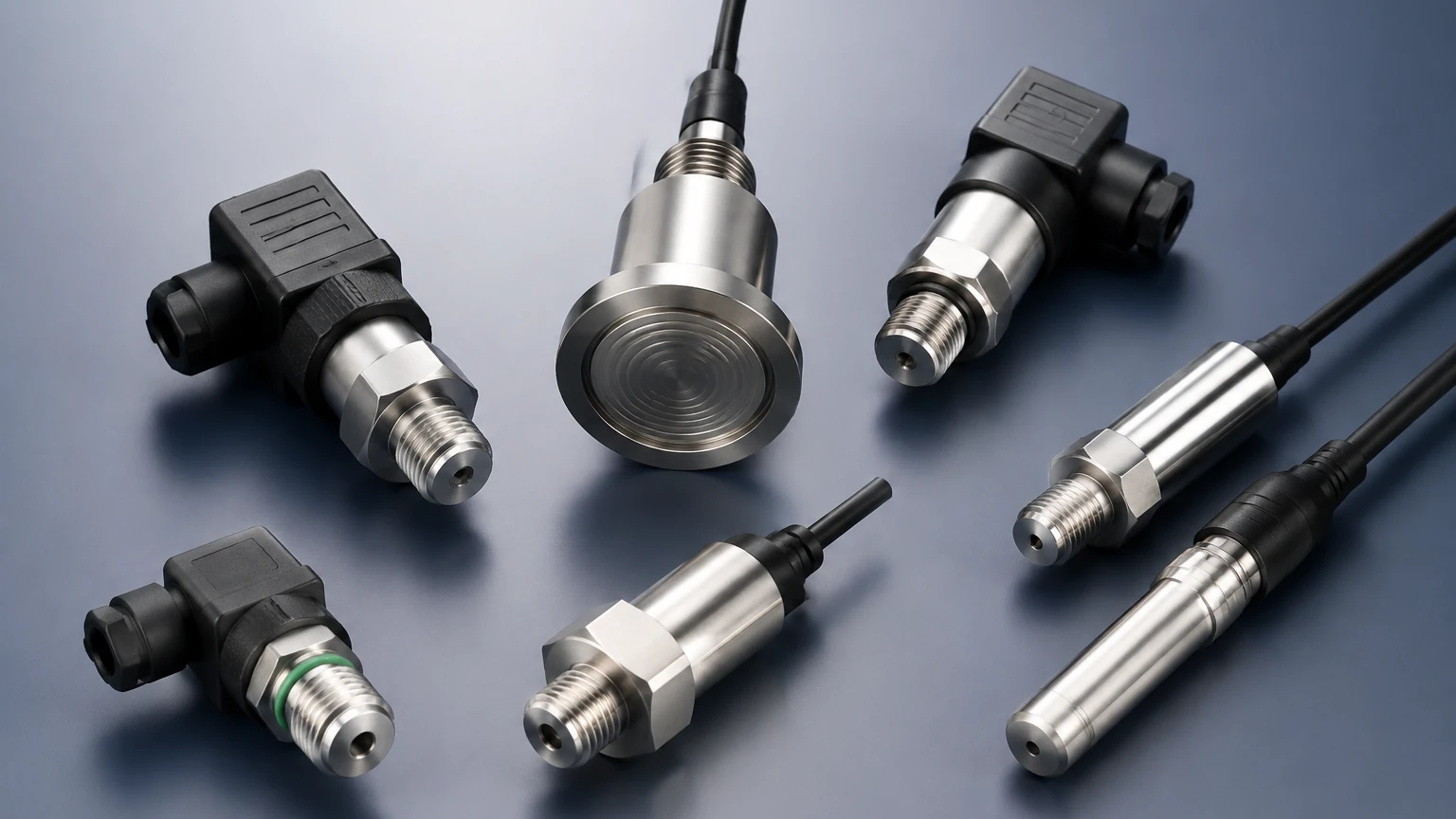
1. Submersible Transmitters: These are gauge pressure sensors designed to be lowered into a well or tank. They must have a high IP rating (IP68) and a reinforced cable containing a vent tube for atmospheric reference.
2. External Mount Transmitters: These are mounted to a flange or threaded port at the bottom of a tank. For viscous or clogging media (like pulp or wastewater), a "flush diaphragm" design is used to prevent buildup in the sensor cavity.
Selection Criteria and Practical Engineering Considerations
Choosing the right sensor requires a balance of technical specifications and environmental realities. Engineers should evaluate the following:
* Pressure Range: The sensor should be rated for a range approximately 25-50% higher than the maximum expected operating pressure to handle surges.
* Media Compatibility: The wetted parts (diaphragm and housing) must be compatible with the process fluid. 316L Stainless Steel is standard, but aggressive chemicals may require Tantalum, Hastelloy, or PTFE coatings.
* Temperature Range: Standard sensors usually operate between -20°C and +80°C. High-temperature applications (up to 200°C or more) require cooling fins or capillary tubes to protect the electronics.
* Output Signal: Common industrial outputs include 4-20mA (current loop), 0-10V, or digital protocols like HART, Modbus, or Profibus for integration into PLC systems.
Installation and Maintenance Best Practices
Even the most advanced sensor will fail if installed incorrectly. Consider these guidelines:
* Orientation: Some sensors are sensitive to orientation due to the weight of the internal oil fill. Always calibrate the sensor in its final mounting position.
* Venting: For gauge sensors, ensure the vent tube is clear and protected by a moisture filter. A blocked vent will cause the sensor to drift with changes in weather.
* Isolation: Use isolation valves to allow for the removal and calibration of the sensor without draining the entire system.
* Turbulence: In level applications, avoid installing the sensor near agitators or inlet pipes. If turbulence is unavoidable, use a stilling well to dampen the fluid movement.
Comparison Table of Pressure Sensor Technologies
| Sensor Type | Operating Principle | Best For | Main Limitation |
| :— | :— | :— | :— |
| Piezoresistive | Resistance change in silicon | General industrial use, low cost | Temperature sensitivity |
| Capacitive | Capacitance change between plates | High precision, low pressure | Higher cost |
| Strain Gauge | Resistance change in metal foil | High pressure, heavy duty | Lower sensitivity |
| Piezoelectric | Charge generation | Dynamic/pulsating pressure | No static measurement |
| Resonant | Frequency shift in vibrating wire | Laboratory/High-end process | Sensitive to vibration |
| Optical | Light interference/intensity | EMI-heavy or ATEX zones | Specialized equipment |
Frequently Asked Questions
Q: How often should pressure sensors be calibrated?
A: For most industrial B2B applications, annual calibration is standard. However, in critical safety systems or highly corrosive environments, semi-annual checks may be necessary.
Q: What is the difference between accuracy and stability?
A: Accuracy is how close the reading is to the true value at a single point in time. Stability (or drift) is the sensor's ability to maintain that accuracy over months or years. For long-term level monitoring, stability is often more important than initial accuracy.
Q: Can I use a pressure sensor to measure the level of a closed, pressurized tank?
A: Yes, but you must use a differential pressure sensor. One port measures the liquid at the bottom, and the other measures the gas pressure at the top. The sensor subtracts the gas pressure to find the true liquid head.
Q: Why do some sensors use a ceramic diaphragm instead of stainless steel?
A: Ceramic diaphragms are highly resistant to abrasion and chemical corrosion. They are often used in wastewater or slurry applications where metal diaphragms might be pitted or worn down over time.
Conclusion
Selecting from the various types of pressure sensors requires a deep understanding of both the technology and the application environment. By matching the transducer principle—whether piezoresistive, capacitive, or otherwise—to the specific needs of the process, engineers can ensure reliable data and system longevity. For those looking to integrate these sensors into comprehensive level measurement systems, reviewing professional-grade hardware and application support on the Main Page is a recommended next step in the procurement process. Proper selection, coupled with rigorous installation standards, remains the cornerstone of modern industrial process efficiency.