Ultra High Temperature Thermocouple
Ultra High Temperature Thermocouple
In the landscape of industrial thermal processing, standard temperature sensors often reach their physical limits long before a process achieves its peak operating state. For industries such as aerospace, glass manufacturing, semiconductor processing, and metallurgy, monitoring temperatures exceeding 1000°C (1832°F) is not merely a requirement for quality control—it is a fundamental necessity for safety and structural integrity. An ultra high temperature thermocouple is a specialized sensor engineered to withstand these extreme thermal loads while maintaining signal accuracy and mechanical stability.
Unlike standard base-metal thermocouples, which oxidize or melt at these thresholds, ultra high temperature variants utilize noble metals or refractory alloys. Understanding the underlying physics, material constraints, and installation requirements is essential for any engineer tasked with managing high-heat industrial assets.
Measurement Principles: The Seebeck Effect at Scale
At its core, an ultra high temperature thermocouple operates on the Seebeck Effect, a phenomenon where a temperature gradient across two dissimilar electrical conductors produces a voltage difference. When these two conductors are joined at one end (the sensing junction), the voltage generated at the open end (the reference junction) is proportional to the temperature difference between the two points.
In ultra-high temperature applications, the challenge lies in the material science. As temperatures rise, molecular agitation increases, leading to potential diffusion between the two thermocouple wires, which can shift the calibration. Furthermore, the insulation materials that prevent short-circuiting between the wires must remain non-conductive at white-hot temperatures. Standard ceramic insulators like Alumina ($Al_2O_3$) are often pushed to their limits, requiring more exotic materials like Hafnia ($HfO_2$) or Beryllium Oxide ($BeO$) in extreme cases.
Classification of High-Temperature Sensors
Ultra high temperature thermocouples are generally categorized into two primary groups based on their metallurgy: Noble Metal (Platinum-based) and Refractory Metal (Tungsten-based).
Noble Metal Thermocouples (Types S, R, and B)
Noble metal thermocouples utilize platinum and rhodium. They are characterized by their high resistance to oxidation in air, making them the industry standard for high-temperature measurements in oxidizing atmospheres.
* Type S (Pt-10%Rh/Pt): Capable of measuring up to 1450°C (2642°F) continuously. It is frequently used as a calibration standard due to its high stability.
* Type R (Pt-13%Rh/Pt): Similar to Type S but offers a slightly higher signal output. It is used in glass and steel industries.
* Type B (Pt-30%Rh/Pt-6%Rh): The most robust of the noble group, capable of reaching 1700°C (3092°F). It is unique because it produces nearly zero output below 40°C, often eliminating the need for cold-junction compensation in less critical applications.
Refractory Metal Thermocouples (Types C, D, and G)
When temperatures exceed 1700°C, noble metals begin to soften and lose accuracy. Here, refractory metals like Tungsten and Rhenium are employed. These sensors can measure up to 2320°C (4208°F).
* Type C (W-5%Re/W-26%Re): The most common refractory thermocouple. It is highly durable but must never be used in oxidizing atmospheres (oxygen-rich environments) because tungsten oxidizes rapidly and catastrophically. It is strictly for vacuum, inert gas, or reducing atmospheres.
Practical Selection Table
Choosing the correct sensor requires balancing the maximum process temperature with the chemical composition of the environment.
| Thermocouple Type | Composition | Max Continuous Temp (°C) | Recommended Atmosphere |
| :— | :— | :— | :— |
| Type S | Pt-10%Rh / Pt | 1450°C | Oxidizing / Inert |
| Type R | Pt-13%Rh / Pt | 1450°C | Oxidizing / Inert |
| Type B | Pt-30%Rh / Pt-6%Rh | 1700°C | Oxidizing / Inert |
| Type C | W-5%Re / W-26%Re | 2320°C | Vacuum / Inert / Reducing |
| Type G | W / W-26%Re | 2320°C | Vacuum / Inert |
| Type D | W-3%Re / W-25%Re | 2320°C | Vacuum / Inert |
Protection Tubes and Sheathing
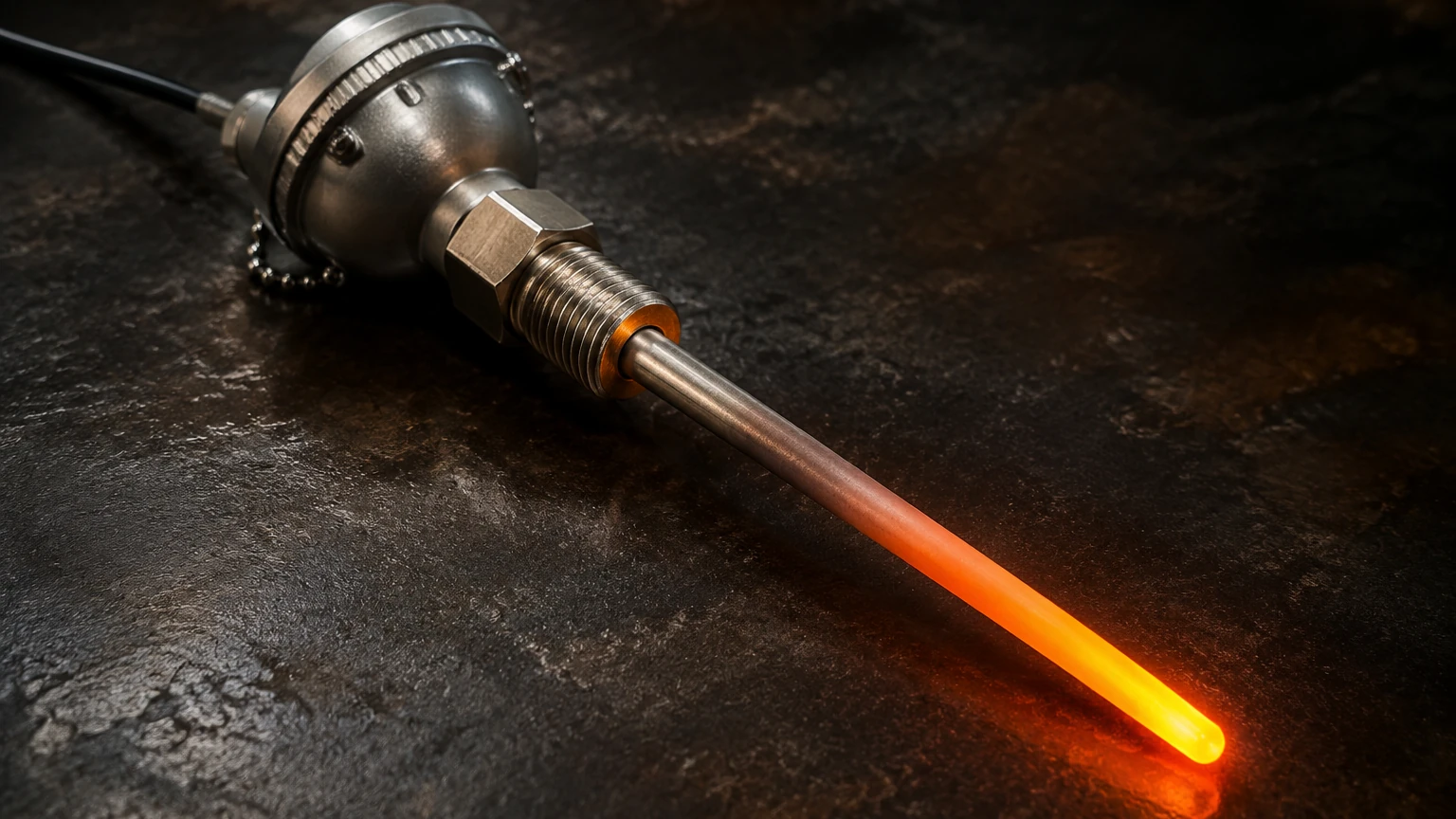
An ultra high temperature thermocouple is rarely exposed directly to the process. It is typically housed within a protection tube (thermowell) to prevent chemical attack and mechanical damage. The choice of sheathing is as critical as the thermocouple itself.
1. Alumina ($Al_2O_3$): Used up to 1800°C. It is gas-tight and provides excellent electrical insulation but is susceptible to thermal shock.
2. Zirconia ($ZrO_2$): Offers higher temperature resistance than alumina but becomes electrically conductive at very high temperatures, which can interfere with the thermocouple signal.
3. Molybdenum/Tantalum: Used as metallic sheaths in vacuum furnaces for refractory thermocouples. These provide excellent mechanical strength but cannot be used in the presence of oxygen.
4. Silicon Carbide (SiC): Often used in the aluminum and non-ferrous metal industries due to its resistance to molten metal erosion.
Installation Considerations
Successful deployment of these sensors requires adherence to specific engineering practices:
* Immersion Depth: To avoid conduction errors (where heat escapes through the sensor body), the thermocouple should be immersed to a depth at least 10 times the diameter of the protection tube.
* Orientation: At temperatures above 1200°C, protection tubes can soften and sag. Vertical installation is preferred. If horizontal installation is mandatory, external support structures are required.
* Thermal Shock: Ceramics are brittle. Rapid heating or cooling can cause the protection tube to crack. Pre-heating the sensor before insertion into a hot furnace is a standard safety protocol.
* Lead Wire Matching: Ensure that the extension wires used to connect the thermocouple to the control system match the thermocouple type. Using standard copper wire will introduce significant measurement errors at the connection point.
Integration with Industrial Level Measurement
In many B2B industrial applications, temperature sensing is not an isolated requirement. It is often a critical variable in accurate level measurement. For instance, in molten glass or molten metal processing, the density of the material and the dielectric properties of the vapor space change dramatically with temperature.
When using advanced level measurement technologies, such as those found on the Welk Main Page, temperature data from an ultra high temperature thermocouple is used to provide real-time compensation. For radar level meters, the speed of the electromagnetic wave can be influenced by the temperature and pressure of the medium it travels through. By integrating high-accuracy temperature data, the level measurement system can adjust its algorithms to maintain sub-millimeter precision even in a furnace operating at 1500°C.
Furthermore, in high-pressure steam applications or chemical reactors, hydrostatic level transmitters rely on density calculations. Since density is a function of temperature, the ultra high temperature thermocouple provides the necessary input for the level transmitter to calculate the true liquid height accurately.
Limitations and Common Risks
Despite their robust design, ultra high temperature thermocouples are subject to several failure modes:
* Decalibration (Drift): At sustained high temperatures, rhodium can vaporize from one leg of a noble metal thermocouple and contaminate the other. This changes the metallurgical composition and leads to a gradual drift in temperature readings.
* Embrittlement: Tungsten-based thermocouples become extremely brittle after their first exposure to high heat. Once used, they cannot be bent or repositioned without breaking.
* Contamination: Even trace amounts of silica or sulfur in a furnace atmosphere can attack platinum wires, leading to premature failure. This is why high-purity alumina (99.7% or higher) is required for protection tubes.
Frequently Asked Questions (FAQ)
Q: How often should an ultra high temperature thermocouple be calibrated?
A: This depends on the stability of the process. In critical aerospace applications, sensors may be checked after every heat cycle. In glass manufacturing, noble metal sensors may remain stable for months, but periodic comparison against a secondary standard is recommended.
Q: Can I use a Type K thermocouple for short bursts at 1300°C?
A: While Type K can theoretically reach 1260°C, using it at 1300°C will cause rapid oxidation of the Green-Rot type and lead to immediate and significant measurement error. It is safer and more cost-effective to use a Type S or R sensor.
Q: Why are refractory thermocouples so expensive?
A: The cost is driven by the difficulty of processing tungsten and rhenium, the requirement for high-purity inert gas or vacuum during manufacturing, and the specialized ceramic insulators required to survive at 2000°C+.
Q: Does the diameter of the thermocouple wire affect the reading?
A: The wire diameter does not change the voltage output (Seebeck voltage), but thicker wires provide a longer service life at high temperatures as they take longer to degrade due to oxidation or alloy migration.
By carefully selecting the appropriate ultra high temperature thermocouple and ensuring its proper integration with level measurement and control systems, engineers can ensure the reliability of their most demanding thermal processes.