Ultrasonic Flow Meter Accuracy
Ultrasonic Flow Meter Accuracy
In industrial process control and water management, the precision of flow measurement is a critical factor in maintaining operational efficiency, ensuring product quality, and managing costs. Ultrasonic flow meters have become a preferred choice for many engineers due to their non-invasive nature and lack of moving parts. However, achieving high ultrasonic flow meter accuracy requires a deep understanding of the underlying measurement principles, fluid dynamics, and installation environment. This guide explores the technical factors that influence accuracy and provides practical benchmarks for selecting the right instrumentation for industrial applications.
Measurement Principles of Ultrasonic Flow Meters
Before evaluating accuracy, it is essential to understand how these instruments calculate flow. Ultrasonic flow meters primarily use two distinct technologies: Transit-Time and Doppler Effect. Each is suited to specific fluid conditions, and selecting the wrong principle for a given application is the most common cause of measurement error.
Transit-Time Principle
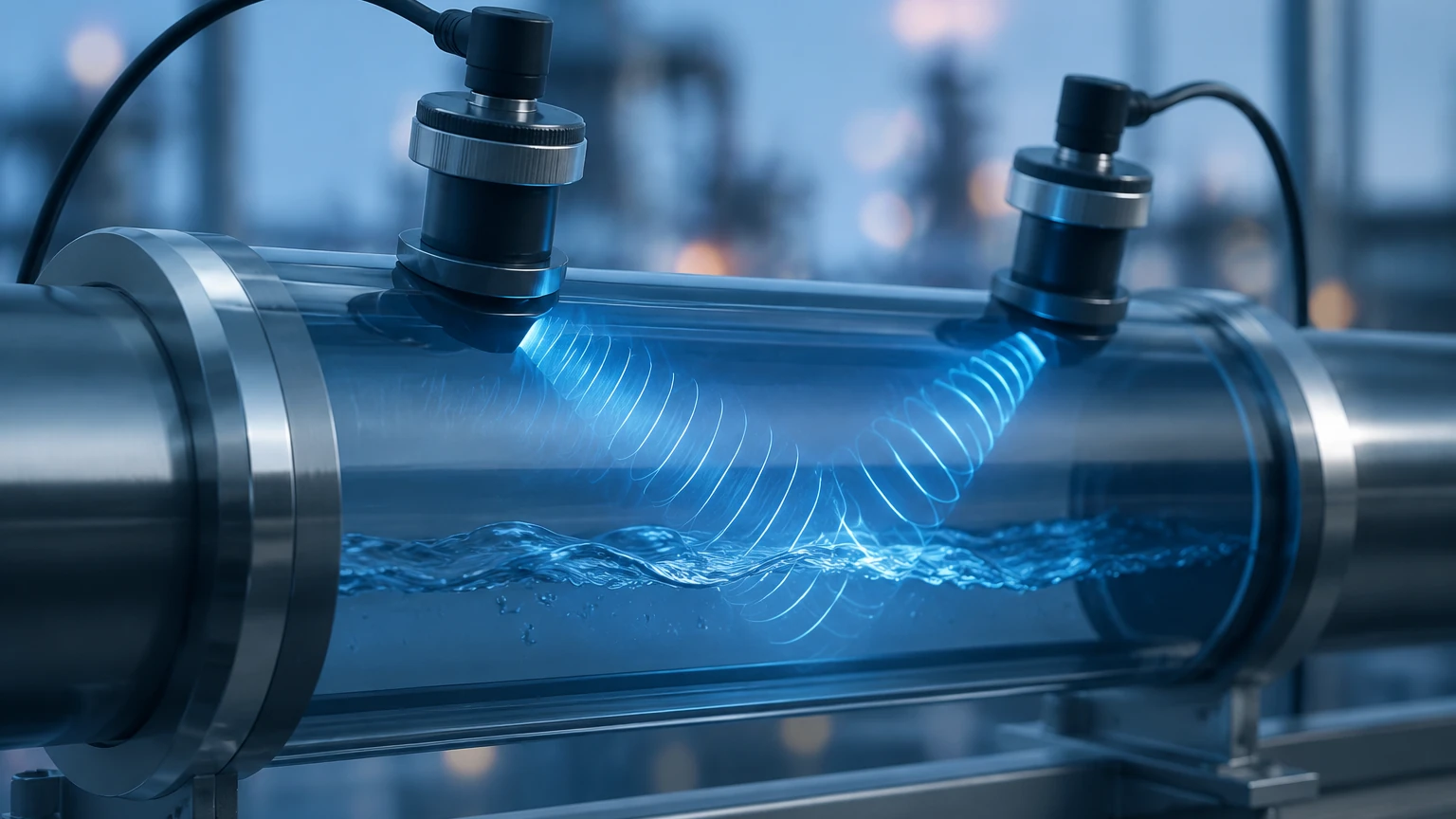
Transit-time meters utilize two transducers that act as both transmitters and receivers. They are mounted on opposite sides of a pipe or at a specific distance from each other. One transducer sends an ultrasonic signal downstream, and the other sends a signal upstream.
Because the moving fluid carries the sound waves, the signal traveling downstream moves faster than the signal traveling upstream. The meter measures the time difference (delta-T) between these two signals. This time difference is directly proportional to the velocity of the fluid. Transit-time meters are highly accurate for clean liquids, such as treated water, chemicals, and light oils. For those seeking advanced instrumentation, reviewing the Main Page of specialized manufacturers like Welk can provide insights into high-precision transit-time models.
Doppler Effect Principle
Doppler flow meters rely on the reflection of ultrasonic waves off particles or air bubbles within the fluid. The transducer transmits a signal at a known frequency; when this signal hits a moving particle, it reflects back to the receiver at a shifted frequency. The magnitude of this frequency shift is proportional to the flow velocity.
While Doppler meters are essential for slurries, wastewater, and aerated liquids where transit-time signals would be blocked, they generally offer lower accuracy than transit-time meters because they depend on the velocity of the particles rather than the average velocity of the entire fluid stream.
Defining Accuracy: Rate vs. Full Scale
When discussing ultrasonic flow meter accuracy, it is vital to distinguish between "percentage of rate" and "percentage of full scale."
* Percentage of Rate: This indicates that the error is a percentage of the actual flow being measured. For example, if a meter is rated at ±1% of rate and the flow is 100 m³/h, the error is ±1 m³/h. If the flow drops to 50 m³/h, the error remains ±1% of that value (±0.5 m³/h).
* Percentage of Full Scale (FS): This means the error is a percentage of the maximum capacity of the meter. If a meter with a 100 m³/h capacity is rated at ±1% FS, the error is ±1 m³/h regardless of whether the actual flow is 100 m³/h or 10 m³/h. At low flow rates, FS accuracy becomes significantly less precise.
Most high-quality industrial ultrasonic meters, such as those provided by Welk, specify accuracy as a percentage of the measured rate to ensure reliability across a wide range of flow conditions.
Factors Influencing Ultrasonic Flow Meter Accuracy
Several environmental and mechanical factors can degrade the performance of an ultrasonic flow meter. Understanding these variables allows engineers to mitigate risks during the design phase.
1. Flow Profile and Reynolds Number
Ultrasonic meters assume a fully developed flow profile—where the fluid velocity is predictable across the pipe cross-section. Turbulence or non-uniform flow profiles (caused by elbows, valves, or pumps) can lead to significant errors. The Reynolds number, a dimensionless value representing the ratio of inertial forces to viscous forces, helps determine if the flow is laminar, transitional, or turbulent. Most ultrasonic meters are calibrated for turbulent flow (Reynolds number > 4,000).
2. Pipe Material and Lining
For clamp-on ultrasonic meters, the signal must pass through the pipe wall and any internal lining before reaching the fluid. If the pipe is heavily corroded, has internal scaling, or contains air gaps between the lining and the wall, the ultrasonic signal will be attenuated or refracted, leading to poor accuracy. Accurate measurement of pipe wall thickness using a dedicated ultrasonic thickness gauge is often a prerequisite for successful flow meter setup.
3. Fluid Properties
The speed of sound varies depending on the fluid's temperature, pressure, and density. For instance, the speed of sound in water at 20°C (68°F) is approximately 1,482 m/s, but this changes as the temperature rises. High-accuracy meters often include temperature compensation or allow the user to input specific fluid parameters to maintain precision.
4. Transducer Alignment and Coupling
In clamp-on applications, the physical alignment of the transducers is paramount. Even a few millimeters of misalignment can cause signal loss or timing errors. Furthermore, a high-quality acoustic coupling gel must be used to eliminate air gaps between the transducer face and the pipe surface.
Practical Selection Table for Ultrasonic Flow Meters
The following table provides a general comparison of typical accuracy levels and applications for different ultrasonic flow meter configurations.
| Meter Type | Typical Accuracy (% of Rate) | Best Application | Fluid Condition |
| :— | :— | :— | :— |
| Inline (Wetted) Transit-Time | ±0.5% to ±1.0% | Custody transfer, high-precision process | Clean liquids, no bubbles |
| Clamp-on Transit-Time | ±1.0% to ±3.0% | Retrofitting, non-contact measurement | Clean liquids, <2% solids |
| Inline Doppler | ±2.0% to ±5.0% | Industrial waste, slurries | Aerated liquids, >100 ppm particles |
| Clamp-on Doppler | ±3.0% to ±5.0% | Temporary troubleshooting, pump protection | Dirty liquids, raw sewage |
| Multi-path Transit-Time | ±0.2% to ±0.5% | Large diameter pipes, high-value fluids | Clean liquids, stable profile |
Installation Considerations for Maximum Accuracy
To achieve the specified ultrasonic flow meter accuracy, strict adherence to installation guidelines is required. The most critical factor is the "straight run" requirement.
Straight Pipe Requirements
Obstructions such as bends, tees, and valves create swirls and velocity profile distortions. To allow the flow to stabilize, the meter should be installed in a straight section of pipe. Standard engineering practice recommends:
* Upstream: Minimum of 10 times the pipe diameter (10D).
* Downstream: Minimum of 5 times the pipe diameter (5D).
If a valve or a pump is located upstream of the meter, the requirement may increase to 20D or 30D. In space-constrained environments, flow conditioners (vanes or plates) can be used to shorten these requirements, though they may introduce a pressure drop.
Mounting Orientation
For horizontal pipes, transducers should be mounted at the 3 o'clock and 9 o'clock positions (the sides of the pipe). Mounting on the top can lead to errors caused by air bubbles trapped at the top of the pipe, while mounting on the bottom can lead to errors caused by sediment buildup.
Limitations and Common Risks
While versatile, ultrasonic technology has inherent limitations:
* Minimum Velocity: Most ultrasonic meters struggle to maintain accuracy at very low velocities (typically below 0.1 m/s or 0.3 ft/s).
* High Solid Content: Transit-time meters will fail if the concentration of suspended solids or entrained air exceeds 2% to 5% by volume, as the sound waves will be scattered.
* Signal Attenuation: Certain plastic pipes (like HDPE) or lined pipes can absorb ultrasonic energy, making it difficult to get a strong signal-to-noise ratio in clamp-on applications.
Frequently Asked Questions (FAQs)
Q: Can I use a clamp-on meter on a pipe with an internal liner?
A: Yes, provided the liner is sonically conductive and bonded tightly to the pipe wall. If there is an air gap between the liner and the pipe, the signal will not pass through. You must also account for the liner material and thickness in the meter's configuration.
Q: How often should an ultrasonic flow meter be calibrated?
A: For critical processes, annual calibration is recommended. While ultrasonic meters have no moving parts to wear out, electronic drift and changes in pipe condition (like scaling) can affect accuracy over time.
Q: Does pipe vibration affect accuracy?
A: Extreme vibration can interfere with the ultrasonic signal or cause mechanical stress on the transducers. Using damped mounting brackets or choosing a location with lower vibration is advisable.
Q: Is ultrasonic flow meter accuracy affected by pressure changes?
A: Generally, no. Ultrasonic meters measure velocity. However, if the pressure change causes a change in fluid density or temperature, or if the fluid is a gas, the speed of sound will change, necessitating compensation.
Conclusion and Next Steps
Achieving reliable ultrasonic flow meter accuracy is a balance of selecting the correct technology (Transit-Time vs. Doppler), ensuring proper pipe conditions, and following rigorous installation standards. For engineers and procurement professionals, it is essential to confirm the specific fluid properties and pipe geometry before selecting a device.
When accuracy is paramount, consulting with a professional manufacturer like Welk ensures that the selected instrument is tailored to the specific demands of water treatment, chemical processing, or industrial automation. For more detailed technical specifications and product options, visiting the Main Page is a recommended step in the project planning process. By verifying the installation environment and fluid characteristics upfront, organizations can leverage the full benefits of ultrasonic technology while maintaining the highest levels of process precision.