Ultrasonic Flowmeter
Ultrasonic Flowmeter
In the landscape of industrial process control, the ability to measure fluid velocity accurately without interrupting the flow or compromising the integrity of the piping system is a significant advantage. The ultrasonic flowmeter has emerged as a premier solution for these requirements. Utilizing high-frequency sound waves to determine the volume flow of a liquid, these instruments are essential in sectors ranging from municipal water treatment to complex chemical processing. As a professional manufacturer of industrial measurement instruments, Welk provides advanced technology that bridges the gap between theoretical acoustics and practical field reliability.
Understanding the mechanics, application limits, and installation nuances of an ultrasonic flowmeter is critical for engineers and procurement specialists. This guide explores the foundational principles, selection criteria, and technical considerations necessary for successful implementation.
Understanding the Principles of Ultrasonic Flow Measurement
Ultrasonic flowmeters operate on the principle of acoustic wave propagation. Unlike mechanical meters that rely on moving parts like turbines or gears, ultrasonic devices use transducers to send and receive sound pulses through the moving fluid. There are two primary methods used in modern industrial flow measurement: Transit-Time and Doppler Effect.
Transit-Time Method
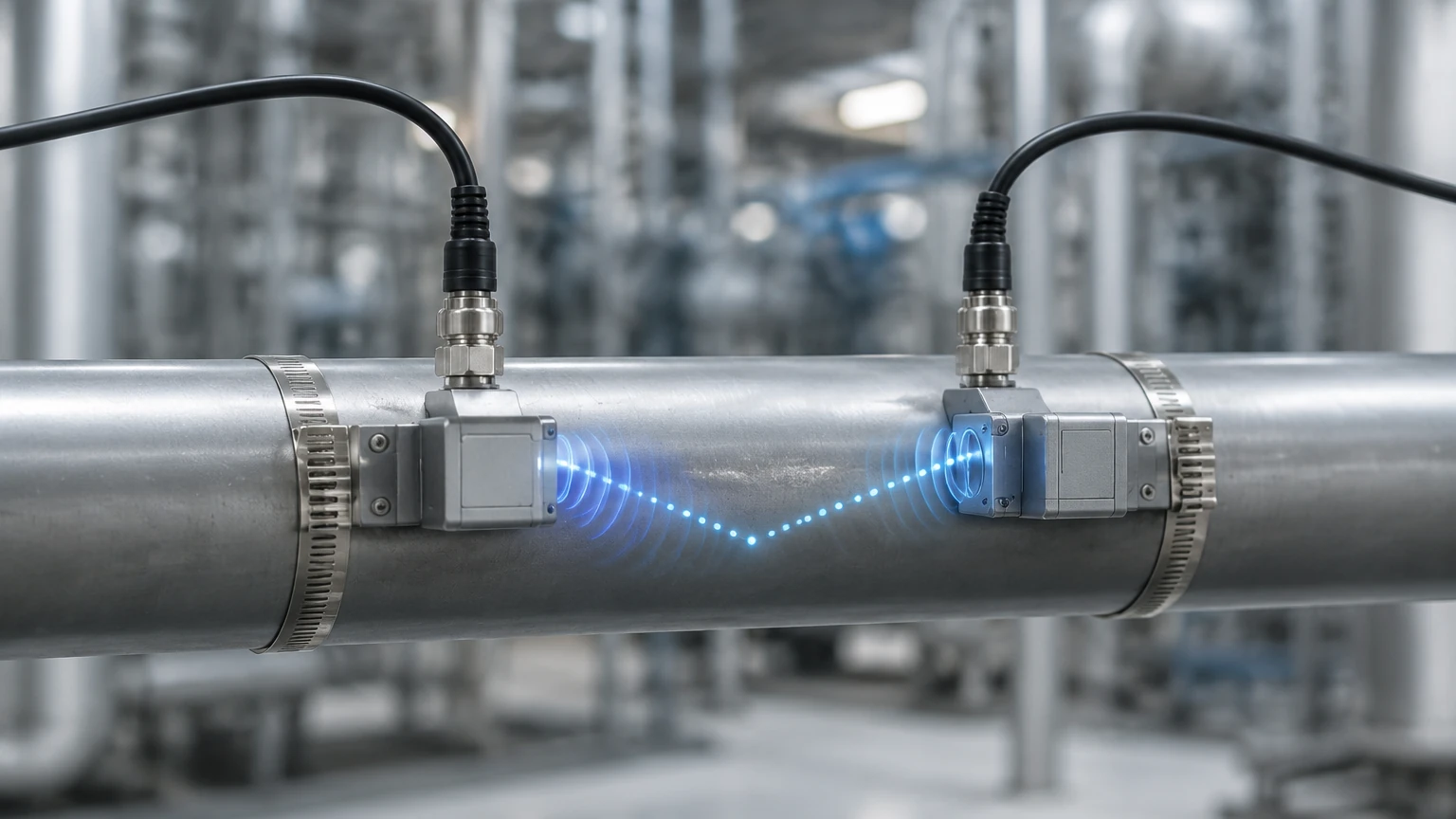
This is the most common method for measuring clean liquids. The system uses a pair of transducers, both acting as transmitters and receivers. One transducer is mounted upstream and the other downstream. The device measures the time it takes for an ultrasonic pulse to travel between them in both directions.
When the fluid is moving, the pulse traveling with the flow (downstream) reaches the second transducer faster than the pulse traveling against the flow (upstream) reaches the first. This time difference (Δt) is directly proportional to the velocity of the fluid. The internal processor calculates the flow velocity based on this time difference, the distance between transducers, and the angle of the signal path. For high accuracy, the fluid must be relatively free of suspended solids or entrained gases, typically containing less than 2% by volume.
Doppler Effect Method
The Doppler method is designed for fluids that contain "reflectors," such as suspended solids, sediment, or air bubbles. The meter transmits an ultrasonic signal of a known frequency into the fluid. This signal reflects off the moving particles or bubbles and returns to a receiver.
According to the Doppler principle, the frequency of the reflected signal shifts in proportion to the velocity of the reflecting objects. By measuring this frequency shift, the ultrasonic flowmeter determines the flow rate of the carrier liquid. This method is ideal for wastewater, slurries, and aerated liquids where transit-time signals would otherwise be scattered or absorbed.
Transit-Time vs. Doppler Effect: Which One to Choose?
Selecting the correct principle is the first step in ensuring measurement reliability. The following table highlights the primary differences and application suitability.
| Feature | Transit-Time Flowmeter | Doppler Flowmeter |
| :— | :— | :— |
| Fluid Type | Clean liquids, deionized water, oils | Slurries, wastewater, aerated liquids |
| Solid Content | < 2% by volume | > 100 ppm of 75-micron particles |
| Accuracy | High (0.5% to 1.0% of rate) | Moderate (2% to 5% of full scale) |
| Pipe Sizes | 15 mm to over 5000 mm | 25 mm to 3000 mm |
| Primary Benefit | High precision in clean fluids | Ability to measure "dirty" fluids |
Key Evaluation Criteria for Selection
When evaluating an ultrasonic flowmeter for a specific project, several technical parameters must be confirmed to ensure the device performs within its specified accuracy limits.
Pipe Material and Condition
Ultrasonic waves must pass through the pipe wall. While materials like carbon steel, stainless steel, and most plastics are excellent conductors, pipes with internal liners (like cement or rubber) or heavy internal scaling can interfere with signal transmission. It is vital to know the pipe material, wall thickness, and whether any delamination of the liner has occurred.
Fluid Characteristics
Beyond the clean vs. dirty distinction, the fluid’s sonic velocity must be considered. Most modern meters, including those offered by Main Page, come pre-programmed with the sonic velocities of common liquids (water, alcohol, oil). However, if the fluid is a proprietary chemical blend, its acoustic properties should be verified.
Temperature and Pressure
Extreme temperatures can affect the transducer's piezoelectric crystals and the coupling material used to attach them to the pipe. Standard transducers usually operate up to 80°C (176°F), while high-temperature versions can reach 200°C (392°F) or higher. Pressure is generally not a concern for clamp-on models but is a critical factor for inline (wetted) models.
Installation Guidelines for Optimal Accuracy
The performance of an ultrasonic flowmeter is heavily dependent on the installation environment. Even the most advanced sensor will fail to provide accurate data if placed in a turbulent flow zone.
Straight Pipe Requirements
To ensure a stable, laminar flow profile, the meter requires a certain length of straight pipe before and after the installation point.
* Upstream: Minimum 10D (10 times the nominal pipe diameter).
* Downstream: Minimum 5D (5 times the nominal pipe diameter).
If there are pumps, valves, or multiple elbows nearby, the upstream requirement may increase to 20D or 30D to allow the flow profile to stabilize.
Transducer Mounting Configurations
For clamp-on transit-time meters, there are three common mounting methods:
1. V-Method: The signal crosses the pipe twice. This is the standard for pipe diameters from 25 mm to 400 mm.
2. Z-Method: The transducers are mounted on opposite sides of the pipe, and the signal crosses once. This is used for large pipes (above 400 mm) or where the fluid is slightly attenuating.
3. W-Method: The signal crosses the pipe four times. This is used for very small pipes (15 mm to 50 mm) to increase the transit time for better resolution.
Coupling and Surface Preparation
For clamp-on sensors, the interface between the transducer and the pipe must be free of air gaps. The pipe surface should be sanded smooth and cleaned of rust or paint flakes. A coupling agent (typically a silicone grease or ultrasonic gel) is applied to ensure a seamless acoustic path. In permanent installations, solid coupling pads or specialized epoxy may be used.
Common Risks and Limitations
While the ultrasonic flowmeter offers significant advantages—such as zero pressure drop and no risk of leakage—it is not a universal solution for every application. Engineers should be aware of the following risks:
* Signal Attenuation: Highly viscous liquids or those with high concentrations of fine bubbles can absorb the ultrasonic signal, leading to a "signal lost" error.
* Pipe Wall Interference: In very old pipes, heavy corrosion or pitting on the interior wall can scatter the signal, making it impossible to get a reliable reading.
* Flow Profile Distortion: If the meter is installed too close to a partially closed valve or a pump discharge, the resulting turbulence will cause erratic readings.
* Environmental Noise: High-frequency vibration from nearby machinery can occasionally interfere with the ultrasonic sensors, though digital signal processing (DSP) in modern Welk instruments mitigates much of this risk.
Maintenance and Long-term Reliability
One of the primary selling points of ultrasonic technology is the lack of maintenance. Since there are no moving parts to wear out, the primary maintenance task for clamp-on systems is periodically checking the coupling grease. Over several years, grease can dry out or be washed away in outdoor environments, leading to signal degradation. Re-applying the coupling agent and checking the tightness of the mounting straps is usually sufficient to restore performance.
For inline ultrasonic meters, maintenance is similarly minimal, though the internal flow tube should be checked for scaling if the fluid is prone to mineral deposits.
Frequently Asked Questions (FAQs)
Q: Can an ultrasonic flowmeter measure gas flow?
A: While this article focuses on liquid measurement, specialized ultrasonic gas flowmeters exist. They operate on similar transit-time principles but require much higher frequency transducers and more sensitive electronics due to the low density of gas.
Q: Does the pipe need to be full for the meter to work?
A: Yes. For accurate volume flow measurement, the pipe must be completely full. If the pipe is partially full, the meter will calculate the velocity of the fluid, but the cross-sectional area used for the volume calculation will be incorrect, leading to significant errors.
Q: How does pipe wall thickness affect the measurement?
A: In transit-time measurement, the device must calculate the time the signal spends traveling through the pipe wall versus the fluid. An incorrect wall thickness entry in the setup menu is one of the most common causes of measurement error.
Q: Can I use a clamp-on meter on a plastic pipe?
A: Yes, ultrasonic signals travel well through most plastics, including PVC, PE, and PP. However, ensure the pipe is not a composite material with air gaps between layers, as air is a poor conductor of ultrasound.
Conclusion
The ultrasonic flowmeter represents a sophisticated blend of acoustic science and digital processing, offering a non-invasive, highly accurate method for monitoring industrial fluids. By understanding the distinction between transit-time and Doppler methods and adhering to strict installation protocols regarding straight pipe runs and surface preparation, operators can achieve long-term measurement stability.
Whether you are managing a water distribution network or a chemical dosing line, selecting a high-quality instrument is paramount. For more information on technical specifications and to explore a wide range of industrial measurement solutions, visit the Main Page to review product options and application support provided by Welk's engineering team.