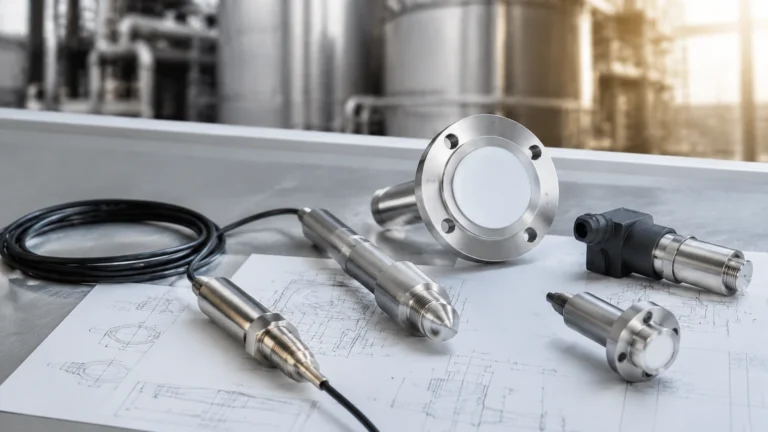
Vegason 61
Vegason 61
In the field of industrial process control, selecting the appropriate level measurement technology is critical for operational efficiency and safety. The Vegason 61 is a widely recognized ultrasonic sensor designed for the non-contact level measurement of liquids and bulk solids. Particularly suited for small vessels and open basins, this instrument utilizes the time-of-flight principle to determine the distance between the sensor and the medium surface. As a professional manufacturer, Welk provides these technical insights to help engineers understand the capabilities, limitations, and installation requirements of ultrasonic technology compared to other industrial solutions available on our Main Page.
Principles of Ultrasonic Level Measurement
To effectively implement the Vegason 61, one must first understand the physics of ultrasonic measurement. The sensor contains a piezoelectric transducer that converts electrical energy into mechanical vibrations. These vibrations generate high-frequency sound pulses—typically in the range of 30 kHz to 70 kHz—which are emitted toward the medium.
The Time-of-Flight Mechanism
When the sound wave encounters the surface of the liquid or solid, a portion of the energy is reflected back toward the sensor as an echo. The sensor then switches to a receiving mode to detect this return signal. The electronics within the device measure the time interval ($t$) between the emission of the pulse and the reception of the echo.
Since the speed of sound in air ($v$) is approximately 343 m/s at 20°C, the distance ($d$) to the product surface is calculated using the formula:
$$d = \frac{v \times t}{2}$$
The level of the tank is then derived by subtracting this distance from the total height of the vessel (the calibration point). Because the speed of sound is highly dependent on air temperature, the Vegason 61 includes an integrated temperature sensor to compensate for these fluctuations, ensuring consistent accuracy across its operating range.
The Concept of the Blocking Distance
A critical characteristic of all ultrasonic sensors, including the Vegason 61, is the "blocking distance" or "dead zone." This is the area immediately below the transducer face where the sensor cannot accurately measure. This occurs because the transducer requires a finite amount of time to stop vibrating after emitting a pulse before it can begin listening for an echo. For the Vegason 61, this distance is typically 0.25 meters (approx. 10 inches). If the medium enters this zone, the sensor may produce erratic readings or a "high level" error signal.
Technical Specifications and Performance
The Vegason 61 is engineered for light-to-medium duty applications. Its design emphasizes compact dimensions and ease of integration into existing PLC (Programmable Logic Controller) systems.
| Feature | Specification |
| :— | :— |
| Measuring Range (Liquids) | Up to 5.0 m (16.4 ft) |
| Measuring Range (Solids) | Up to 2.0 m (6.56 ft) |
| Process Temperature | -40°C to +80°C |
| Process Pressure | -0.2 to +2 bar (-20 to +200 kPa) |
| Accuracy | ± 4 mm |
| Beam Angle | 10° |
| Materials (Wetted Parts) | PVDF, EPDM |
| Output Signal | 4…20 mA/HART |
These specifications make the device an ideal candidate for water treatment facilities, chemical dosing skids, and small storage tanks. However, for applications involving high pressure or extreme temperatures, engineers often turn to radar level meters, which are not dependent on a medium for signal propagation. You can explore these high-performance alternatives on the Welk Main Page.
Application Suitability and Selection Criteria
Choosing the Vegason 61 requires an analysis of the process environment. While ultrasonic technology is cost-effective, it is sensitive to the atmosphere through which the sound travels.
Ideal Applications
1. Water and Wastewater: Monitoring levels in open channels, flumes, and wet wells. The non-contact nature prevents sensor fouling from sewage or debris.
2. Chemical Storage: Measuring acids and bases in plastic or metal tanks where the medium is compatible with PVDF (Polyvinylidene fluoride).
3. Small Buffer Tanks: Precise control in vessels where the total height does not exceed 5 meters.
Selection Table: Ultrasonic vs. Other Technologies
| Process Condition | Vegason 61 (Ultrasonic) | Radar (80 GHz) | Hydrostatic Transmitter |
| :— | :— | :— | :— |
| Heavy Foam | Poor (Absorbs sound) | Moderate/Good | Excellent |
| Vacuum Conditions | Impossible | Excellent | Good |
| Dust/Steam | Moderate (Scatters signal) | Excellent | Excellent |
| Cost | Low | Moderate/High | Moderate |
| Installation | Top-mounted | Top-mounted | Bottom/Side-mounted |
Installation Guidelines and Best Practices
Proper mechanical installation is the most significant factor in the reliability of a Vegason 61. Because the ultrasonic pulse spreads out in a cone (10° beam angle), the path must be kept clear of obstructions.
Mounting Position
* Avoid the Center: Do not mount the sensor in the exact center of a domed tank top, as this can concentrate multiple reflections (parabolic effect) and cause signal interference.
* Distance from Wall: The sensor should be placed at a distance from the tank wall of at least 200 mm for every meter of depth to avoid false echoes from wall seams or build-up.
* Nozzle Length: If mounting in a nozzle, the bottom of the sensor transducer must extend at least 10 mm past the bottom of the nozzle to prevent the pulse from reflecting off the nozzle edges.
Avoiding Obstructions
Internal tank structures such as ladders, heating coils, or agitators will reflect the ultrasonic signal. If these cannot be moved, the Vegason 61 software allows for "false signal suppression," where the sensor is taught to ignore echoes at specific distances. However, it is always better to provide a clear "Line of Sight" to the medium.
Turbulence and Inflow
The sensor should not be mounted directly above the tank's filling inlet. The turbulence of the incoming liquid and the presence of air bubbles can dissipate the ultrasonic pulse, leading to signal loss. If the surface is extremely turbulent, a stilling well (a vertical pipe) can be used to provide a calm surface for measurement.

Limitations and Environmental Factors
While the Vegason 61 is robust, engineers must account for the following physical limitations:
1. Vapor Layers and Gases: If the tank contains a gas other than air (e.g., Nitrogen or Carbon Dioxide), the speed of sound will change significantly. For instance, sound travels slower in $CO_2$ than in air, which would cause the sensor to report a level lower than the actual value unless calibrated for that specific gas.
2. Foam: Heavy, thick foam acts as an acoustic insulator, absorbing the pulse rather than reflecting it. In such cases, ultrasonic sensors are generally unsuitable.
3. Temperature Gradients: If there is a significant temperature difference between the sensor and the liquid surface (e.g., a heated tank), the sound wave will refract (bend), potentially missing the receiver or providing inaccurate timing.
4. Pressure: Ultrasonic sensors rely on the mechanical movement of the transducer face. High pressure (above 2 bar) dampens this movement, significantly reducing the effective range and accuracy.
Comparison with Welk Industrial Solutions
At Welk, we recognize that while the Vegason 61 is an excellent tool for specific ranges, many industrial processes require higher precision or resistance to harsher environments. For example, our high-frequency radar level meters operate at 80 GHz, allowing for a much narrower beam angle (as low as 3°) and the ability to penetrate steam and dust that would baffle an ultrasonic sensor.
Furthermore, for deep wells or pressurized vessels where top-mounting is impractical, Welk provides hydrostatic level transmitters. These measure the head pressure of the liquid column and are unaffected by surface foam or vapor layers. For a full comparison of these technologies and to find the right fit for your project, visit our Main Page.
Frequently Asked Questions (FAQs)
Q: Can the Vegason 61 be used for solids measurement?
A: Yes, but with a reduced range. Because solids (like plastic pellets or grains) are not as reflective as liquids and often form conical piles, the effective range is limited to approximately 2 meters. The sensor must also be mounted with a swiveling holder to aim the beam perpendicular to the slope of the material.
Q: What happens if the medium reaches the sensor face?
A: This is known as entering the blocking distance. The sensor will typically output an error code or a maximum mA signal. It is recommended to install the sensor high enough so that the maximum possible liquid level remains at least 0.25m below the transducer.
Q: Does the sensor require regular maintenance?
A: Generally, no. Because it is non-contact, there is no wear and tear. However, in applications with heavy condensation or crystallization, the transducer face should be checked periodically and cleaned with a soft cloth and mild detergent if necessary.
Q: How do I calibrate the Vegason 61?
A: Calibration is typically performed via the built-in display and adjustment module (PLICSCOM) or via a PC using DTM/FDT software. You define the "Min" (0% level) and "Max" (100% level) distances from the sensor face.
Conclusion
The Vegason 61 remains a staple for simple, non-contact level monitoring in the water and chemical industries. By understanding the time-of-flight principle and respecting the physical constraints of ultrasonic waves—such as the blocking distance and the impact of foam—engineers can achieve reliable results. For applications that exceed the 5-meter range or involve complex process conditions, exploring advanced radar or hydrostatic solutions is recommended. Comprehensive technical data and customized OEM services for these alternative instruments are available through the Welk Main Page.