Wastewater Control Panels
Wastewater Control Panels
In the realm of industrial and municipal water management, wastewater control panels serve as the centralized intelligence for lift stations, treatment plants, and drainage systems. These panels are engineered to automate the complex task of managing pumps, monitoring fluid levels, and ensuring system safety. By integrating sophisticated logic with robust electrical components, wastewater control panels prevent overflows, optimize energy consumption, and extend the service life of expensive pumping equipment.
Effective wastewater management begins with accurate data. For a control panel to function correctly, it must receive reliable input from level measurement instruments. As a professional manufacturer, Welk provides the foundational sensing technology—including radar, ultrasonic, and hydrostatic sensors—that allows these panels to make real-time operational decisions. Understanding the synergy between sensing technology and control logic is essential for any engineer or facility manager designing a wastewater infrastructure.
Level Measurement Principles for Automation
Before selecting or configuring wastewater control panels, it is critical to understand the measurement principles that drive their logic. The choice of sensor directly impacts the panel’s design and its ability to handle specific environmental challenges such as foam, turbulence, or corrosive vapors.
Non-Contact Ultrasonic Measurement
Ultrasonic sensors emit high-frequency sound pulses that reflect off the surface of the wastewater. By measuring the time-of-flight of these pulses, the sensor calculates the distance to the liquid. This is a popular choice for many wastewater control panels because the sensor does not come into contact with the often-contaminated medium. However, ultrasonic waves can be affected by heavy foam or significant temperature fluctuations, which may require the control panel to have built-in signal filtering logic.
Radar Level Technology
For more demanding applications, 80GHz radar level meters offer superior precision. Unlike ultrasonic waves, radar pulses are electromagnetic and are not influenced by air temperature, pressure, or vapor. In a wastewater sump where steam or chemical fumes are present, radar provides a stable 4-20mA or RS485 signal to the control panel. This ensures that the pump start/stop commands are based on accurate data, even in turbulent conditions.
Hydrostatic Pressure Sensing
Hydrostatic level transmitters are submerged at the bottom of a tank or well. They measure the pressure exerted by the liquid column above them. This principle is highly effective for deep lift stations where surface foam might interfere with top-down sensors. The control panel converts the pressure reading (e.g., bar or psi) into a linear level measurement (meters or feet). To explore various sensing options that integrate with these systems, you can review product options and application support on our Main Page.
Key Components of Wastewater Control Panels
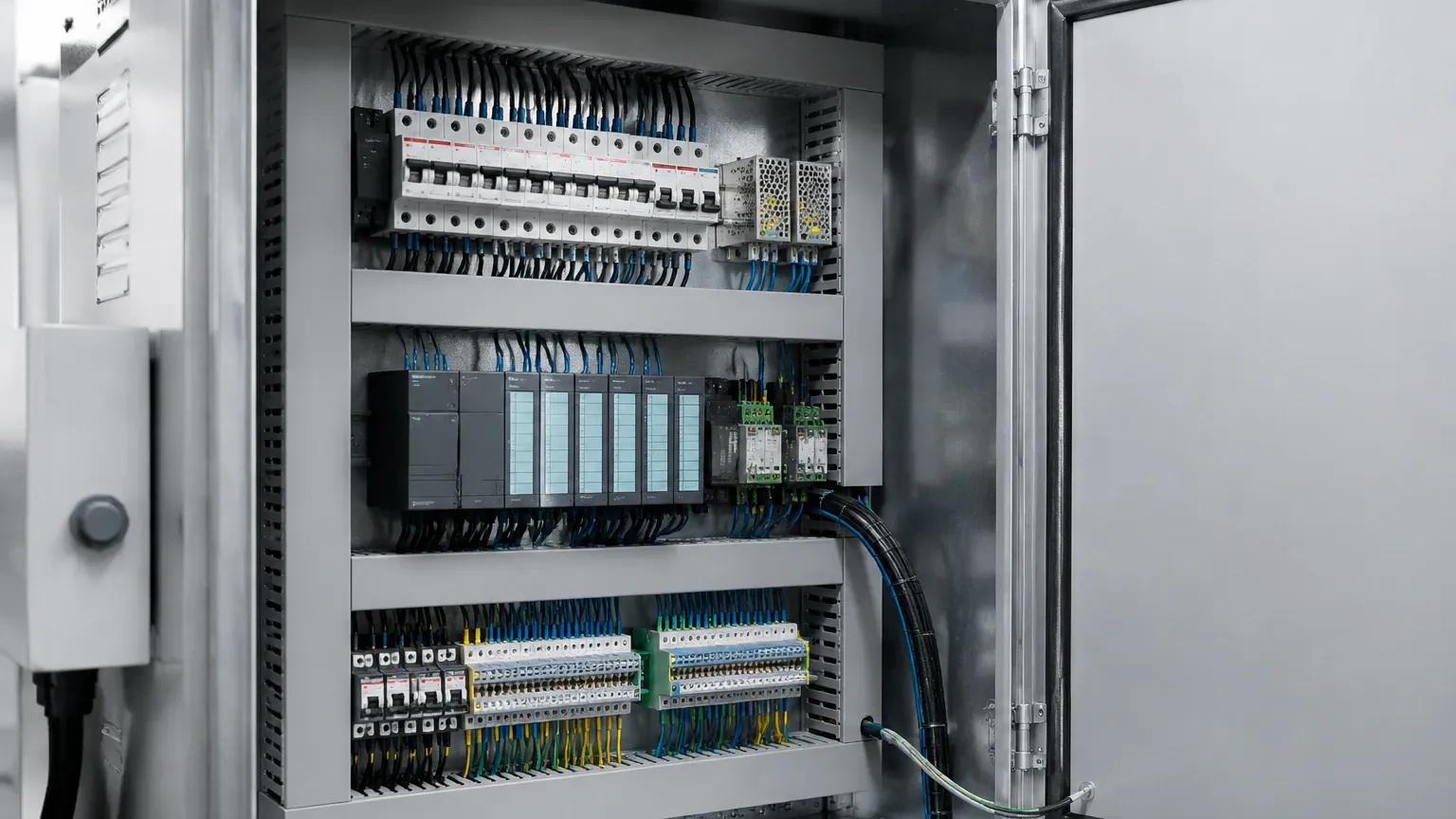
A standard industrial wastewater control panel is an assembly of several critical components, each serving a specific role in the automation loop.
1. The Controller (PLC or Logic Relay): The "brain" of the panel. It receives signals from level sensors and executes programmed logic to start or stop pumps. Advanced panels use Programmable Logic Controllers (PLCs) to allow for complex pump alternation and data logging.
2. Motor Starters and VFDs: These components provide the power to the pumps. Variable Frequency Drives (VFDs) are increasingly common in wastewater control panels as they allow pumps to ramp up slowly, reducing water hammer and energy spikes.
3. Human-Machine Interface (HMI): A touchscreen or digital display that allows operators to view real-time levels, adjust setpoints, and acknowledge alarms without opening the high-voltage section of the panel.
4. Alarm Systems: Visual (strobes) and audible (horns) indicators that trigger during high-level events or pump failures. Many modern panels also include cellular or Ethernet gateways for remote telemetry.
5. Circuit Protection: Breakers, fuses, and surge protectors ensure that the internal electronics and the external pumps are shielded from electrical faults.
Selection Criteria and Technical Specifications
Choosing the right wastewater control panel requires an evaluation of the specific site requirements. The following table provides a comparison of common panel configurations based on application complexity.
Selection Comparison Table
| Feature | Simplex Panel | Duplex Panel | Advanced PLC Panel |
| :— | :— | :— | :— |
| Application | Small sumps / Single pump | Standard lift stations | Large treatment plants |
| Pump Control | Single pump (On/Off) | Two pumps (Alternating) | Multi-pump (Lead/Lag/Standby) |
| Level Input | Float switches | Floats or 4-20mA Analog | Radar / Ultrasonic / Hydrostatic |
| Data Logging | None | Basic hour meters | Full trend analysis & SCADA |
| Enclosure | NEMA 4X (Polycarbonate) | NEMA 4X (Stainless/FRP) | NEMA 4X or 12 (Climate controlled) |
| Communication | Local alarm only | Optional Modbus | Integrated IoT / Ethernet / Cellular |
Environmental Ratings
Since wastewater environments are often humid and corrosive, the enclosure rating is paramount. Most wastewater control panels are rated NEMA 4X or IP66. This ensures the panel is watertight and resistant to corrosion from hydrogen sulfide (H2S) gases commonly found in sewage systems. Stainless steel or fiberglass-reinforced polyester (FRP) are the preferred materials for these enclosures.
Installation Best Practices and Considerations
Proper installation is as important as the hardware itself. Failure to follow engineering best practices can lead to premature component failure or inaccurate level readings.
* Sensor Positioning: When using ultrasonic or radar sensors with a control panel, ensure the sensor has a clear "view" of the liquid surface. Avoid mounting sensors directly above the inflow pipe, as the falling water will create turbulence and false readings.
* Wiring and Shielding: Analog signals (4-20mA) from level meters should be run in shielded cables to prevent electromagnetic interference (EMI) from the pump power lines. Ensure the shield is grounded only at the panel end to avoid ground loops.
* Intrinsically Safe Barriers: If the wastewater pit is classified as a hazardous area (Class I, Div 1 or ATEX Zone 0), the control panel must include intrinsically safe barriers. These limit the energy sent to the sensors in the pit, preventing any potential spark from causing an explosion.
* Ventilation: In warmer climates, the heat generated by VFDs inside the panel can lead to overheating. Proper ventilation or even small air conditioning units may be necessary to maintain an internal temperature below 40°C (104°F).
Limitations and Common Operational Challenges
While wastewater control panels are designed for reliability, they are not immune to challenges. Understanding these limitations helps in designing a more resilient system.
* Fats, Oils, and Grease (FOG): In municipal sewage, FOG can build up on float switches and hydrostatic sensors. This "ragging" can cause floats to stick in the up or down position, leading to pump failure or dry running. This is why non-contact sensors like radar are often preferred in high-FOG environments.
* Power Surges: Lift stations are often located in remote areas prone to lightning strikes. Without robust surge protection within the wastewater control panels, the sensitive PLC and level meter electronics are at high risk.
* Sensor Dead Zones: Every ultrasonic and radar sensor has a "dead zone" or "blocking distance" (typically 0.2m to 0.5m). If the wastewater rises into this zone, the panel may receive an erroneous signal. The panel logic should be programmed to recognize these values as a high-level alarm state.
Frequently Asked Questions (FAQs)
Q: Can I use a wastewater control panel with different types of sensors simultaneously?
A: Yes. Many engineers design systems with a primary analog sensor (like a Welk radar meter) for continuous level control and secondary float switches for high-level and low-level redundant alarms. This provides a safety net in case the primary sensor fails.
Q: What is pump alternation and why is it important?
A: In a duplex (two-pump) panel, alternation ensures that both pumps receive equal wear. The panel logic switches the "lead" pump every cycle. If one pump cannot keep up with the inflow, the "lag" pump is activated to assist.
Q: How do I handle corrosive gases inside the panel?
A: While the enclosure protects against external gases, internal components can be protected by using sealed relays and ensuring that conduit entries from the wet well are properly sealed with gas-tight potting compound to prevent H2S from migrating into the panel.
Q: Is it better to use a VFD or a standard starter in my panel?
A: VFDs are better for reducing mechanical stress and energy costs, especially in systems with varying flow rates. However, for simple, constant-flow applications, a standard across-the-line starter or soft starter may be more cost-effective.
By integrating high-quality level measurement instruments with well-designed wastewater control panels, operators can ensure a reliable, efficient, and safe wastewater management system. Whether utilizing hydrostatic, ultrasonic, or radar technology, the goal remains the same: precise control for a cleaner environment.