Water Level Monitoring Sensor
Water Level Monitoring Sensor
In industrial automation and process control, the water level monitoring sensor serves as a critical component for ensuring operational safety, efficiency, and resource management. Whether managing municipal wastewater, monitoring cooling towers in a power plant, or controlling chemical storage tanks, selecting the appropriate sensing technology is fundamental to system reliability. This guide examines the primary measurement principles, selection criteria, and installation best practices for industrial water level monitoring.
Measurement Principles of Water Level Sensors
Before selecting a water level monitoring sensor, it is essential to understand the physics behind the different measurement technologies. Each method interacts with the liquid and the environment differently, affecting its suitability for specific applications.
Hydrostatic Pressure Measurement
Hydrostatic level sensors operate on the principle that the pressure at a specific point in a static liquid is proportional to the height of the liquid column above it. The relationship is defined by the formula: $P = \rho \cdot g \cdot h$, where $P$ is pressure, $\rho$ (rho) is the density of the liquid, $g$ is the gravitational constant, and $h$ is the height of the liquid.
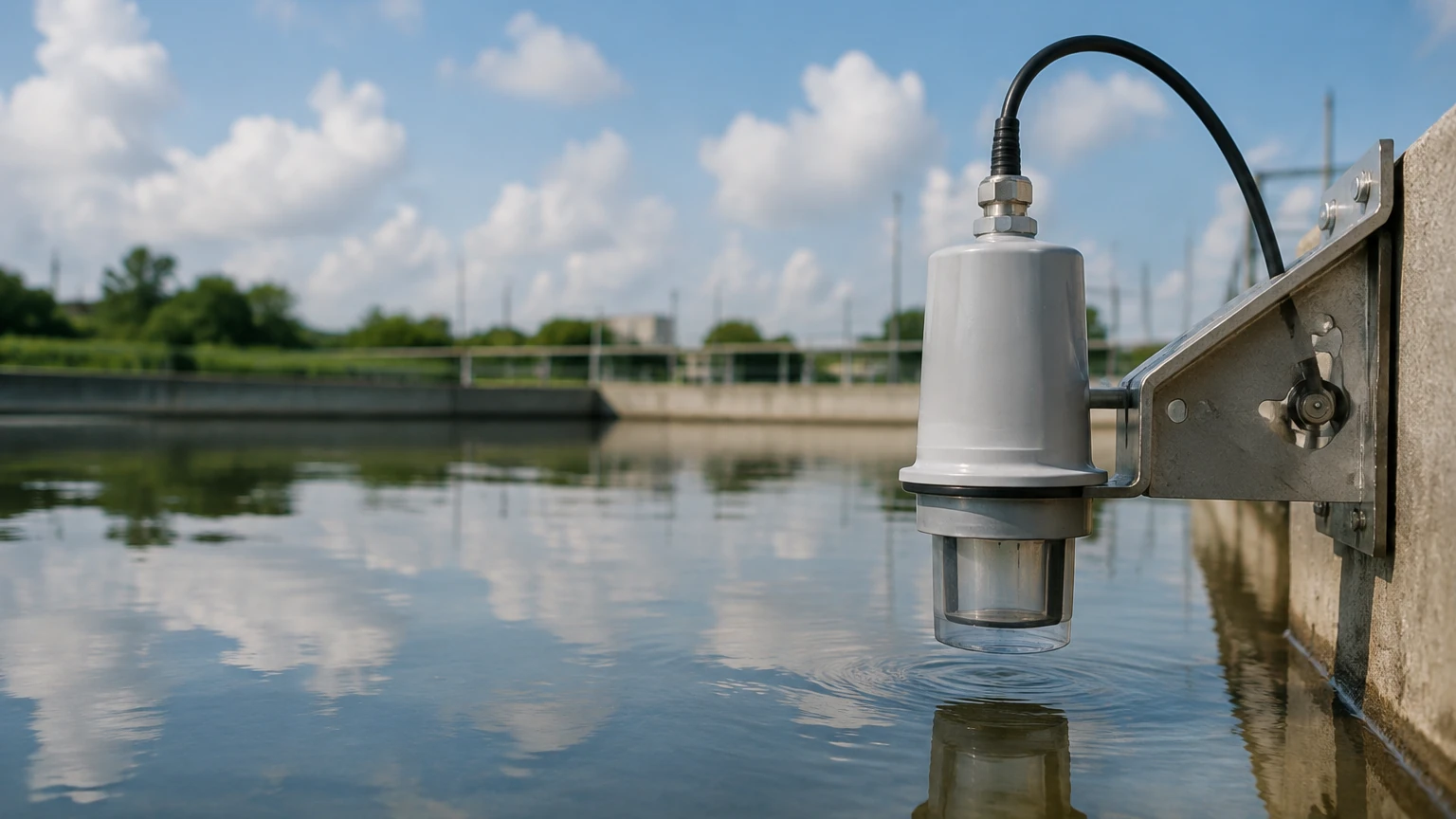
Submersible pressure transducers are lowered to the bottom of a tank or well. They measure the pressure exerted by the water and convert it into an electrical signal (typically 4-20mA). Because they rely on density, any significant change in water temperature or salinity that alters density will affect accuracy unless compensated.
Ultrasonic (Time-of-Flight)
Ultrasonic sensors are non-contact devices that emit high-frequency sound waves from a transducer mounted at the top of a vessel. The waves travel through the air, reflect off the water surface, and return to the sensor. The distance is calculated based on the time it takes for the pulse to return: $D = (c \cdot t) / 2$, where $c$ is the speed of sound and $t$ is the time.
These sensors are popular because they do not touch the media, reducing maintenance in corrosive or dirty water. However, the speed of sound is affected by air temperature, requiring built-in temperature compensation.
Radar (Microwave) Technology
Radar level meters use electromagnetic waves rather than sound. Like ultrasonic sensors, they use the time-of-flight principle. However, radar waves travel at the speed of light and are largely unaffected by air temperature, pressure, or the presence of dust and steam.
There are two main types: Guided Wave Radar (GWR), which uses a probe to direct the signal, and Non-contact Radar (Pulse or FMCW). Radar is often considered the gold standard for high-accuracy industrial applications, particularly where the surface may be turbulent or the atmosphere above the liquid is volatile.
Capacitance and Conductivity
Conductivity sensors use electrodes to detect the presence of water at specific points. When water touches the probe, it completes an electrical circuit, making this technology ideal for point-level detection (high/low alarms). Capacitance sensors measure the change in electrical capacitance between two electrodes (or one electrode and the tank wall) as the water level rises. These are contact-based and are often used in smaller tanks or specialized chemical applications.
Selection Criteria for Industrial Applications
Choosing the right water level monitoring sensor requires an evaluation of the physical environment and the specific requirements of the process. For a comprehensive overview of available technologies, engineers often consult a Main Page of industrial instrumentation to compare specifications.
Key factors to consider include:
1. Measurement Range: Submersible sensors are excellent for deep wells (up to 200m or more), while ultrasonic sensors are typically limited to 15–30m depending on the transducer power.
2. Media Characteristics: Is the water clean, or does it contain solids (sludge)? Is it corrosive? Non-contact sensors (Radar/Ultrasonic) are preferred for aggressive chemicals or wastewater to avoid sensor fouling.
3. Process Conditions: High temperatures and pressures can disqualify ultrasonic sensors. Radar or high-specification hydrostatic sensors are better suited for pressurized vessels.
4. Accuracy Requirements: Radar typically offers the highest precision (often within ±2mm), whereas hydrostatic and ultrasonic sensors generally offer accuracy in the range of 0.25% to 0.5% of the span.
5. Installation Constraints: Does the tank have internal obstructions like agitators or ladders? Radar with narrow beam angles can often ignore these, while ultrasonic waves might reflect off them.
Technical Comparison Table
| Technology | Contact Type | Accuracy | Max Range (Typical) | Ideal Environment |
| :— | :— | :— | :— | :— |
| Hydrostatic | Contact | High (0.1% – 0.5%) | 200m+ | Deep wells, open reservoirs, vented tanks |
| Ultrasonic | Non-contact | Moderate (0.25%) | 15m – 30m | Wastewater pits, open channels, clean water tanks |
| Radar | Non-contact | Very High (±2mm) | 30m – 100m | Chemical storage, pressurized vessels, foam/steam |
| Capacitance | Contact | Moderate | 5m | Small tanks, oil-water interface detection |
Installation Considerations
Proper installation is as critical as sensor selection. Even the most advanced water level monitoring sensor will fail to provide accurate data if installed incorrectly.
For Submersible Sensors
* Venting: Hydrostatic sensors must be vented to the atmosphere via a capillary tube in the cable to compensate for changes in barometric pressure. Ensure the vent filter is kept dry.
* Still Wells: In turbulent water (like a flowing river or a tank with an agitator), install the sensor inside a still well (a pipe with small holes) to prevent mechanical damage and signal noise.
* Cable Protection: Ensure the cable jacket is compatible with the fluid. Use a cable clamp to support the weight of the sensor and prevent strain on the electrical connections.
For Non-contact Sensors (Radar/Ultrasonic)
* Dead Band (Blocking Distance): All non-contact sensors have a minimum distance near the transducer where they cannot measure. Ensure the sensor is mounted high enough that the water level never enters this zone.
* Beam Angle: Understand the spread of the signal. If the beam hits a tank wall or a pipe before reaching the water, it will produce a false reading.
* Orientation: The sensor face must be perfectly parallel to the water surface to ensure the maximum signal return.
Limitations and Common Risks
While modern sensors are robust, certain conditions can compromise their performance:
* Foam: Heavy foam on the water surface absorbs ultrasonic signals and can scatter radar waves. For foamy applications, Guided Wave Radar or hydrostatic sensors are usually more reliable.
* Turbulence: Rapidly moving water surfaces can cause fluctuating readings. Digital signal processing (damping) can help, but physical still wells are often necessary.
* Vapor and Condensation: In closed tanks, condensation can form on the face of an ultrasonic transducer, "blinding" the sensor. Many industrial radar sensors use PTFE lenses that shed droplets to mitigate this.
* Build-up: In wastewater applications, grease or biological growth can accumulate on contact-based probes, leading to drift or failure. Regular cleaning cycles or switching to non-contact methods are the standard solutions.
Frequently Asked Questions (FAQ)
Q: Can I use an ultrasonic sensor in a vacuum?
No. Ultrasonic sensors require air (or another gas) to transmit sound waves. In a vacuum, there is no medium for the sound to travel through. Radar is the appropriate non-contact choice for vacuum applications.
Q: How often should a hydrostatic water level monitoring sensor be calibrated?
In most clean water applications, annual calibration is sufficient. However, in wastewater or corrosive environments, semi-annual checks are recommended to ensure the diaphragm has not been compromised or coated with debris.
Q: What is the difference between 26GHz and 80GHz radar?
80GHz radar uses a much higher frequency, which results in a narrower beam angle and better signal focus. This makes it easier to install in narrow tanks or vessels with internal obstructions compared to 26GHz models.
Q: Is a vented cable always necessary for hydrostatic sensors?
If you are measuring a sealed, pressurized tank, you would use a differential pressure sensor instead of a vented submersible sensor. For open tanks or wells, a vented cable is necessary to cancel out the effects of weather-related atmospheric pressure changes.
Conclusion
Effective water level monitoring is a balance between technological capability and application requirements. By understanding the principles of hydrostatic pressure, ultrasonic reflection, and radar microwaves, engineers can specify solutions that minimize maintenance and maximize uptime. For those in the planning stages of a project, reviewing detailed product options and application support on a professional Main Page is a recommended next step to ensure all environmental variables are addressed. Accurate measurement not only protects equipment but also ensures the sustainability of water resources across industrial sectors.