Factory Performance Improvement Food and Beverage
Factory Performance Improvement Food and Beverage
In the modern industrial landscape, factory performance improvement food and beverage operations rely heavily on the precision and reliability of process instrumentation. Level measurement, often overlooked as a basic utility, serves as a critical data point for inventory management, batch consistency, and waste reduction. For engineers and plant managers, selecting the correct level sensor is not merely a procurement task but a strategic decision that impacts the overall Equipment Effectiveness (OEE) and bottom-line profitability.
Achieving factory performance improvement food and beverage requires a shift from reactive maintenance to proactive process optimization. This guide explores how advanced level measurement technologies—ranging from non-contact radar to hydrostatic pressure transmitters—provide the foundational data necessary to streamline production and ensure compliance with stringent hygiene standards.
Core Principles of Level Measurement in F&B
Before selecting a device for factory performance improvement food and beverage, it is essential to understand the physical principles governing different measurement technologies. Each method has distinct advantages depending on the medium, vessel geometry, and environmental conditions.
1. Radar Level Measurement (FMCW and Pulse)
Radar level meters operate by emitting electromagnetic waves toward the product surface. The time-of-flight between emission and reception is used to calculate the distance. In the food industry, 80GHz Frequency Modulated Continuous Wave (FMCW) radar is increasingly preferred. This technology offers a narrow beam angle, allowing it to ignore internal tank obstructions like agitators or spray balls.
* Principle: Non-contact electromagnetic wave reflection.
* Advantages: Unaffected by temperature fluctuations, pressure, or vacuum. It can penetrate steam and dust, making it ideal for boiling liquids or grain silos.
2. Ultrasonic Level Sensors
Ultrasonic sensors function by emitting high-frequency sound waves. The sensor measures the time it takes for the echo to return from the surface of the liquid or solid.
* Principle: Mechanical sound wave reflection.
* Advantages: Cost-effective and easy to install. Best suited for water treatment applications or stable liquid storage where foam and vapor are minimal.
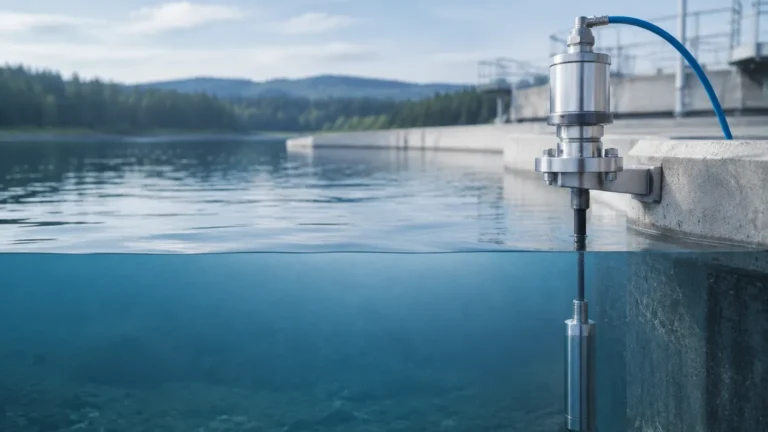
3. Hydrostatic Level Transmitters
These sensors measure the pressure exerted by a liquid column. Since pressure is directly proportional to the height of the liquid and its specific gravity, the level can be calculated with high accuracy.
* Principle: $P = \rho \cdot g \cdot h$ (Pressure = Density × Gravity × Height).
* Advantages: Highly reliable for homogeneous liquids in vented or pressurized tanks. When equipped with flush diaphragms, they meet strict sanitary requirements.
4. Magnetic Level Gauges and Switches
Magnetic gauges provide a visual indication of level via a float system. Level switches (vibrating fork or capacitive) are used for point-level detection to prevent overfills or pump dry-running.
Impact on Factory Performance Improvement Food and Beverage
Implementing high-precision level measurement directly contributes to factory performance improvement food and beverage through several key mechanisms:
Yield Optimization and Waste Reduction
In beverage production or dairy processing, even a 1% error in level measurement can result in thousands of liters of lost product over a year. High-accuracy radar sensors, often accurate to within ±1 mm, ensure that tanks are utilized to their maximum safe capacity and that batch transfers are precise. This precision reduces "shrinkage" and ensures that raw materials are accounted for accurately.
Enhanced Cleaning-in-Place (CIP) Efficiency
Hygiene is paramount in food production. Level sensors must withstand CIP and Sterilization-in-Place (SIP) cycles, which involve high-temperature caustic chemicals and steam (often up to 130°C / 266°F). By providing real-time data on the level of cleaning agents, sensors help optimize the duration and volume of cleaning cycles, reducing water and chemical consumption while ensuring the facility meets food safety standards.
Improved Inventory Management
For dry bulk solids like flour, sugar, or grain, accurate level measurement prevents stockouts and over-ordering. Advanced radar sensors can map the uneven surfaces of solids in silos, providing a more accurate volume calculation than traditional single-point measurements.
Selection Criteria for Food and Beverage Applications
Choosing the right instrument involves evaluating the physical properties of the medium and the operational environment. The following table provides a general selection framework:
| Application | Recommended Technology | Key Reason |
| :— | :— | :— |
| Milk/Dairy Storage | 80GHz Radar | Non-contact, ignores foam, high hygiene. |
| Cooking Oil | Hydrostatic (Flush Diaphragm) | Reliable in high-viscosity, stable density. |
| Grain Silos | High-Frequency Radar | Penetrates dust, handles uneven surfaces. |
| Wastewater Sumps | Ultrasonic | Cost-effective, non-contact for corrosive fluids. |
| Syrup/Honey | Radar or Hydrostatic | Handles high viscosity and changing temperatures. |
| Carbonated Soft Drinks | Radar | Unaffected by CO2 gas or pressure changes. |
When reviewing options, engineers should consult the Main Page of specialized manufacturers like Welk to compare specific model specifications against their process requirements.
Installation Considerations and Best Practices
To ensure that level measurement contributes effectively to factory performance improvement food and beverage, proper installation is mandatory. Incorrect placement can lead to false readings and process downtime.
1. Sanitary Fittings: All sensors in contact with food products must use sanitary connections, such as Tri-Clamp or SMS fittings. These designs eliminate "dead zones" where bacteria can grow.
2. Surface Roughness: For food safety, the wetted parts (usually 316L stainless steel or PTFE) should have a surface roughness (Ra) of less than 0.8 μm.
3. Nozzle Positioning: For radar and ultrasonic sensors, the device should be mounted away from the tank wall to avoid interference from weld seams. It should also be positioned away from the fill stream to prevent turbulence from affecting the signal.
4. Agitator Interference: In tanks with mixers, the use of "false signal suppression" software is necessary. This allows the sensor to "learn" the position of the agitator blades and ignore them during measurement.
Limitations and Challenges
While modern sensors are highly advanced, certain limitations must be acknowledged to maintain factory performance improvement food and beverage standards:
* Heavy Foam: While 80GHz radar can penetrate light foam, extremely dense or "wet" foam can absorb the signal. In these cases, hydrostatic sensors or guided wave radar may be more appropriate.
* Dielectric Constant (dk): Radar relies on the dielectric constant of the material. Low dk materials (like certain oils) reflect less energy, requiring sensors with higher sensitivity.
* Temperature Shocks: Rapid temperature changes during CIP can cause condensation on sensor faces. While many sensors have "drip-off" lens designs, extreme cases may require air purging or specialized antenna coatings.
Integration with Industrial Automation
Level measurement is a vital component of the Industrial Internet of Things (IIoT). For comprehensive factory performance improvement food and beverage, sensors should support digital protocols such as HART, Modbus, or Profibus. This connectivity allows for:
* Remote Diagnostics: Monitoring sensor health to predict failure before it happens.
* Automated Replenishment: Linking silo levels directly to supplier ERP systems to automate raw material ordering.
* Data Logging: Maintaining historical records for regulatory compliance and traceability.
Frequently Asked Questions (FAQs)
Q: Can one sensor type be used for all food and beverage applications?
A: No. While radar is highly versatile, hydrostatic sensors are often better for pressurized tanks with high foam, and ultrasonic sensors are more economical for simple water applications. Selection depends on the specific process conditions.
Q: How often do level sensors need calibration in a food plant?
A: This depends on the criticality of the process and local regulations. Generally, an annual calibration check is recommended, though many modern digital sensors feature self-diagnostic capabilities that can extend calibration intervals.
Q: Are non-contact sensors always better than contact sensors?
A: Not necessarily. Non-contact sensors (like radar) reduce contamination risks and maintenance. However, contact sensors (like hydrostatic transmitters) are often more reliable in vacuum conditions or where the liquid surface is extremely turbulent.
Q: How does level measurement improve OEE (Overall Equipment Effectiveness)?
A: By reducing downtime caused by overfills or empty tanks, and by ensuring batch consistency, accurate level measurement improves the "Availability" and "Quality" components of the OEE calculation.
Conclusion
Investing in the right level measurement technology is a fundamental step toward factory performance improvement food and beverage. By understanding the principles of radar, ultrasonic, and hydrostatic measurement, and by adhering to strict sanitary installation standards, manufacturers can significantly enhance their operational efficiency. For those looking to upgrade their systems, it is advisable to Review product options and application support to find the most cost-effective and reliable solutions tailored to specific industrial needs.
Download Factory Performance Improvement Food and Beverage as a PDF