Water Treatment in Food and Beverage Industry
Water Treatment in Food and Beverage Industry
In the food and beverage (F&B) sector, water is more than just a utility; it is a critical raw material, a cleaning agent, and a heat transfer medium. The rigorous standards for hygiene and product safety necessitate sophisticated water treatment processes. Central to the efficiency and safety of these processes is the precise monitoring of liquid levels. Accurate level measurement ensures that treatment chemicals are dosed correctly, storage tanks do not overflow, and filtration systems operate within designed parameters.
Effective water treatment in food and beverage industry applications requires a deep understanding of both the chemical processes involved and the instrumentation used to monitor them. From raw water intake to effluent discharge, level sensors provide the data necessary for automated control and regulatory compliance.
Principles of Level Measurement in Water Treatment
Before selecting specific instrumentation for F&B water treatment, it is essential to understand the underlying physical principles of the most common measurement technologies. Each method has distinct advantages depending on the fluid properties and tank environment.
Hydrostatic Level Measurement
Hydrostatic sensors operate on the principle that the pressure at the bottom of a liquid column is directly proportional to the height of that column ($P = \rho gh$). By measuring the pressure exerted by the water, the sensor calculates the level based on the known density of the fluid. In water treatment, these are often used in open reservoirs or atmospheric tanks. They are robust and relatively simple to install, though they require contact with the medium.
Ultrasonic Level Measurement
Ultrasonic sensors use the "time-of-flight" principle. The device emits a high-frequency sound pulse that travels through the air, reflects off the liquid surface, and returns to the sensor. The distance is calculated based on the time elapsed and the speed of sound. This is a non-contact method, making it ideal for corrosive chemicals used in water treatment, such as sodium hypochlorite or acids, provided there is no heavy foam or steam present.
Radar Level Measurement (FMCW)
Radar sensors, particularly Frequency Modulated Continuous Wave (FMCW) radar, also use time-of-flight but utilize microwave signals instead of sound. Operating at high frequencies (such as 80 GHz), radar is unaffected by air temperature fluctuations, pressure, or steam. This makes it the gold standard for process water tanks where condensation or varying vapor phases might interfere with ultrasonic signals.
Magnetic Level Gauges
Magnetic level gauges utilize a float containing an internal magnet that moves with the liquid level inside a bypass chamber. This magnet interacts with an external indicator (flags or a follower). These are purely mechanical and provide a highly visible local indication without requiring power, often used for auxiliary storage tanks in treatment plants.
Application Scenarios in F&B Water Treatment
The food and beverage industry utilizes water in various grades, each requiring specific treatment and monitoring strategies.
Raw Water Pre-treatment
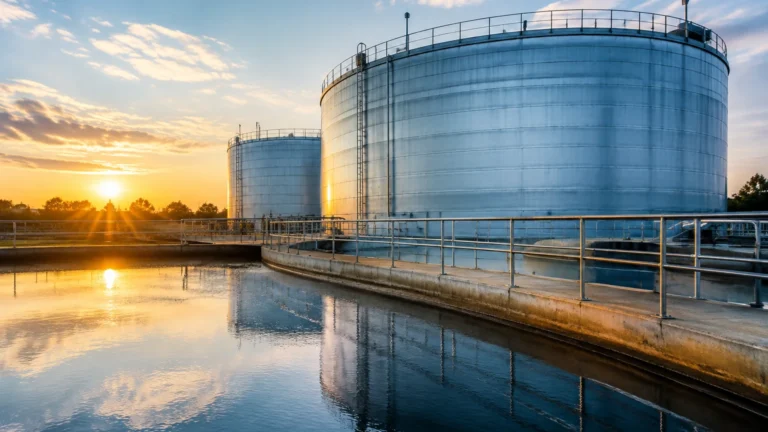
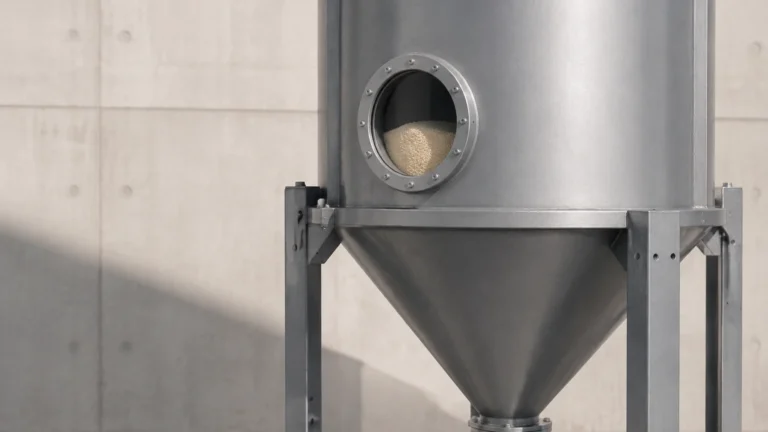
Water sourced from municipal supplies or private wells must be filtered and softened. Level sensors in large storage silos or settling tanks ensure a steady supply for the plant. Because raw water may contain debris, non-contact ultrasonic or radar sensors are preferred to prevent clogging or mechanical wear on the instrument.
Ingredient and Process Water
Water used directly in products (such as soft drinks or beer) or for cleaning (CIP – Clean-in-Place) must meet stringent purity standards. This often involves Reverse Osmosis (RO) or Ultrafiltration (UF). Level measurement in permeate and concentrate tanks is critical to balance the system and prevent pump cavitation. In these environments, sanitary fittings (such as Tri-Clamp) and stainless steel housings are mandatory to prevent bacterial growth.
Boiler Feed and Cooling Water
Water used for steam generation or cooling must be treated to prevent scaling and corrosion. Level sensors in deaerators and condensate return tanks must withstand high temperatures and pressures. Guided wave radar (GWR) is frequently used here as it provides reliable measurement even in the presence of steam and turbulent surfaces.
Wastewater and Effluent Treatment
The F&B industry produces high volumes of wastewater rich in organic matter. Treatment involves equalization tanks, anaerobic digesters, and clarifiers. Monitoring sludge levels and chemical dosing for pH neutralization requires sensors that can handle high turbidity and potential coating. Hydrostatic transmitters with flush diaphragms are often chosen for their ability to resist build-up.
Selection Criteria for Level Instrumentation
Choosing the right sensor for water treatment in food and beverage industry facilities depends on the specific process stage and the physical constraints of the tank. The following table provides a comparison of common technologies.
| Technology | Accuracy | Contact Type | Best Use Case | Limitations |
| :— | :— | :— | :— | :— |
| Hydrostatic | High | Contact | Open tanks, deep wells | Density changes affect accuracy |
| Ultrasonic | Moderate | Non-contact | Chemical storage, sumps | Affected by foam and heavy steam |
| Radar (80 GHz) | Very High | Non-contact | Process tanks, high precision | Higher initial cost |
| Magnetic Gauge | Moderate | Contact | Visual local monitoring | Moving parts subject to wear |
| Level Switch | Point only | Contact | Overfill protection | No continuous data |
When evaluating hardware, engineers should visit the Main Page to review specific product specifications and application support for industrial level measurement.
Installation Considerations and Best Practices
Proper installation is as critical as sensor selection. In the F&B industry, additional layers of complexity arise due to sanitary requirements.
1. Sanitary Connections: For any water that comes into contact with the product or food-contact surfaces, sensors must use hygienic connections like Tri-Clamp or Varivent. These designs eliminate "dead legs" where bacteria can proliferate.
2. Mounting Position: Non-contact sensors (Radar/Ultrasonic) should be mounted away from the tank wall to avoid false reflections. They should also be positioned away from the fill stream to prevent interference from incoming water.
3. Beam Angle: High-frequency radar (80 GHz) offers a narrow beam angle, which is beneficial in narrow tanks or tanks with internal obstructions like agitators or spray balls.
4. Material Compatibility: Ensure that the wetted parts (e.g., PTFE, 316L Stainless Steel) are compatible with the cleaning chemicals used in the plant, such as caustic soda or nitric acid.
Limitations and Environmental Factors
While modern instrumentation is highly advanced, certain environmental factors can still pose challenges in a water treatment setting.
* Foam: Heavy foam on the surface of a wastewater equalization tank can absorb ultrasonic signals, leading to a "loss of echo." In such cases, radar or hydrostatic sensors are more reliable.
* Condensation: In hot water storage or CIP tanks, heavy condensation can form on the sensor face. Sensors with specialized antenna designs (like drip-off lenses) are required to shed moisture and maintain a clear signal.
* Turbulence: Agitators used in mixing tanks for chemical dosing can create surface turbulence. Software filtering (damping) within the sensor or the use of a stilling well can help stabilize the reading.
Maintenance and Calibration
To maintain the integrity of water treatment in food and beverage industry operations, a regular maintenance schedule is necessary.
* Calibration Verification: Periodic checks against a manual tape measure or a reference pressure gauge ensure the sensor has not drifted. Many modern digital sensors offer internal diagnostics that can alert operators to potential failures before they occur.
* Cleaning: In wastewater applications, sensors may require periodic cleaning to remove fats, oils, and grease (FOG) or mineral scaling. Hydrostatic sensors with flush diaphragms are easier to clean than those with recessed ports.
Frequently Asked Questions (FAQ)
Q: Why is 80 GHz radar preferred over 26 GHz for F&B water tanks?
A: The 80 GHz frequency allows for a much smaller antenna and a narrower beam. This makes it easier to install on small tanks and ensures that the signal does not hit internal pipes or agitators, which are common in food processing environments.
Q: Can ultrasonic sensors be used in CIP (Clean-in-Place) tanks?
A: Generally, no. CIP processes often involve high temperatures and steam. Since ultrasonic waves rely on the speed of sound through air (which changes with temperature and vapor density), the readings will become inaccurate. Radar is the preferred non-contact choice for CIP.
Q: How do I handle level measurement in a tank with a spherical bottom?
A: Most modern level transmitters allow for the input of a "tank strapping table" or a linearization curve. This converts the linear distance measurement into a volume measurement based on the specific geometry of the tank.
Q: Is hydrostatic pressure affected by the presence of carbonation in beverage water?
A: Yes. If the water is in a pressurized tank (e.g., carbonated water storage), a standard hydrostatic sensor will measure both the liquid head and the gas pressure. In this case, a differential pressure (DP) transmitter system is required to subtract the top gas pressure from the total bottom pressure.
Conclusion
Precision in level measurement is a cornerstone of effective water treatment in food and beverage industry facilities. By selecting the appropriate technology—whether it be the reliability of hydrostatic pressure, the versatility of ultrasonic pulses, or the precision of high-frequency radar—operators can ensure consistent water quality and process efficiency. Adhering to sanitary standards and considering the specific environmental challenges of the F&B plant will lead to long-term operational success and regulatory compliance.
Download Water Treatment in Food and Beverage Industry as a PDF