Industrial Treatment
Industrial Treatment
In the modern landscape of industrial treatment, the ability to monitor and control fluid levels with precision is fundamental to operational efficiency, safety, and regulatory compliance. Whether managing municipal wastewater, processing aggressive chemicals, or refining oil and gas, the accuracy of level measurement instruments directly impacts the performance of the entire treatment cycle. This guide explores the technical principles, selection criteria, and practical installation strategies for level measurement technologies used within various industrial treatment sectors.
The Role of Level Measurement in Industrial Treatment
Industrial treatment encompasses a wide range of processes designed to purify, neutralize, or transform liquids for reuse or safe discharge. These processes often involve complex chemical reactions, biological filtration, and physical separation. Level measurement instruments serve as the "eyes" of the automation system, providing real-time data to control pumps, prevent tank overflows, and ensure that chemical dosing remains within strict parameters.
In water and wastewater treatment, for instance, maintaining the correct level in sedimentation tanks and aeration basins is critical for biological health and sediment removal. In chemical industrial treatment, level sensors must withstand corrosive environments while preventing hazardous spills. The integration of reliable sensors reduces manual labor, minimizes chemical waste, and protects downstream equipment from damage caused by dry running or over-pressurization.
Core Measurement Principles for Process Monitoring
Before selecting a specific instrument, it is essential to understand the physics behind the measurement. Industrial treatment facilities typically utilize one of four primary measurement principles: Radar, Ultrasonic, Hydrostatic, and Magnetic.
Radar Level Measurement (Non-Contact)
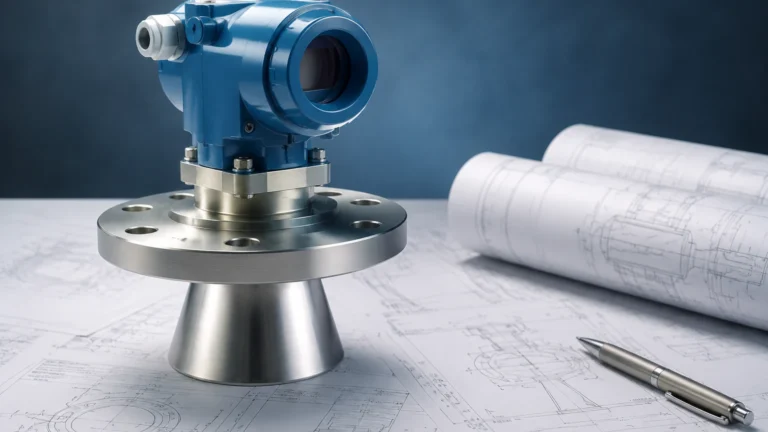
Radar level meters utilize high-frequency electromagnetic waves, typically in the 26GHz or 80GHz range. The sensor emits a pulse that travels to the surface of the liquid and reflects back. By measuring the time-of-flight (ToF) and knowing the speed of light, the device calculates the distance to the surface.
* Advantages: Radar is unaffected by vacuum, pressure, temperature fluctuations, or dust. High-frequency 80GHz radar offers a narrow beam angle, which is ideal for avoiding internal obstructions like agitators or heating coils.
* Application: Used extensively in chemical storage and volatile liquid tanks where non-contact measurement is required to prevent sensor degradation.
Ultrasonic Level Measurement (Non-Contact)
Ultrasonic sensors function similarly to radar but use sound waves instead of electromagnetic pulses. The sensor emits an ultrasonic pulse that reflects off the liquid surface. The time taken for the echo to return is proportional to the distance.
* Advantages: Cost-effective for open-channel flow and simple water storage.
* Limitations: Sound speed is affected by air temperature and gas composition. Therefore, integrated temperature compensation is necessary. It is generally not suitable for applications with heavy foam or vacuum conditions, as sound requires a medium to travel.
Hydrostatic Level Measurement (Contact)
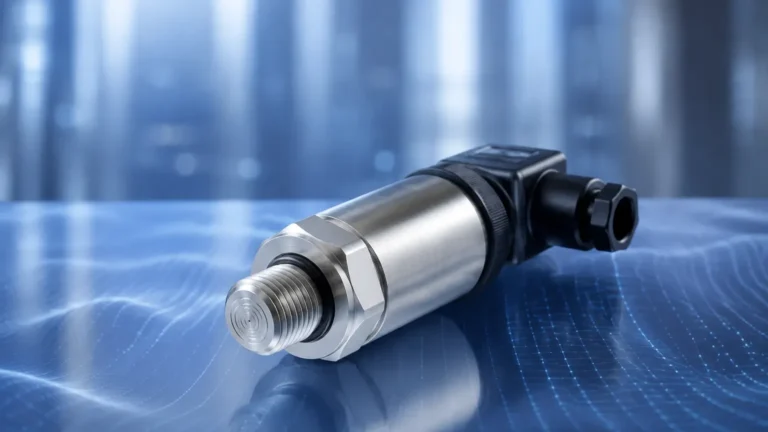
This principle relies on the relationship between the height of a liquid column and the pressure it exerts at the base: $P = \rho gh$ (where $P$ is pressure, $\rho$ is density, $g$ is gravity, and $h$ is height). A pressure transmitter is installed at the bottom of the tank or submerged in the liquid.
* Advantages: Simple to install and highly reliable for vented tanks. It is a preferred method for deep wells and large reservoirs in water treatment.
* Consideration: Changes in liquid density (due to temperature or concentration changes) will affect accuracy unless compensated for in the control system.
Magnetic Level Gauges (Contact/Visual)
Magnetic level gauges consist of a bypass chamber attached to the side of a vessel. Inside the chamber, a float containing a permanent magnet moves with the liquid level. This magnet flips external flags for visual indication or triggers a reed-chain transmitter for remote signaling.
* Advantages: Provides a clear visual reference without requiring power. It is highly robust for high-pressure and high-temperature industrial treatment environments.
Technology Selection Criteria for Industrial Applications
Choosing the correct instrument requires a detailed analysis of the process media and the physical environment. The following table provides a comparison of common technologies used in industrial treatment.
| Technology | Accuracy | Suitability for Foam | Chemical Resistance | Typical Range |
| :— | :— | :— | :— | :— |
| 80GHz Radar | ±1 mm | Moderate to High | Excellent (PTFE lenses) | Up to 120 m |
| Ultrasonic | ±0.25% of range | Poor | Good (Plastic housings) | 0.3 m to 15 m |
| Hydrostatic | ±0.1% to 0.5% | Excellent | Dependent on Diaphragm | 1 m to 200 m |
| Magnetic Gauge| ±5 mm to 10 mm | Excellent | High (Stainless/Alloy) | 0.5 m to 6 m |
Key Evaluation Factors
1. Media Characteristics: Is the liquid corrosive, viscous, or prone to crystallization? For corrosive industrial treatment, non-contact radar or PTFE-coated hydrostatic sensors are preferred.
2. Process Conditions: What are the maximum operating pressures and temperatures? Magnetic gauges and specialized radar units can handle temperatures exceeding 400°C and pressures over 100 bar.
3. Tank Geometry: Small tanks with narrow nozzles favor 80GHz radar due to its focused beam. Deep, narrow sumps are often best served by submersible hydrostatic transmitters.
4. Accuracy Requirements: For inventory management, high-accuracy radar is necessary. For simple pump control (start/stop), ultrasonic or level switches are sufficient.
For a comprehensive review of specific instrument models and technical support for your project, you can visit our Main Page.
Installation Best Practices and Engineering Considerations
Even the most advanced sensor will fail to provide accurate data if installed incorrectly. In industrial treatment settings, several engineering factors must be addressed during the design phase.
Avoiding Dead Zones
Every non-contact sensor (Radar and Ultrasonic) has a "dead zone" or "blocking distance" directly beneath the sensor face where measurement is impossible. Designers must ensure the sensor is mounted high enough so that the maximum liquid level never enters this zone. For example, if an ultrasonic sensor has a 300 mm dead zone, the tank should be designed or the sensor mounted on a nozzle to maintain this clearance.
Nozzle Design
When mounting radar or ultrasonic sensors on nozzles, the nozzle height and diameter must be considered. If a nozzle is too long or too narrow, the sensor may detect the edge of the nozzle as the liquid surface (false echo). As a general rule, the nozzle should be as short as possible, and the sensor face should ideally extend slightly into the tank space.
Agitators and Obstructions
Many industrial treatment tanks contain mixers or baffles. These internal structures can cause interference. When using radar, it is vital to map the "false echoes" during commissioning. This allows the software to ignore static reflections from internal tank structures and focus only on the moving liquid surface.
Turbulence and Foam
In aeration tanks or rapid-mix chemical reactors, the surface may be turbulent or covered in foam. Foam absorbs ultrasonic signals, often leading to signal loss. Radar is more resilient but may still experience signal attenuation. In these cases, using a stilling well (a vertical pipe that stabilizes the liquid surface) can provide a calm area for accurate measurement.

Addressing Operational Risks and Environmental Limitations
Industrial treatment environments are often harsh, presenting various risks to instrumentation longevity and accuracy.
* Corrosion and Material Compatibility: In chemical treatment, the sensor materials must be compatible with the media. For example, using 316 stainless steel in a tank containing high concentrations of hydrochloric acid will lead to rapid failure. In such cases, Tantalum, Hastelloy, or PTFE-lined components are required.
* Condensation and Build-up: In wastewater applications, humidity is high. Condensation can form on the sensor face, causing signal scattering. Modern radar sensors with convex lenses are designed to shed droplets, while ultrasonic sensors may require periodic cleaning or the use of a self-cleaning face.
* Lightning and Power Surges: Since many industrial treatment facilities are located outdoors in large open areas, sensors are susceptible to lightning strikes. Installing surge protection and ensuring proper grounding of the instrument housing is a critical safety step.
* Signal Interference: In facilities with multiple wireless devices, ensuring that radar frequencies do not interfere with other systems is important. Most industrial radar operates in regulated ISM bands to prevent these issues.
Frequently Asked Questions in Industrial Treatment Level Sensing
Q: Can one sensor type be used for all industrial treatment applications?
No. While radar is highly versatile, it may be overkill for a simple water storage tank where a hydrostatic transmitter or ultrasonic sensor would be more cost-effective. Conversely, hydrostatic sensors are not suitable for tanks where the liquid density changes significantly.
Q: How do I measure the level of sludge or slurry?
Sludge measurement is challenging due to its high solids content. Non-contact radar is often the best choice because it does not touch the media, preventing build-up on the sensor. If contact measurement is necessary, a hydrostatic transmitter with a large, flush-mounted diaphragm is recommended to prevent clogging.
Q: What maintenance is required for these sensors?
Non-contact sensors generally require very little maintenance. Contact sensors, such as magnetic floats or hydrostatic diaphragms, should be inspected periodically for scaling or biological growth, especially in wastewater industrial treatment.
Q: How does temperature affect measurement?
Temperature affects the density of the liquid (impacting hydrostatic sensors) and the speed of sound (impacting ultrasonic sensors). Radar is largely immune to temperature changes. Most modern sensors include internal temperature sensors to compensate for these effects automatically.
Conclusion
Successful level measurement in industrial treatment requires a balanced approach that considers the physical properties of the media, the constraints of the vessel, and the specific goals of the process. By understanding the underlying principles of radar, ultrasonic, and hydrostatic technologies, engineers can select the most reliable and cost-effective solutions for their infrastructure.
Before finalizing a specification, always confirm the chemical compatibility of the wetted parts, the expected range of process temperatures, and the presence of any internal obstructions. For further technical guidance and to explore our full range of industrial level measurement instruments, please refer to our Main Page.