What Is One Type of Switch That Monitors Liquid Levels
What Is One Type of Switch That Monitors Liquid Levels
In industrial process control, monitoring the presence or absence of a liquid at a specific point is a fundamental requirement for safety and automation. While continuous level transmitters provide a constant stream of data regarding the exact volume or height of a fluid, level switches serve a different, equally critical purpose: point level detection. If you are asking what is one type of switch that monitors liquid levels, the most common and historically significant answer is the float level switch. However, modern engineering has introduced several other technologies, such as tuning forks and capacitive sensors, to handle more complex industrial environments.
Level switches act as the "eyes" of a control system, triggering alarms, starting or stopping pumps, or opening and closing valves when a liquid reaches a predetermined threshold. Understanding the principles behind these devices is essential for selecting the right tool for specific applications in water treatment, chemical processing, or oil and gas production.
The Fundamental Principle of Point Level Detection
Before diving into specific types, it is important to understand how these switches function within a circuit. Most liquid level switches operate using a dry contact output, typically categorized as Normally Open (NO) or Normally Closed (NC).
When the liquid level reaches the switch, the sensing element (whether it is a float, a vibrating tine, or an electrode) undergoes a physical or electrical change. This change is converted into a switching signal. For instance, in a high-level alarm application, the switch remains "open" until the liquid reaches the top of the tank. Once submerged, the switch closes, completing a circuit that sounds an alarm or shuts off an inlet pump to prevent overfill.
Float Switches: The Traditional Choice
When considering what is one type of switch that monitors liquid levels, the float switch is the most widely recognized. Its operation is based on the principle of buoyancy—the upward force exerted by a fluid that opposes the weight of an immersed object.
How Float Switches Work
Most float switches contain a hollow buoyant body with a magnet inside. This float moves up and down a stationary stem or pivots on a hinge. Inside the stem is a hermetically sealed reed switch. As the liquid level rises, the float moves into proximity with the reed switch. The magnetic field causes the reed switch contacts to close (or open), sending an electrical signal to the controller.
Types of Float Switches
1. Vertical Float Switches: These are mounted at the top or bottom of a tank. They are ideal for deep tanks where multiple switching points are needed on a single stem.
2. Horizontal/Side-Mounted Switches: These are installed through the side wall of a vessel. They are often used in compact spaces or where top access is restricted.
3. Cable-Suspended Float Switches: Often used in wastewater sumps, these consist of a large float attached to a flexible cable. As the water rises, the float tilts, triggering an internal ball-bearing microswitch.
Advantages and Limitations
Float switches are highly cost-effective and require no external power to operate the sensing element itself. However, because they have moving parts, they are susceptible to mechanical failure if the liquid is highly viscous, contains debris, or causes crystalline buildup (scaling) on the stem.
Tuning Fork (Vibrating) Level Switches
For applications where mechanical floats might fail due to turbulence or coating, the tuning fork—or vibrating level switch—is a superior alternative. This is a solid-state device, meaning it has no moving parts that can jam or wear out.
Measurement Principle
The sensor consists of two tines (the "fork") that are vibrated at their resonant frequency by a piezoelectric crystal. When the tines are in the air, they vibrate freely at a high frequency. When liquid covers the tines, the frequency drops significantly due to the increased density of the medium. An internal electronic circuit detects this frequency shift and converts it into a switching output.
Industrial Application
Tuning fork switches are exceptionally reliable for detecting "light" liquids or aerated fluids. They are frequently used in the food and beverage industry because they can be manufactured with hygienic polished surfaces that resist bacterial growth. For engineers looking for robust solutions, visiting the Main Page of a specialized manufacturer like Welk provides insights into how these sensors are integrated into automated systems.
Capacitance Level Switches
Capacitance switches operate based on the electrical properties of the liquid, specifically its dielectric constant. This technology is often used when the liquid is corrosive or when the process involves high temperatures and pressures.
Measurement Principle
The switch probe and the tank wall (or a second reference probe) act as two plates of a capacitor. The liquid acts as the dielectric material between them. Since most liquids have a higher dielectric constant than air, the capacitance of the system increases when the probe is submerged. The switch detects this change in capacitance and triggers the output.
Key Considerations
Capacitance switches are excellent for detecting the interface between two different liquids (such as oil and water). However, they may require calibration to account for the specific dielectric properties of the fluid. If the fluid composition changes frequently, the switch may need readjustment to maintain accuracy.
Selection Criteria: Choosing the Right Switch
Selecting a switch involves more than just identifying the type. Engineers must evaluate the physical and chemical properties of the process. The following table provides a comparison of the most common technologies used in modern industrial settings.
Liquid Level Switch Comparison Table
| Switch Type | Principle | Ideal Media | Max Temperature (Approx) | Pros | Cons |
| :— | :— | :— | :— | :— | :— |
| Float | Buoyancy | Clean water, oils | 120°C (248°F) | Low cost, no power needed | Moving parts can jam |
| Tuning Fork | Vibration | Slurries, aerated liquids | 150°C (302°F) | No moving parts, reliable | High viscosity may damp vibration |
| Capacitance | Dielectric | Corrosive chemicals | 250°C (482°F) | Handles high temp/pressure | Requires calibration |
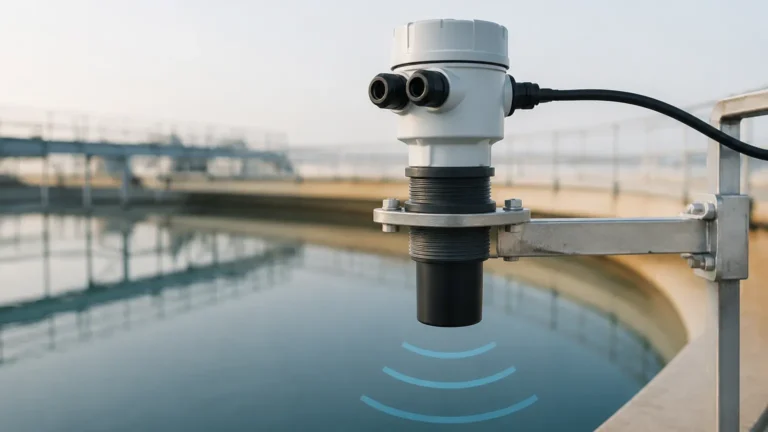
| Ultrasonic | Sound Wave | Non-foaming liquids | 80°C (176°F) | Non-contact options | Affected by foam and vapor |
| Optical | Infrared | Clear, clean liquids | 100°C (212°F) | Very small footprint | Fails if probe is coated |

Installation and Engineering Considerations
Correct installation is vital to the longevity of a level switch. Even the most advanced sensor will fail if placed in an environment it wasn't designed for.
Turbulence and Stilling Wells
In tanks with heavy agitation or splashing, a float switch may "bounce," causing the pump to cycle on and off rapidly (chattering). To prevent this, engineers install a stilling well—a vertical pipe that surrounds the switch to provide a calm surface for measurement.
Orientation and Mounting
* Top Mounting: Preferred for float and ultrasonic switches to keep the electrical housing away from potential leaks.
* Side Mounting: Common for tuning forks and small float switches in OEM machinery where space is at a premium.
* Protection from Flow: Switches should never be placed directly under an infill pipe. The force of the falling liquid can damage the probe or cause false readings.
Material Compatibility
For chemical applications, the wetted parts (the parts of the switch that touch the liquid) must be compatible with the medium. While Stainless Steel 316 is the standard, aggressive acids may require PTFE (Teflon), PP (Polypropylene), or PVDF coatings.
Limitations and Common Pitfalls
While point level switches are robust, they are not universal.
1. Coating and Buildup: In applications like wastewater or syrup production, material can build up on the sensor. A tuning fork might eventually think it is submerged because of a thick layer of dried material. In these cases, a "coat-reject" capacitance switch is required.
2. Specific Gravity: Float switches depend on the liquid being denser than the float. If the liquid's specific gravity is too low (e.g., certain hydrocarbons), the float will sink rather than rise.
3. Pressure Ratings: Standard plastic float switches may collapse under high pressure. Always verify the bar/psi rating of the vessel before selection.
Frequently Asked Questions (FAQs)
Q: Can one switch monitor multiple levels?
A: Yes, vertical float switches can be custom-built with multiple reed switches inside a single stem, allowing for "Low," "High," and "High-High" detection in one unit.
Q: What is the difference between a level switch and a level transmitter?
A: A switch provides a binary output (On/Off) at a specific point. A transmitter provides a continuous signal (e.g., 4-20mA) representing the level from 0% to 100%.
Q: Do tuning fork switches work in foam?
A: Most tuning fork switches are designed to ignore foam and only trigger when the actual liquid level reaches the tines, making them superior to ultrasonic sensors in soapy or agitated applications.
Q: How do I test if my level switch is working?
A: For mechanical switches, you can manually move the float and check for continuity with a multimeter. For electronic switches like tuning forks, most have a diagnostic LED that changes color when the state changes.
Conclusion
Identifying what is one type of switch that monitors liquid levels is the first step in designing a reliable industrial system. Whether you opt for the simplicity of a float switch or the advanced reliability of a vibrating tuning fork, the goal remains the same: ensuring process safety and efficiency. For professionals seeking technical specifications or customized OEM solutions, the Main Page of an established manufacturer like Welk offers a comprehensive overview of the hardware available to meet these engineering challenges. By matching the technology to the specific gravity, temperature, and chemical nature of the fluid, you can ensure a maintenance-free installation that protects your equipment and personnel.
Download What Is One Type of Switch That Monitors Liquid Levels as a PDF