What Is Thermowell
What Is Thermowell
In the realm of industrial process control, the integrity of measurement instruments is paramount to both safety and efficiency. While sensors like thermocouples and Resistance Temperature Detectors (RTDs) are the primary tools for monitoring thermal conditions, they are often too delicate to be exposed directly to the harsh environments found in chemical reactors, steam pipes, or pressurized tanks. This is where the thermowell becomes indispensable.
Understanding what is thermowell requires looking at it as a protective barrier. It is a cylindrical pressure-tight fitting used to shield temperature sensors from the corrosive effects, high pressures, and high-velocity flows of process fluids. By isolating the sensor from the medium, a thermowell allows for the removal and replacement of the instrument without requiring a system shutdown or the draining of a vessel. This article provides a comprehensive engineering guide to thermowell principles, selection, and installation.
Measurement Principles and Functionality
The primary function of a thermowell is to act as a heat exchanger. It must protect the internal sensor while simultaneously allowing heat to pass through its walls with minimal resistance to ensure an accurate reading.
Heat Transfer Mechanism
When a thermowell is inserted into a process stream, heat transfer occurs from the process fluid to the thermowell wall, and subsequently from the wall to the internal sensor via conduction and radiation. The efficiency of this process depends on several factors:
1. Thermal Conductivity: The material of the thermowell must have sufficient conductivity to minimize the "lag time" between a temperature change in the fluid and the sensor's response.
2. Surface Area: A larger surface area increases heat absorption but may also increase the drag and mechanical stress on the probe.
3. Sensor Fit: There must be minimal air gap between the sensor tip and the bottom of the thermowell (the "bore"). Often, heat transfer paste or spring-loaded sensors are used to ensure positive contact, reducing thermal resistance.
Structural Integrity
Beyond measurement, a thermowell serves as a pressure boundary. It must withstand the static pressure of the vessel and the dynamic forces of the fluid flow. If a thermowell fails, it can lead to catastrophic leaks, especially in high-pressure steam or hazardous chemical applications. Therefore, its design is governed by rigorous mechanical standards, most notably the ASME PTC 19.3 TW.
Types of Thermowell Designs
Thermowells are categorized by their connection type and their stem shape. Choosing the right design is a balance between mechanical strength and thermal sensitivity.
Connection Types
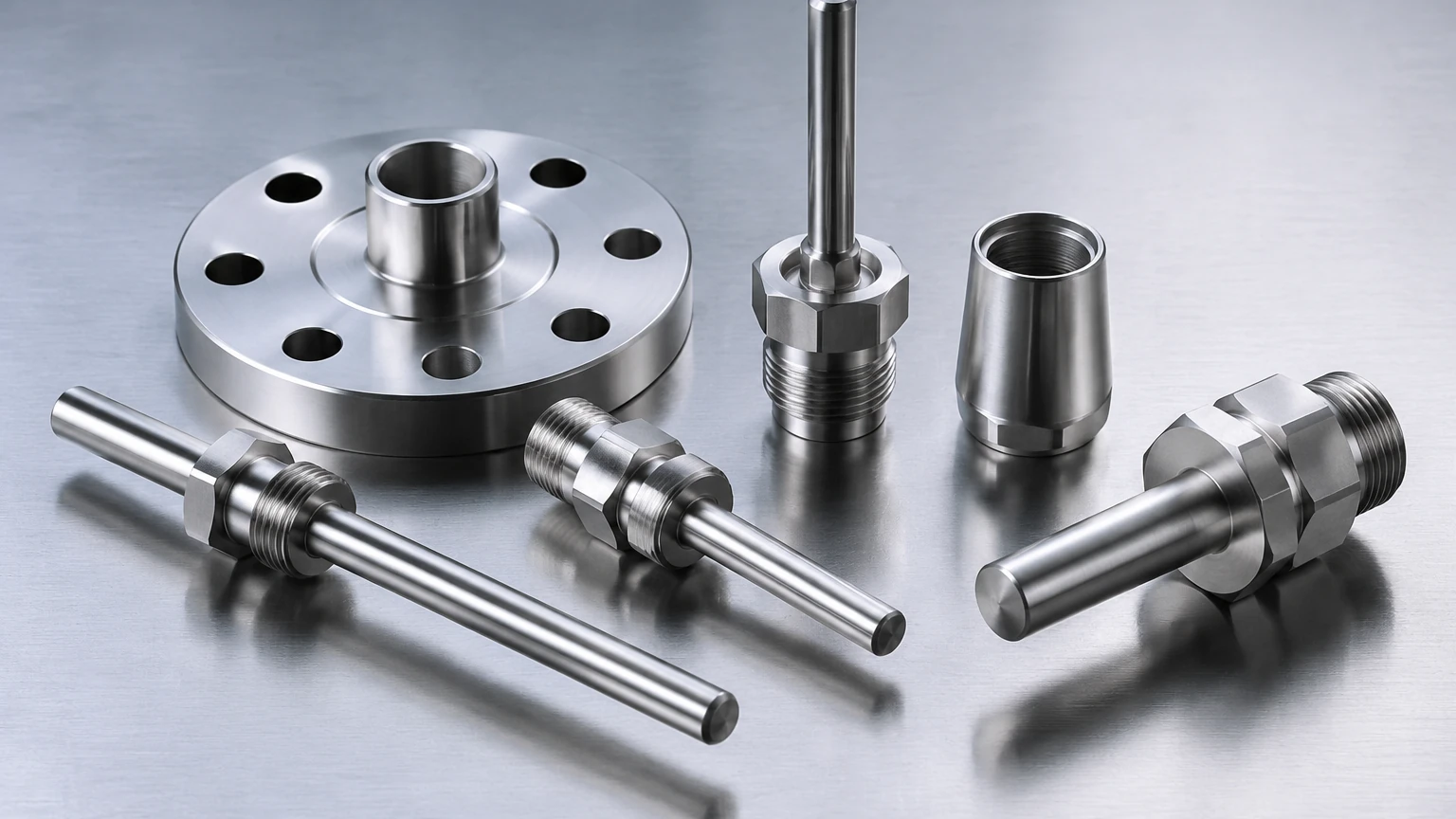
* Threaded Thermowells: These are screwed into a process pipe or vessel. They are cost-effective and easy to install but are generally limited to lower pressure applications and non-corrosive environments where a leak-tight seal is less critical.
* Flanged Thermowells: These feature a flange collar that bolts to a matching flange on the process equipment. They are the standard for high-pressure, high-temperature, and highly corrosive applications. They allow for easier inspection and are common in the oil, gas, and petrochemical sectors.
* Socket Weld Thermowells: These are welded into a socket on the pipe. They provide a permanent, leak-proof connection suitable for high-pressure steam lines but are difficult to replace.
* Weld-In Thermowells: These are welded directly into the process wall, offering the highest pressure integrity.
Stem Geometries
* Straight Stem: The diameter is uniform throughout the insertion length. This provides good strength but has a slower response time due to the larger mass at the tip.
* Stepped Stem: The diameter decreases abruptly near the tip (e.g., from 19 mm to 12.7 mm / 0.75" to 0.5"). This reduces the thermal mass, significantly improving response time while maintaining strength at the base.
* Tapered Stem: The diameter gradually decreases from the base to the tip. This design offers the best compromise between high structural rigidity (to resist vibration) and a relatively fast response time.
Material Selection Criteria
The material of the thermowell must be compatible with the process fluid to prevent corrosion and erosion. While Stainless Steel 316 is the industry standard, specialized applications require more robust alloys.
| Material | Common Applications | Temperature Range (Approx.) |
| :— | :— | :— |
| 316/316L Stainless Steel | General purpose, water treatment, food and beverage. | Up to 850°C (1562°F) |
| Hastelloy C-276 | Highly corrosive acids, chlorine, and chemical processing. | Up to 1000°C (1832°F) |
| Inconel 600 | High-temperature oxidation resistance, heat treating. | Up to 1150°C (2102°F) |
| Monel 400 | Sea water, hydrofluoric acid, and salt solutions. | Up to 500°C (932°F) |
| Titanium | Marine environments and specific chemical bleaching agents. | Up to 300°C (572°F) |
When selecting a material, engineers must consider the "corrosion allowance" and the potential for stress corrosion cracking. For high-velocity abrasive slurries, specialized coatings like Tungsten Carbide may be applied to the exterior of the thermowell.
Installation Considerations and Best Practices
Proper installation is critical to ensuring that the thermowell provides an accurate representation of the process temperature without failing mechanically.
Insertion Length (U-Length)
The insertion length is the distance from the tip of the thermowell to the underside of the connection. To avoid errors caused by ambient heat conduction (where the cold exterior pipe wall cools the thermowell), the following rules of thumb are applied:
* Liquids: The insertion length should be at least 5 to 8 times the thermowell diameter.
* Gases/Steam: The insertion length should be 10 to 15 times the diameter.
* Pipe Centerline: Ideally, the tip should be located in the middle third of the pipe diameter to capture the most representative flow temperature.
Orientation
In small-diameter pipes (less than 100 mm / 4"), a thermowell may be installed at an angle or in an elbow (facing into the flow) to ensure sufficient immersion depth without obstructing the flow path.
Wake Frequency Calculations
As fluid flows past a thermowell, it creates a wake—a series of vortices known as a Von Kármán vortex street. These vortices cause the thermowell to vibrate. If the frequency of these vortices (the wake frequency) matches the natural frequency of the thermowell, resonance occurs. This can lead to fatigue failure in a matter of hours. Engineers must perform ASME PTC 19.3 TW calculations to ensure the thermowell is stiff enough to withstand the flow velocity at the operating temperature.
Limitations and Common Risks
While thermowells are essential, they introduce certain limitations to the measurement system:
1. Response Lag: The mass of the thermowell acts as a thermal buffer. In processes with rapid temperature fluctuations, the thermowell may prevent the sensor from detecting changes quickly enough for effective control.
2. Conduction Error: If the thermowell is too short, heat can conduct away from the sensor toward the cooler pipe wall, leading to a reading that is lower than the actual fluid temperature.
3. Pressure Drop: In high-velocity systems, the presence of a thermowell creates a slight pressure drop and turbulence, which may affect downstream flow meters.
4. Maintenance Overlook: Because they are robust, thermowells are often neglected during maintenance. However, they should be inspected periodically for thinning walls due to erosion or pitting from corrosion.
Thermowells in the Context of Level Measurement
In industrial automation, temperature measurement and level measurement are often inextricably linked. As a professional manufacturer, Welk provides advanced solutions for level monitoring, but we recognize that accurate level data often depends on accurate temperature data.
For instance, in hydrostatic level measurement, the pressure at the bottom of a tank is used to calculate the liquid level. However, because the density of a liquid changes with temperature, a precise temperature reading is required to compensate for these density variations. Similarly, in high-precision radar level applications, monitoring the vapor space temperature can be necessary for certain gas phase compensations. For more information on how these technologies integrate into a complete process solution, you can visit our Main Page.
Frequently Asked Questions (FAQ)
Q: How do I know if I need a tapered or straight thermowell?
A: Tapered thermowells are generally preferred for high-velocity applications because they have a higher natural frequency and are more resistant to vortex-induced vibration. Straight thermowells are sufficient for low-velocity tanks or large-diameter pipes where vibration is not a concern.
Q: Can I use a thermowell with an ultrasonic level sensor?
A: No, thermowells are specifically for contact temperature sensors. Ultrasonic level sensors are non-contact devices. However, you might install a thermowell in the same tank to provide temperature compensation for the ultrasonic sensor’s speed-of-sound calculations.
Q: What is the difference between "U" length and "L" length?
A: The "U" length is the insertion length (the part that goes into the process). The "L" length usually refers to the total length including the lagging extension, which is the portion that sticks out past the insulation of a pipe to reach the sensor head.
Q: Why is my temperature reading slower than expected?
A: This is likely due to the thermal mass of the thermowell or an air gap between the sensor and the bore. Ensure the sensor is spring-loaded to maintain contact with the tip, or consider a stepped-stem thermowell to reduce mass.
Conclusion
Defining what is thermowell goes beyond describing a simple metal tube. It is a critical engineered component that balances the conflicting requirements of mechanical strength and thermal sensitivity. By carefully selecting the material, connection type, and stem geometry, and by performing the necessary wake frequency calculations, engineers can ensure long-term reliability in their process measurements. Whether you are managing water treatment facilities or complex chemical reactors, the thermowell remains the first line of defense for your temperature instrumentation, ensuring that your control systems receive accurate data while protecting the integrity of the process boundary.