Who Was the Inventor of the Thermometer
Who Was the Inventor of the Thermometer
In the realm of industrial process control, temperature and level measurement are the two most critical parameters for ensuring safety, efficiency, and product quality. While modern engineers rely on sophisticated radar level meters and digital temperature transmitters, the journey to these advanced technologies began centuries ago. Understanding who was the inventor of the thermometer requires looking past a single name and exploring a timeline of scientific evolution that transformed a simple curiosity into a foundational tool for global industry.
From the early thermoscopes of the Renaissance to the standardized mercury instruments of the Enlightenment, the development of the thermometer paved the way for the precise industrial instrumentation manufactured today by companies like Welk. This article explores the historical figures behind temperature measurement and how their inventions evolved into the modern sensors used in water treatment, chemical processing, and oil and gas applications.
The Early Foundations: From Thermoscope to Thermometer
The question of who was the inventor of the thermometer does not have a single, simple answer because the device evolved from the "thermoscope." A thermoscope could show changes in temperature (specifically, the expansion and contraction of air) but lacked a numerical scale to provide a quantitative measurement.
Galileo Galilei (1593)
Galileo Galilei is most frequently cited as the primary inventor of the first thermoscope around 1593. His device utilized a glass tube filled with air, with the open end submerged in a vessel of water. As the air in the tube heated or cooled, its volume changed, causing the water level in the tube to rise or fall. While revolutionary, Galileo’s thermoscope was "open" to the atmosphere, meaning it was influenced by barometric pressure, making it inaccurate for precise scientific work.
Santorio Santorio (1612)
A colleague of Galileo, Santorio Santorio, was the first to apply a numerical scale to the thermoscope. By adding marks to the glass tube, he transformed the device from a qualitative indicator into a quantitative instrument. Santorio used the device to measure human body temperature, marking a significant milestone in medical and experimental science.
The Shift to Liquid-in-Glass Instruments
The transition from air-based thermoscopes to liquid-filled, sealed thermometers was the next major leap in accuracy. Air is highly compressible and sensitive to atmospheric pressure; liquids like alcohol and mercury provided much more stable readings.
Ferdinand II de' Medici (1654)
The Grand Duke of Tuscany, Ferdinand II, is credited with developing the first sealed-liquid-in-glass thermometer. By sealing the top of the tube, he eliminated the interference of atmospheric pressure. His instruments typically used "spirit of wine" (alcohol), which has a lower freezing point than water, allowing for measurements in colder environments.
Daniel Gabriel Fahrenheit (1714)
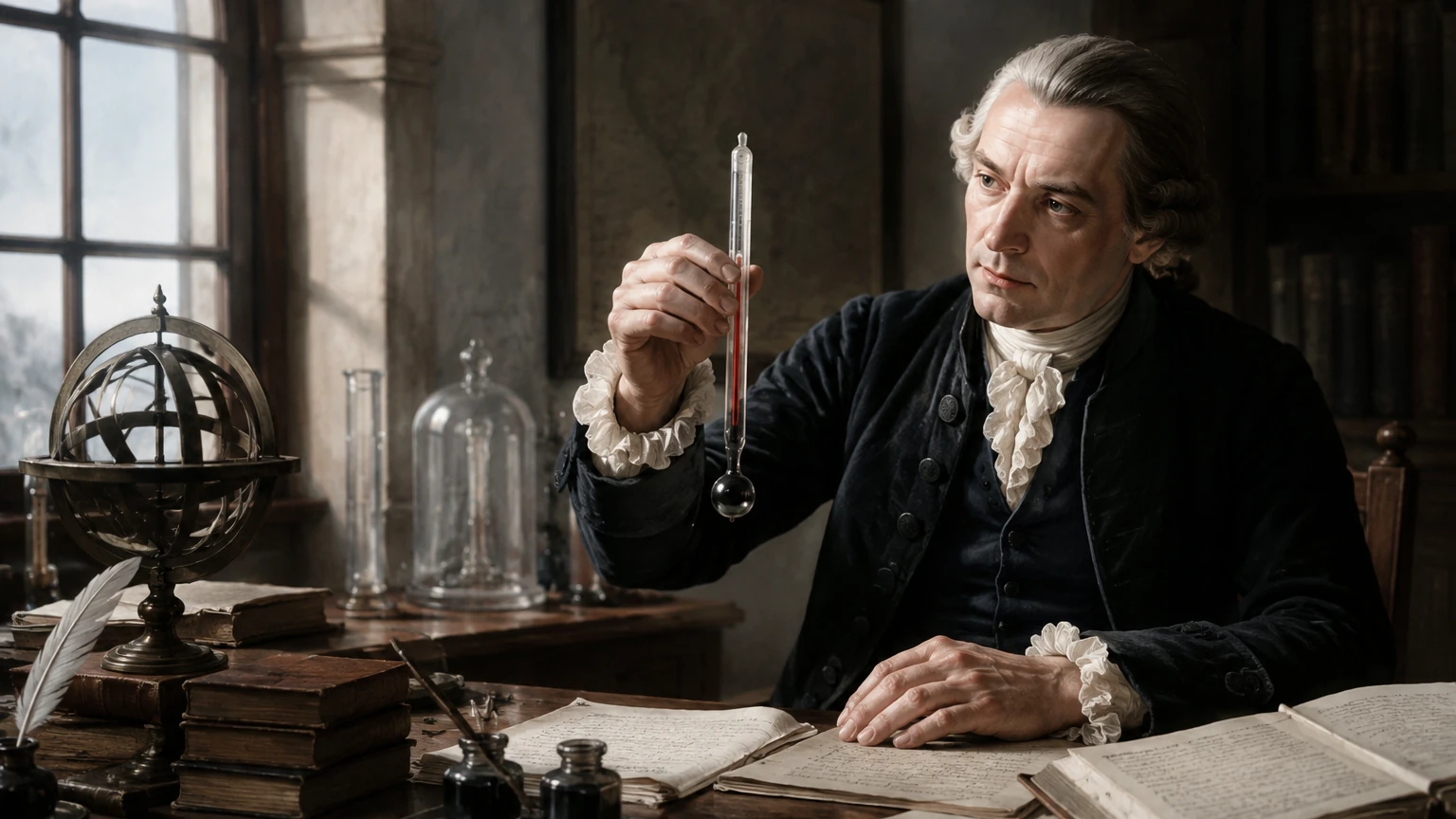
While many contributed to the early designs, Daniel Gabriel Fahrenheit is perhaps the most influential figure in the history of the thermometer. In 1714, he invented the first reliable mercury thermometer. Mercury was a superior choice for industrial and scientific use because it does not stick to the glass, remains liquid over a wide temperature range, and expands linearly with temperature changes.
Fahrenheit also introduced the Fahrenheit scale, which provided the first standardized reference points (the freezing and boiling points of water). This standardization was the precursor to the rigorous calibration standards required for modern industrial sensors found on the Main Page of instrumentation catalogs today.
The Evolution of Temperature Scales
Following Fahrenheit, other scientists sought to simplify the scaling system for better international and scientific adoption.
* Anders Celsius (1742): The Swedish astronomer proposed a scale based on the properties of water at standard atmospheric pressure. Interestingly, his original scale placed the boiling point at 0° and the freezing point at 100°. It was later reversed to the 0–100° scale we use today.
* Lord Kelvin (1848): As thermodynamics became a formal field of study, William Thomson (Lord Kelvin) developed the Absolute Scale. The Kelvin scale starts at absolute zero, the point where all molecular motion ceases. This scale is vital in modern gas laws and high-precision industrial calculations.
Measurement Principles in Modern Industry
Today, the mechanical expansion of liquids has largely been replaced in industrial settings by electronic sensing. However, the fundamental principles established by the early inventors remain relevant. Modern temperature measurement generally falls into four categories:
1. Resistance Temperature Detectors (RTDs): These operate on the principle that the electrical resistance of a metal (usually platinum) changes predictably with temperature.
2. Thermocouples: These use two dissimilar metals joined at one end. A temperature difference between the junction and the reference point creates a voltage (the Seebeck effect).
3. Infrared (Non-contact): These measure the thermal radiation emitted by an object.
4. Bimetallic Strips: A mechanical method where two metals with different expansion coefficients are bonded together, causing the strip to bend as temperature changes.
Integration with Level Measurement
In many B2B applications, temperature and level measurement are inseparable. For instance, in hydrostatic level measurement, the density of a liquid changes with its temperature. To maintain accuracy, a level transmitter must often incorporate a temperature sensor to provide density compensation. This is why professional manufacturers like Welk integrate multi-parameter sensing into their industrial solutions.
Practical Selection Table for Temperature and Level Instrumentation
When selecting instrumentation for industrial tanks or process lines, engineers must balance accuracy, range, and environmental conditions.
| Technology | Measurement Principle | Best Use Case | Limitations |
| :— | :— | :— | :— |
| RTD (Pt100/Pt1000) | Electrical Resistance | High accuracy, stable long-term monitoring | Fragile in high-vibration environments |
| Thermocouple | Voltage (Seebeck Effect) | Extreme temperatures (up to 1700°C) | Lower accuracy than RTDs; requires compensation |
| Radar Level Meter | Microwave Reflection | Non-contact level measurement in harsh tanks | Higher initial investment |
| Hydrostatic Transmitter | Pressure vs. Liquid Column | Deep wells, open tanks, water treatment | Sensitive to liquid density changes |
| Ultrasonic Sensor | Sound Wave Reflection | Simple water/waste level monitoring | Affected by foam, steam, and heavy dust |
Installation Considerations for Process Sensors
Regardless of who was the inventor of the thermometer or the level gauge, the accuracy of the device depends heavily on proper installation. For industrial B2B environments, follow these engineering guidelines:
1. Immersion Depth: For temperature sensors, ensure the probe is immersed deep enough to avoid "stem conduction" errors, where the ambient temperature of the pipe wall affects the reading. A general rule is an immersion depth of at least 10 times the diameter of the protection tube.
2. Thermowells: In high-pressure or corrosive environments, always use a thermowell. This allows the sensor to be replaced without draining the process line or tank.
3. Level Sensor Positioning: For radar or ultrasonic level meters, avoid mounting the sensor in the center of a domed tank or near the filling inlet, as this can cause false echoes or signal interference.
4. Wiring and Shielding: Use shielded cables for electronic transmitters to prevent electromagnetic interference (EMI) from heavy machinery or variable frequency drives (VFDs).
Limitations and Environmental Factors
Modern sensors are robust, but they are not universal. Engineers must account for:
* Thermal Lag: The time it takes for a sensor to register a change in process temperature. This is influenced by the mass of the thermowell and the conductivity of the process fluid.
* Vibration: Constant mechanical stress can fatigue the internal wiring of RTDs or the ceramic elements in pressure sensors.
* Chemical Compatibility: Ensure that the wetted parts (the materials touching the fluid) are compatible with the process media. Stainless steel (316L), PTFE, and Hastelloy are common choices for corrosive chemical applications.
Frequently Asked Questions (FAQ)
Q: Why was mercury used in thermometers for so long?
A: Mercury has a very uniform coefficient of expansion, meaning it expands at a consistent rate across a wide temperature range. It also has a high boiling point (356.7°C) and does not wet the glass, making it easy to read. However, due to toxicity, it has been phased out in favor of digital sensors and non-toxic liquids.
Q: What is the difference between a thermoscope and a thermometer?
A: A thermoscope indicates a change in temperature without a scale, whereas a thermometer includes a scale that allows for a numerical measurement.
Q: How does temperature affect level measurement accuracy?
A: For hydrostatic level sensors, temperature changes the density of the liquid. If the density decreases (due to heating), the pressure at the bottom of the tank decreases even if the volume remains the same. Modern transmitters use integrated temperature data to correct these errors.
Q: Which inventor's scale is used in industrial automation?
A: Most industrial systems use Celsius for standard process monitoring, though Kelvin is used in specialized gas and cryogenic applications. In the United States, Fahrenheit is still common in some legacy oil and gas sectors.
Conclusion
From Galileo's first air thermoscope to the precision radar and hydrostatic level meters of today, the history of measurement is a story of refining accuracy. While the question of who was the inventor of the thermometer leads us back to the 16th and 17th centuries, the legacy of those pioneers lives on in every automated factory and water treatment plant.
For engineers and procurement professionals, choosing the right instrument involves understanding these physical principles and applying them to modern challenges. Whether you require a radar level meter for a chemical reactor or a hydrostatic transmitter for a reservoir, selecting a reliable partner is essential. To explore a full range of industrial measurement solutions, visit the Main Page for detailed product specifications and application support. By combining historical principles with cutting-edge technology, Welk continues to provide the accuracy and reliability that modern industry demands.