Accuracy of Radar Level Transmitter
Accuracy of Radar Level Transmitter: An Engineering Guide to Precision Measurement
In industrial process automation, the precision of level measurement directly impacts safety, inventory management, and process efficiency. Among the various technologies available, Radar Level Meters have emerged as the industry standard for non-contact measurement in challenging environments. However, understanding the factors that define the accuracy of radar level transmitter systems is essential for engineers and procurement specialists to ensure the selected instrument meets the specific demands of their application.
This guide explores the technical foundations of radar accuracy, the variables that influence performance in the field, and the practical considerations for selecting and installing these instruments.
Measurement Principles and Their Impact on Accuracy
Radar level transmitters operate by emitting electromagnetic waves (microwaves) toward the surface of a medium and measuring the reflected signal. The accuracy of the measurement is fundamentally linked to how the instrument processes these signals. There are two primary methods used in modern industrial radar:
1. Pulse Radar (Time-of-Flight)
Pulse radar transmitters emit a short microwave pulse and measure the time it takes for the pulse to travel to the surface and back to the sensor. Since the speed of light is constant, the distance is calculated as:
*Distance = (Speed of Light × Travel Time) / 2*.
While effective for many applications, pulse radar accuracy can be influenced by the resolution of the internal timer. In older or lower-frequency models, the "pulse" can be relatively wide, leading to a broader margin of error, typically in the range of ±5 mm to ±15 mm.
2. FMCW (Frequency Modulated Continuous Wave)
FMCW radar transmits a continuous signal with a constantly changing frequency. The transmitter compares the frequency of the emitted signal with the frequency of the reflected signal. The frequency difference is directly proportional to the distance.
FMCW technology generally provides superior accuracy of radar level transmitter performance compared to pulse radar. Because it operates in the frequency domain rather than the time domain, it can distinguish between the true level and background noise more effectively. High-end FMCW units, particularly those operating at 80GHz, can achieve accuracies of ±1 mm or better.
Factors Influencing the Accuracy of Radar Level Transmitter
While a datasheet may specify an accuracy of ±2 mm under laboratory conditions, real-world industrial environments introduce variables that can degrade this performance. Understanding these factors is critical for maintaining measurement integrity.
Dielectric Constant ($ε_r$)
The dielectric constant of the material being measured is the most significant factor in signal reflection. Materials with high dielectric constants (e.g., water, $ε_r ≈ 80$) reflect signals strongly, providing a clear "peak" for the transmitter to identify. Materials with low dielectric constants (e.g., hydrocarbons, plastics, or liquefied gases with $ε_r < 2.0$) reflect very little energy.
If the dielectric constant is too low, the signal-to-noise ratio (SNR) decreases, making it harder for the transmitter to distinguish the surface from the bottom of the tank or internal obstructions. This can lead to "signal loss" or a significant decrease in the accuracy of the reading.
Frequency and Beam Angle
The frequency of the radar (typically 6GHz, 26GHz, or 80GHz) dictates the beam angle.
- 6GHz (C-Band): Wide beam angle, better at penetrating foam or heavy dust, but prone to interference from tank walls and internal structures.
- 26GHz (K-Band): A middle-ground frequency suitable for most liquid applications.
- 80GHz (W-Band): Very narrow beam angle (often as small as 3°). A narrower beam avoids internal obstructions like agitators, heating coils, and ladders, which significantly improves the practical accuracy in complex vessels.
Environmental Conditions
Unlike ultrasonic sensors, radar waves are largely unaffected by air temperature, pressure, or vacuum. However, heavy steam, extremely high pressure (which changes the density of the gas phase), or build-up on the antenna can cause slight propagation delays or signal attenuation. For instance, in high-pressure saturated steam, the speed of the radar signal can decrease slightly, requiring a correction factor to maintain the accuracy of radar level transmitter outputs.
Technical Specification Comparison
When evaluating Radar Level Meters, it is helpful to compare technologies based on their typical performance parameters. The following table provides a general reference for engineering selection.
| Feature | 6GHz Pulse Radar | 26GHz Pulse/FMCW | 80GHz FMCW Radar |
| :— | :— | :— | :— |
| Standard Accuracy | ±10 mm to ±15 mm | ±2 mm to ±5 mm | ±1 mm |
| Beam Angle | 20° – 30° | 8° – 12° | 3° – 4° |
| Max Range | 30 meters | 70 meters | 120+ meters |
| Dielectric Limit | ε_r > 2.0 | ε_r > 1.6 | ε_r > 1.2 |
| Best Use Case | Large basins, foam | Process tanks, bypass pipes | Narrow silos, agitators, high precision |
Installation Considerations to Preserve Accuracy
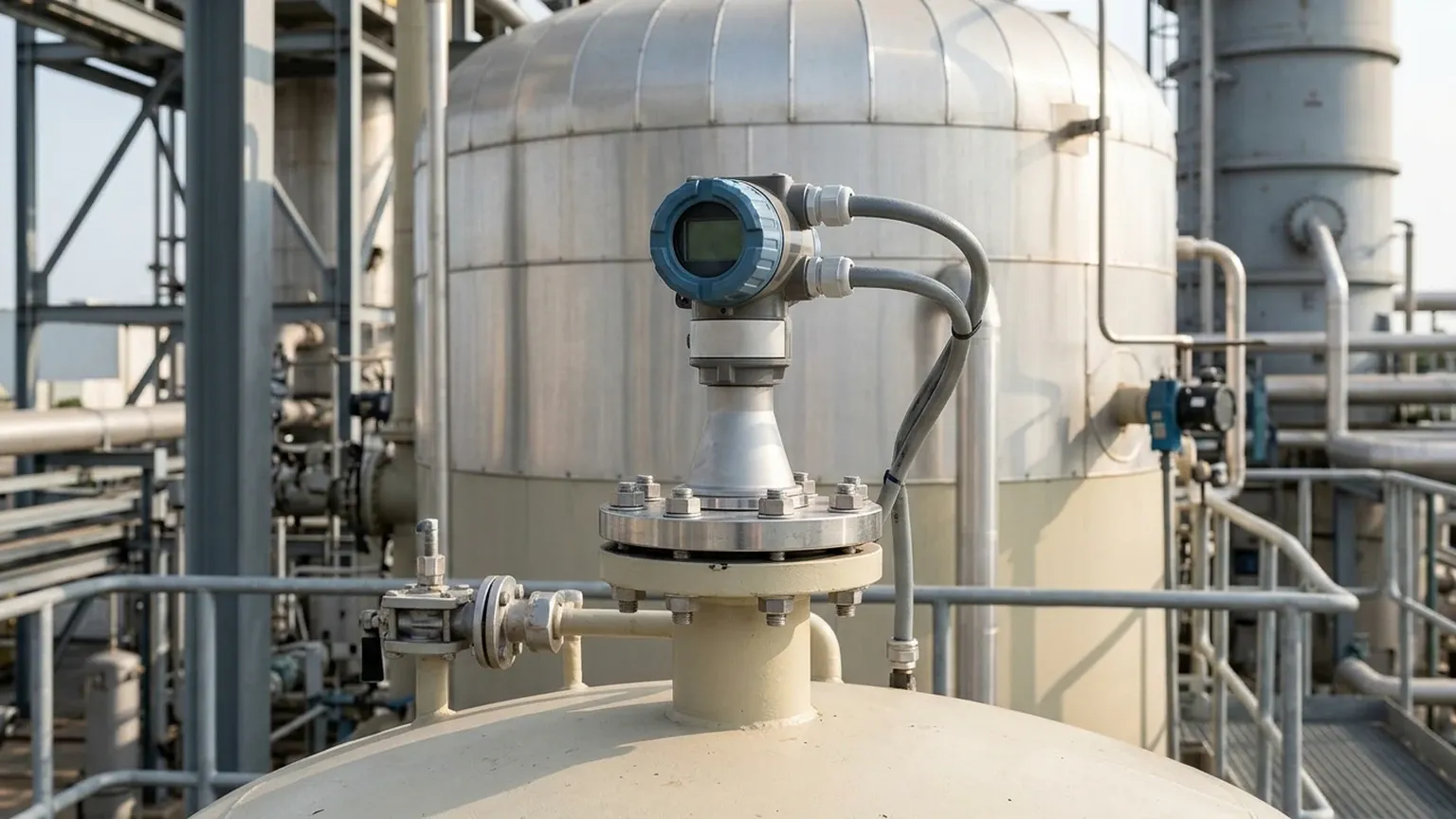
Even the most accurate transmitter will provide unreliable data if installed incorrectly. To ensure the accuracy of radar level transmitter systems, engineers should follow these installation boundaries:
1. Avoid the Center: Do not install the transmitter in the exact center of a circular tank. This can cause multiple reflections to converge, amplifying noise and creating false echoes.
2. The 1/6th Rule: For flat-roofed tanks, a common rule of thumb is to install the sensor at a distance of 1/6th of the tank diameter from the wall. This balances the need to stay away from the wall (to avoid signal drag) and the need to stay away from the center.
3. Nozzle Height and Diameter: The antenna should ideally extend slightly beyond the mounting nozzle. If the nozzle is too long or narrow, it can create "ringing" or internal reflections that interfere with the near-zone measurement accuracy.
4. Inlet Streams: Never install the sensor where the filling stream will pass directly through the radar beam. This will cause the transmitter to read the level of the falling liquid rather than the tank contents.
5. Obstruction Mapping: Modern transmitters allow for "False Echo Suppression." During commissioning, the tank should be empty or at a low level so the transmitter can record and ignore reflections from fixed internal structures like pipes or ladders.
Limitations and Challenges
While radar is highly versatile, it is not a universal solution. Certain conditions present challenges to accuracy:
- Heavy Foam: While some radar frequencies can penetrate light foam, dense, thick foam (like shaving cream) can absorb the radar signal entirely or reflect it from the top of the foam rather than the liquid surface.
- Turbulence: Severe surface agitation can scatter the radar signal. While software algorithms can average these readings to provide a stable output, the absolute accuracy during high turbulence will be lower than in a calm state.
- Condensation and Build-up: While many radar antennas are designed with PTFE covers to shed moisture, extreme build-up of conductive or sticky material can attenuate the signal.
Frequently Asked Questions (FAQ)
Q: Does the material temperature affect the accuracy of radar level transmitter units?
A: Generally, no. Radar waves travel at the speed of light and are not significantly affected by temperature changes in the vapor space, unlike ultrasonic waves which are dependent on the speed of sound. However, extreme temperatures may require specialized cooling or standoff sections to protect the electronics.
Q: What is the difference between accuracy and repeatability?
A: Accuracy refers to how close the measured value is to the actual physical level. Repeatability refers to the ability of the instrument to provide the same measurement under identical conditions. In many process control loops, high repeatability is more important than absolute accuracy.
Q: How often should a radar level transmitter be calibrated?
A: In stable environments, radar transmitters are virtually maintenance-free. However, for custody transfer or highly regulated industries (like pharmaceutical or chemical), annual verification against a manual dip-tape or a secondary reference is recommended.
Q: Can radar measure through a plastic tank wall?
A: Yes, if the tank is made of a non-conductive material like PE, PP, or GRP and is not reinforced with metal, the radar can measure the level from the outside, though this may slightly impact the signal strength and absolute accuracy.
Conclusion
Achieving the desired accuracy of radar level transmitter performance requires a holistic approach that considers the measurement principle, the dielectric properties of the medium, and the geometry of the vessel. By selecting the appropriate frequency—such as 80GHz for high-precision or complex environments—and adhering to strict installation guidelines, industrial users can ensure reliable, long-term level monitoring. For critical applications, consulting with a professional manufacturer like Welk ensures that the instrument is correctly specified for the unique challenges of your process.