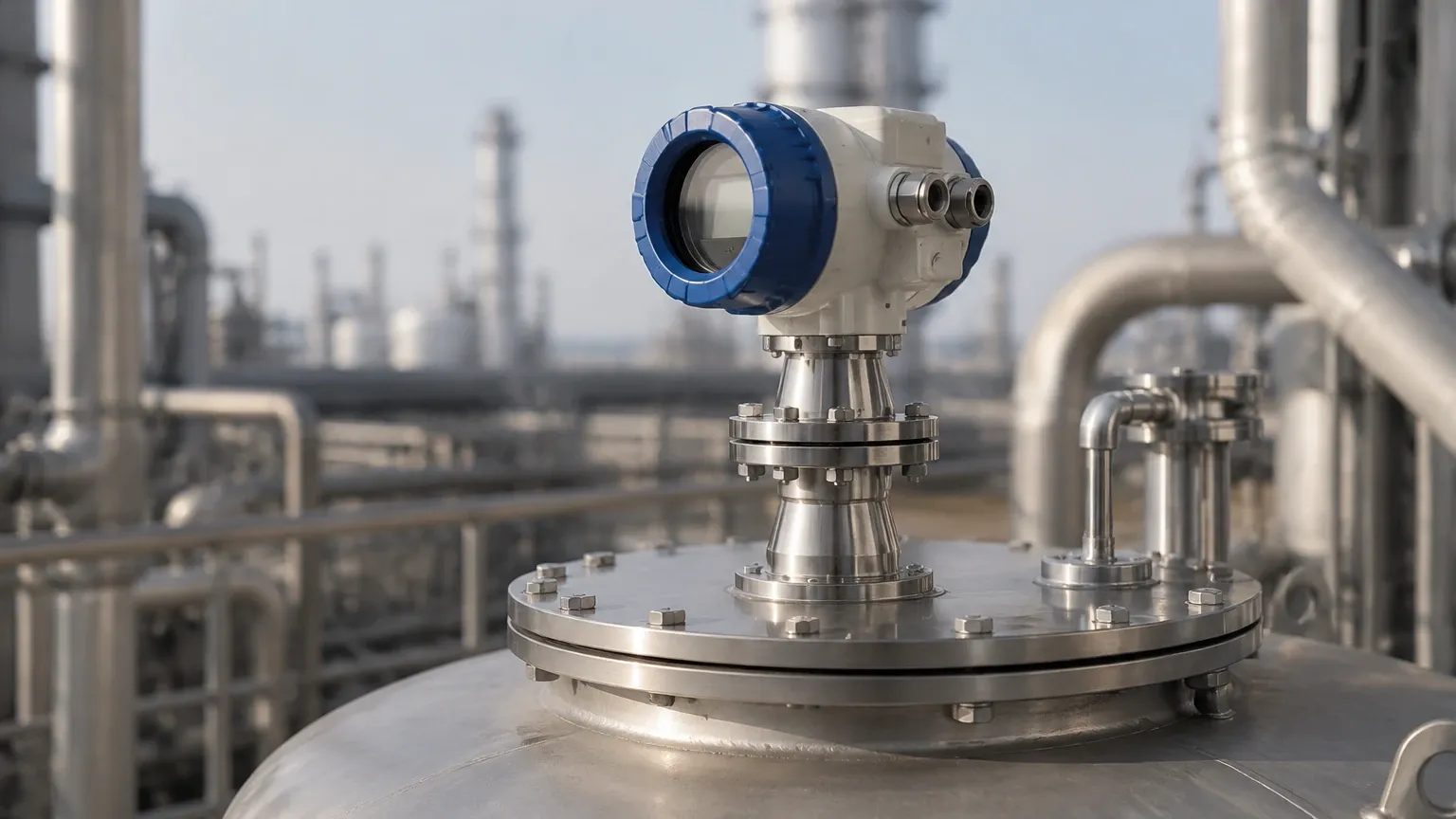
Emerson 5300 Radar Level Transmitter
Emerson 5300 Radar Level Transmitter: Engineering Principles and Application Guide
In modern industrial process control, accurate level measurement is fundamental to safety, efficiency, and inventory management. Among the various technologies available, the emerson 5300 radar level transmitter has established itself as a benchmark for Guided Wave Radar (GWR) performance. However, selecting the right instrumentation requires a deep understanding of how these devices interact with the process media and the physical constraints of the vessel.
This guide explores the technical foundations of GWR technology, compares it within the broader context of Radar Level Meters, and provides practical selection and installation criteria for engineering professionals.
Understanding the Measurement Principle
Radar level measurement generally falls into two categories: non-contact (air-gap) and contact (guided wave). The Emerson 5300 utilizes Guided Wave Radar technology based on the principle of Time Domain Reflectometry (TDR).
Time Domain Reflectometry (TDR)
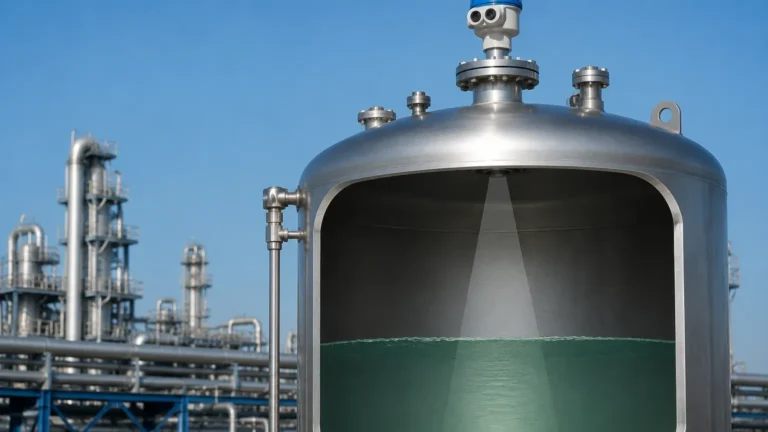
In a GWR system, low-power microwave pulses are sent down a probe (the waveguide) immersed in the process media. When these pulses reach the surface of the product, a portion of the energy is reflected back to the transmitter due to the change in the dielectric constant (εr) between the vapor space and the liquid.
The transmitter measures the time it takes for the pulse to travel down the probe and back. Since the speed of light is constant, the distance is calculated using the formula:
Distance = (Speed of Light × Time Delay) / 2
Unlike non-contact Radar Level Meters, which broadcast signals through the air, GWR concentrates the energy along a physical path. This makes the technology significantly more resistant to internal tank obstructions, turbulence, foam, and varying vapor space conditions (such as high pressure or steam).
Direct Switch Technology (DST)
The Emerson 5300 series often incorporates Direct Switch Technology, which enhances the signal-to-noise ratio. By switching the signal directly at the probe electronics rather than through traditional cabling, the device can detect weaker reflections. This is particularly critical when measuring liquids with low dielectric constants, such as hydrocarbons or liquefied gases.
Key Features of the Emerson 5300
The 5300 series is designed for challenging applications, offering several technical advantages:
1. High Sensitivity: Capable of measuring media with a dielectric constant as low as 1.2.
2. Interface Measurement: It can simultaneously measure the top liquid level and the interface level between two liquids (e.g., oil over water), provided the upper liquid has a lower dielectric than the lower liquid.
3. Probe Redundancy: Various probe designs allow the transmitter to be adapted to corrosive, high-pressure, or high-temperature environments.
4. Verification: Advanced diagnostics allow for signal quality monitoring and remote verification, reducing the need for manual tank climbs.
Practical Selection Criteria
Choosing the correct configuration for an emerson 5300 radar level transmitter depends on several environmental and chemical factors. Engineers must evaluate the following parameters before procurement.
Media Dielectric Constant (εr)
The dielectric constant is the most critical factor in GWR selection. It determines how much energy is reflected.
* High εr (>10): Water-based liquids provide strong reflections and are easy to measure.
* Low εr (1.2 to 2.5): Hydrocarbons and solvents reflect very little energy. These require coaxial probes or high-sensitivity electronics to ensure signal stability.
Probe Type Selection
The probe is the "antenna" of the GWR system. The choice of probe impacts the device's ability to handle viscosity, coating, and tank geometry.
| Probe Type | Best Application | Advantages | Limitations |
| :— | :— | :— | :— |
| Coaxial | Low dielectric liquids, clean fluids | Highest signal strength; immune to tank noise | Prone to clogging; not for viscous or coating media |
| Twin Lead | Long range, mid-dielectric | Better signal than single lead | Susceptible to bridging between leads; difficult to clean |
| Single Lead | Viscous liquids, slurry, coating | Resists buildup; easiest to clean | Lowest signal strength; requires larger clearance from tank walls |
Process Conditions
* Temperature: Standard models typically handle up to 150°C, while high-temperature versions can reach 400°C.
* Pressure: Ratings vary from vacuum up to 345 bar (approx. 5000 psi).
* Corrosion: Ensure probe materials (316L Stainless Steel, Hastelloy, Monel, or PTFE coating) are compatible with the process fluid.
Installation Considerations and Constraints
Even the most advanced Radar Level Meters will fail if installed incorrectly. For the Emerson 5300, adherence to physical clearances is mandatory.
Nozzle Geometry
The nozzle height and diameter can create "ringing" or parasitic reflections. Ideally, the nozzle should be as short as possible. If a tall nozzle is necessary, a coaxial probe is often recommended to isolate the signal from the nozzle walls.
Obstruction Clearance
For single-lead probes, a minimum clearance from the tank wall and internal structures (ladders, agitators, pipes) must be maintained. A general rule of thumb is a 100mm (4 inches) clearance, though this increases as the dielectric constant of the media decreases.
The Upper and Lower Transition Zones (Dead Zones)
Every GWR has a "transition zone" at the very top (near the process connection) and the very bottom (near the probe end) where measurement is either impossible or less accurate.
* Upper Transition Zone: Typically 100mm to 500mm depending on the probe and media.
* Lower Transition Zone: Usually 50mm to 150mm.
Engineers must ensure the working range of the tank falls between these two zones to avoid "loss of echo" errors.
Application Risks and Limitations
While GWR is highly versatile, it is not a universal solution. Engineers should be aware of the following risks:
1. Heavy Coating and Bridging: While single-lead probes handle some coating, extreme buildup or bridging between a probe and the tank wall can cause the transmitter to report a static high-level reading.
2. Emulsion Layers: In interface applications, a thick emulsion layer (rag layer) can scatter the radar signal, making it difficult for the device to distinguish between the two liquids.
3. Mechanical Stress: In high-turbulence tanks or vessels with heavy agitators, the lateral forces on a long probe can cause it to bend or break. In these cases, probe centering disks or stilling wells may be required.
4. Probe Length Limits: Rigid probes are typically limited to 6 meters (approx. 20 feet). For deeper tanks, flexible cable probes are used, but these require a weight at the bottom to stay vertical.
International Buyer Checklist
For procurement officers and engineers sourcing the emerson 5300 radar level transmitter or equivalent high-end Radar Level Meters for international projects, the following technical confirmations are essential:
* Hazardous Area Certifications: Confirm if ATEX, IECEx, or FM Global certifications are required for the specific zone (Zone 0, 1, or 2).
* Safety Integrity Level (SIL): Does the process require a SIL 2 or SIL 3 rated device for functional safety loops?
* Material Traceability: Request Mill Test Reports (MTRs) if the application involves high-pressure or corrosive chemicals.
* Output Protocol: Ensure compatibility with the host system (4-20mA HART, Foundation Fieldbus, or Modbus RS485).
* OEM/ODM Alternatives: In some industrial automation scenarios, specialized manufacturers like Welk provide customized level measurement solutions that offer comparable accuracy and reliability with shorter lead times for specific industrial footprints.
Frequently Asked Questions (FAQ)
Q: Can the Emerson 5300 measure solids or powders?
A: Yes, GWR is effective for solids with a high enough dielectric constant. However, the probe must be able to withstand the pull-down forces (tensile load) exerted by the solid material as it settles.
Q: Does the vapor space pressure affect the accuracy?
A: Unlike ultrasonic sensors, radar signals are largely unaffected by pressure. However, extremely high-pressure steam can slightly slow down the microwave pulse. High-end transmitters often include "Vapor Compensation" features to correct for this.
Q: What is the difference between the 5301 and 5302 models?
A: Typically, the 5301 is designed for standard liquid level measurement, while the 5302 is optimized for interface measurement applications where both a top level and a secondary liquid level are required.
Q: How often does the transmitter require calibration?
A: GWR technology is virtually drift-free because it relies on the speed of light. Periodic "proof testing" is recommended to ensure the electronics are functioning, but the physical calibration rarely changes unless the probe is damaged.
Conclusion
The emerson 5300 radar level transmitter represents a sophisticated solution for complex level and interface challenges. By concentrating microwave energy along a probe, it overcomes the limitations of traditional non-contact Radar Level Meters in turbulent or low-dielectric environments. Success in implementation, however, relies on rigorous attention to probe selection, media characteristics, and installation clearances. For engineers seeking reliable process data, understanding these factual boundaries is the first step toward operational excellence.