5 Inch Into Meter
5 Inch Into Meter
In industrial automation and process control, precision is the foundation of safety and efficiency. Engineers often encounter the need to bridge the gap between imperial and metric systems, particularly when integrating legacy equipment with modern digital controllers. Converting 5 inch into meter measurements (0.127 meters) is more than a simple mathematical exercise; it is a critical step in calibrating Ultrasonic Level Meters and ensuring that sensor "dead zones" or nozzle heights are correctly accounted for in system logic.
This guide explores the technical implications of short-range measurements, the fundamental principles of ultrasonic technology, and how to select the right instrumentation for applications where every millimeter counts.
Measurement Principles of Ultrasonic Technology
Before diving into specific conversions and installation geometries, it is essential to understand how ultrasonic sensors operate. Ultrasonic level measurement is a non-contact technology that relies on the Time-of-Flight (ToF) principle.
The Time-of-Flight (ToF) Equation
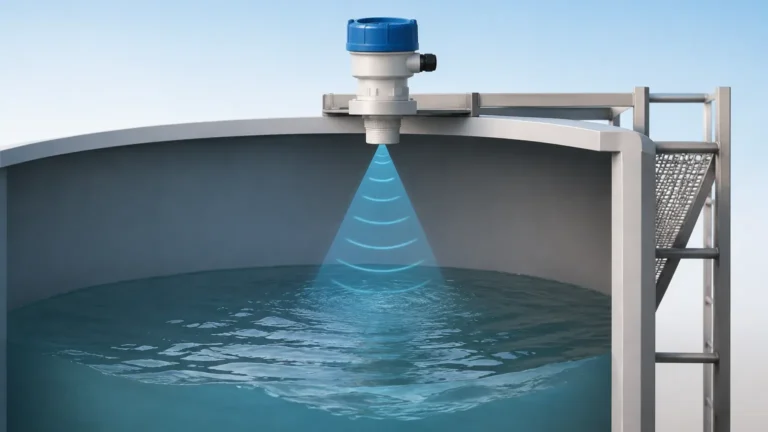
An ultrasonic transducer emits a high-frequency sound pulse (typically between 20 kHz and 200 kHz). This pulse travels through the air, reflects off the surface of the medium (liquid or solid), and returns to the transducer. The sensor’s internal processor measures the time interval between the emission and the reception of the echo.
The distance is calculated using the formula:
D = (c × t) / 2
Where:
* D is the distance from the sensor to the material surface.
* c is the speed of sound in the medium (approximately 343 m/s in air at 20°C).
* t is the total elapsed time for the pulse to travel to the surface and back.
Since the speed of sound is affected by air temperature, modern devices like those manufactured by Welk include integrated temperature compensation to maintain accuracy across varying environmental conditions.
Converting 5 Inch Into Meter: Technical Context
In the context of industrial instrumentation, the conversion of 5 inch into meter units is frequently required for specifying "Blocking Distances" or "Dead Zones."
Conversion Calculation:
* 1 inch = 0.0254 meters
* 5 inches × 0.0254 = 0.127 meters (or 127 millimeters)
Why the 5-Inch (0.127m) Threshold Matters
In many compact ultrasonic sensor designs, the minimum measurable distance—often called the dead zone—falls within the 0.1m to 0.15m range. If a liquid level rises within 5 inches of the transducer face, the sensor cannot switch from "transmit" to "receive" mode fast enough to capture the returning echo. This results in a loss of signal or an error reading. Understanding this 0.127m boundary is vital for tank designers to ensure that the maximum fill level never enters this zone.
Selection Criteria for Ultrasonic Level Meters
Choosing the correct instrument requires evaluating the physical properties of the application against the sensor's capabilities. For short-range applications involving dimensions like 5 inches or 0.127 meters, the following criteria are paramount:
1. Measurement Range and Dead Zone
Every sensor has a specified range (e.g., 0.1m to 5m). For small tanks, you must select a sensor with a dead zone smaller than the distance from the mounting point to the highest possible liquid level. If your tank headspace is limited to 5 inches, you must use a sensor specifically designed with a very short blocking distance or utilize a standpipe to move the sensor further away from the liquid.
2. Beam Angle
Ultrasonic pulses spread out in a cone shape. A 5-inch diameter nozzle may cause interference if the beam angle is too wide. Sensors with a narrow beam angle (e.g., 5° to 10°) are preferred for narrow tanks or tanks with internal obstructions like ladders or agitators.
3. Material Compatibility
Welk provides sensors with various wetted materials, including PVDF or PTFE, for corrosive chemical applications. Ensure the transducer housing can withstand the vapors present in the headspace.
4. Output Protocols
Integration into a B2B automation environment requires standard outputs. Common options include:
* 4-20mA Analog (Standard for long-distance transmission)
* RS485 Modbus (Ideal for multi-drop digital networking)
* HART Protocol
Practical Selection Table: Imperial to Metric Reference
When designing systems, engineers often refer to standard pipe sizes and mounting heights. The following table provides quick conversions for common industrial dimensions related to sensor mounting.
| Imperial (Inches) | Metric (Meters) | Metric (Millimeters) | Typical Application Context |
| :— | :— | :— | :— |
| 1" | 0.0254 m | 25.4 mm | Small nozzle diameter |
| 2" | 0.0508 m | 50.8 mm | Standard mounting flange size |
| 4" | 0.1016 m | 101.6 mm | Common dead zone for mid-range sensors |
| 5" | 0.1270 m | 127.0 mm | Critical blocking distance threshold |
| 6" | 0.1524 m | 152.4 mm | Minimum clearance for wide-beam sensors |
| 12" (1 ft) | 0.3048 m | 304.8 mm | Standard standoff pipe height |

Installation Considerations and Best Practices
To ensure the accuracy of Ultrasonic Level Meters, proper installation is as important as the device's technical specifications.
Avoiding the Dead Zone
As established, the 5 inch into meter conversion (0.127m) represents a common dead zone. If the liquid level is expected to reach the top of the tank, install the sensor on a "nozzle" or "standpipe." This effectively raises the sensor 5 to 10 inches above the tank roof, ensuring the liquid never enters the blocking distance.
Nozzle Geometry
The internal surface of the mounting nozzle should be smooth. Welds, burrs, or sharp edges within a 5-inch diameter nozzle can create "false echoes" that the sensor may mistake for the liquid level. If a nozzle is used, ensure the transducer face extends slightly beyond the bottom of the nozzle or that the nozzle diameter is large enough to accommodate the beam spread.
Mounting Orientation
The sensor must be mounted perfectly perpendicular to the liquid surface. Even a small tilt can cause the ultrasonic pulse to reflect away from the transducer, resulting in a "Signal Lost" error. In tanks with turbulent surfaces, a stilling well (a vertical pipe with vent holes) can be used to provide a calm surface for measurement.
Limitations of Ultrasonic Technology
While highly versatile, ultrasonic sensors are not suitable for every environment. Engineers should be aware of the following limitations:
1. Vacuum Conditions: Sound requires a medium to travel. Ultrasonic sensors will not function in a vacuum.
2. Heavy Foam: Thick, dense foam can absorb the ultrasonic pulse rather than reflecting it, leading to inaccurate readings or signal loss.
3. High Pressure/Temperature: Extreme pressure changes the density of the air, which affects the speed of sound. While Welk sensors compensate for temperature, extreme fluctuations or high-pressure steam can interfere with the acoustic signal.
4. Dust and Vapor: Heavy dust (in silos) or dense steam can scatter the ultrasonic signal. In these cases, Radar level meters may be a more robust alternative.
Frequently Asked Questions (FAQ)
Q1: How do I convert 5.5 inches into meters for sensor calibration?
To convert any inch value to meters, multiply by 0.0254.
5.5 inches × 0.0254 = 0.1397 meters.
Q2: Can I use an ultrasonic sensor if my tank is only 10 inches deep?
Yes, but you must select a sensor with a very small dead zone (less than 2 or 3 inches) or mount the sensor on a standoff pipe so that the total distance from the sensor to the tank bottom is greater than the dead zone.
Q3: Why does my sensor read 0.127m (5 inches) even when the tank is empty?
This often happens if the sensor is detecting a reflection from the bottom of a mounting nozzle or an internal obstruction located at that distance. Check for physical obstructions or use the "False Echo Suppression" feature in the sensor software to ignore that specific distance.
Q4: Does the speed of sound change significantly at 0.127 meters?
The speed of sound is independent of the distance traveled, but it is highly dependent on temperature. At 0.127 meters, the travel time is so short that even small timing errors can impact accuracy, which is why temperature compensation is vital even for short-range measurements.
Conclusion
Understanding the conversion of 5 inch into meter units is a fundamental requirement for the precise setup of industrial level measurement systems. Whether you are accounting for a 0.127m dead zone or designing a mounting nozzle for a Welk ultrasonic sensor, maintaining unit consistency ensures that your automation logic remains accurate. By following proper installation guidelines and selecting the appropriate sensor for your specific environmental conditions, you can achieve reliable, non-contact level monitoring across a wide range of industrial applications.