6 Ultrasonic Meter
6 Ultrasonic Meter
In industrial process automation, selecting the correct range and technology for level measurement is critical for both operational efficiency and safety. Among the various specifications available to engineers, the 6-meter range—often referred to in procurement as a 6 ultrasonic meter—represents one of the most versatile and widely deployed configurations. This guide examines the technical principles, selection criteria, and installation best practices for Ultrasonic Level Meters within this specific performance bracket.
Understanding the Measurement Principle
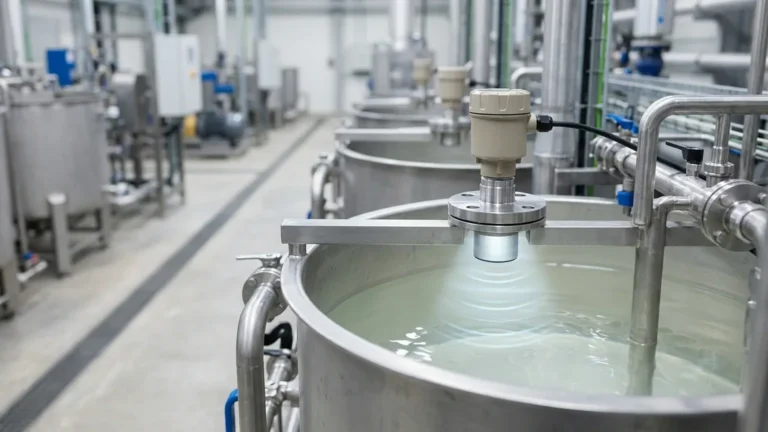
Ultrasonic level measurement is a non-contact technology that relies on the propagation of high-frequency sound waves. The sensor, or transducer, acts as both a transmitter and a receiver.
The Time-of-Flight (ToF) Method
The core principle is the Time-of-Flight (ToF) calculation. The transducer emits an ultrasonic pulse (typically between 20 kHz and 75 kHz) toward the surface of the material being measured. When the pulse hits the medium—whether liquid or solid—it is reflected back to the sensor.
The distance ($D$) from the sensor to the material surface is calculated using the formula:
$$D = \frac{c \times t}{2}$$
Where:
* $c$ is the speed of sound in the medium (air).
* $t$ is the time elapsed between transmission and reception.
Since the total distance the sound travels is twice the distance to the surface (down and back), the result is divided by two. By knowing the total height of the vessel ($H$), the electronics can then determine the level ($L$) of the material: $L = H – D$.
Temperature Compensation
The speed of sound ($c$) is not constant; it varies with the temperature of the air through which it travels. For instance, at 0°C, the speed of sound is approximately 331.5 m/s, while at 20°C, it increases to roughly 343.4 m/s. To maintain accuracy, a professional 6 ultrasonic meter includes an integrated temperature sensor to provide real-time compensation for these fluctuations.
Why the 6-Meter Range is an Industrial Standard
A "6 ultrasonic meter" typically specifies a maximum measuring range of 6 meters (approximately 19.7 feet). This specific range is a standard for several reasons:
1. Vessel Compatibility: Most intermediate bulk containers (IBCs), standard chemical storage tanks, and municipal water sumps fall within a 2-meter to 5-meter height range, making a 6-meter sensor ideal for providing full-scale coverage with a safety margin.
2. Signal Strength: Ultrasonic waves attenuate (lose energy) as they travel through the air. A 6-meter range allows for a transducer design that balances power consumption with a signal-to-noise ratio high enough to penetrate light dust or steam.
3. Dead Zone Optimization: Every ultrasonic sensor has a "dead zone" or blocking distance—a minimum distance from the transducer face where measurements cannot be taken. For a 6-meter sensor, this is typically between 0.25m and 0.35m, which is manageable for most tank geometries.
Technical Selection Criteria
When evaluating a 6 ultrasonic meter for your facility, consider the following technical parameters to ensure the device meets the application requirements.
Selection Table: Ultrasonic Level Meter Specifications
| Feature | Standard 6m Sensor | High-Accuracy 6m Sensor | Harsh Environment 6m Sensor |
| :— | :— | :— | :— |
| Accuracy | ±0.5% of full scale | ±0.25% of full scale | ±0.25% to ±0.5% |
| Beam Angle | 10° – 12° | 8° – 10° | 6° – 9° |
| Dead Zone | 0.30m | 0.25m | 0.35m |
| Output | 4-20mA / HART | 4-20mA / Modbus RTU | 4-20mA / RS485 |
| Housing Material | ABS / Nylon | PVDF / Stainless Steel | PTFE / PVDF |
| Pressure Limit | Atmospheric | Up to 2 Bar | Up to 3 Bar |
Beam Angle and Obstructions
The beam angle is the conical spread of the ultrasonic pulse. For a 6-meter measurement, a narrower beam angle is generally preferred. If the beam is too wide, it may hit the side walls of the tank or internal structures like ladders and agitators, creating "false echoes." Advanced signal processing in modern Ultrasonic Level Meters allows for "echo masking," where the sensor is taught to ignore specific static reflections.
Installation Considerations
Correct installation is the most significant factor in the reliability of a 6 ultrasonic meter. Even the highest-quality instrument will fail if the physical mounting is flawed.
1. The Dead Zone (Blocking Distance)
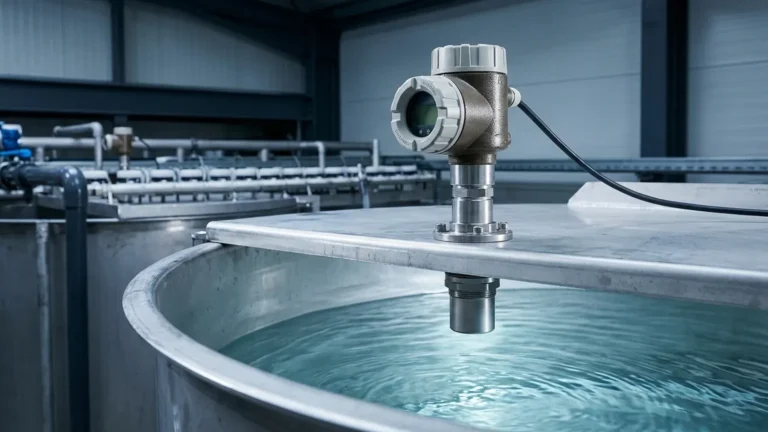
Never install the sensor so that the maximum liquid level enters the dead zone. If the liquid reaches this area, the sensor will report an incorrect reading or a "loss of echo" error. If the tank must be filled to the very top, use a standpipe or a mounting bracket to raise the sensor above the tank roof.
2. Positioning and Orientation
* Perpendicularity: The transducer face must be perfectly parallel to the liquid surface. A tilt of just a few degrees can cause the reflected signal to bounce away from the receiver, especially in 6-meter applications where the return signal is already weakened by distance.
* Wall Distance: Avoid mounting the sensor too close to the tank wall. A general rule of thumb is to maintain a distance from the wall equal to at least 1/6th of the tank height.
* Inflow Avoidance: Do not mount the sensor directly above the fill inlet. The turbulence and the falling stream of material will disrupt the ultrasonic pulse.
3. Standpipe Usage
In applications with heavy foam or surface turbulence, a stilling well or standpipe can be used. The pipe acts as a guide for the ultrasonic wave, protecting it from surface disturbances. However, the internal diameter of the pipe must be smooth, and the sensor's beam angle must be accounted for to prevent reflections from the pipe walls.
Limitations and Environmental Factors
While highly effective, the 6 ultrasonic meter is not a universal solution. Engineers must be aware of the following limitations:
* Vacuum Conditions: Ultrasonic waves require a medium (air or gas) to travel. They cannot function in a vacuum.
* Heavy Foam: Dense foam absorbs ultrasonic energy rather than reflecting it. If the application involves thick chemical foam, a radar level meter may be a more appropriate choice.
* High Pressure/Temperature: Extreme temperatures change the gas density significantly, and high pressure can affect the transducer's ability to vibrate. Most 6-meter ultrasonic units are rated for temperatures up to 70°C or 80°C.
* Vapor and Dust: While light dust is manageable, heavy steam or solvent vapors can change the composition of the air, altering the speed of sound and introducing measurement errors.
Practical Applications for 6-Meter Sensors
Water and Wastewater Treatment
The 6-meter range is the industry standard for monitoring open channel flow (using flumes or weirs) and measuring the level in wet wells and lift stations. Because the sensor is non-contact, it is not subject to fouling from sewage or corrosive chemicals used in water treatment.
Chemical Storage
For tanks containing acids, alkalis, or oils, a 6 ultrasonic meter with a PVDF or PTFE-coated transducer provides excellent chemical resistance. It allows for accurate inventory management without the risk of sensor corrosion or cross-contamination.
Industrial Automation
In manufacturing, these sensors are used for monitoring small silos containing plastic pellets, or for automated tank farms where multiple units are networked via RS485 or Modbus to a central PLC (Programmable Logic Controller).
Maintenance and Troubleshooting
One of the primary advantages of non-contact Ultrasonic Level Meters is the low maintenance requirement. However, periodic checks are recommended:
1. Transducer Cleaning: In high-humidity or dusty environments, condensation or buildup can occur on the transducer face. Wipe it periodically with a soft, damp cloth. Do not use abrasive cleaners.
2. Signal Strength Monitoring: Most modern digital meters provide a "Signal Strength" or "Confidence" value. If this value drops over time, it may indicate a developing obstruction or a change in the process environment (e.g., increased vapor).
3. Cable Integrity: Ensure that the cable glands are tight and that there is no moisture ingress into the electronic housing, which is a common cause of premature failure in outdoor installations.
Frequently Asked Questions (FAQ)
Q: Can a 6-meter ultrasonic sensor measure solids like grain or sand?
A: Yes, but with caveats. Solids do not reflect sound as efficiently as liquids and often have an uneven surface (angle of repose). This typically reduces the effective range of the sensor by 30% to 50%. A 6-meter sensor may only be reliable up to 3 or 4 meters when measuring solids.
Q: How do I handle a tank with an internal agitator?
A: Use the "False Echo Suppression" feature found in Welk ultrasonic instruments. By performing a "mapping" run while the tank is empty and the agitator is running, the software can identify and ignore the specific reflections caused by the blades.
Q: What is the difference between an integrated and a remote 6-meter meter?
A: An integrated unit has the sensor and the display/electronics in one housing. A remote unit connects the transducer to a separate controller via a cable. Remote units are preferred when the measurement point is difficult to access or when the electronics need to be protected from extreme local temperatures.
Q: Does the color of the liquid affect the measurement?
A: No. Unlike optical or laser sensors, ultrasonic technology is unaffected by the color, transparency, or opacity of the liquid.
By understanding the physical principles and environmental constraints of the 6 ultrasonic meter, project engineers can ensure a reliable, long-term solution for their level measurement needs. For specific application support or to view detailed product datasheets, explore the full range of Ultrasonic Level Meters designed for modern industrial challenges.