Ultrasonic Level Sensor Jsn-sr04t
Ultrasonic Level Sensor Jsn-sr04t
In the field of industrial automation and fluid management, non-contact level measurement has become a standard for ensuring reliability and hygiene. Among the various technologies available, ultrasonic sensors offer a balance of cost-effectiveness and accuracy. While many engineers are familiar with high-end industrial Ultrasonic Level Meters, the ultrasonic level sensor jsn-sr04t has gained significant attention as a specialized tool for specific low-cost or prototyping applications.
This guide explores the fundamental principles of ultrasonic measurement, evaluates the technical specifications of the JSN-SR04T module, and provides a comparative analysis to help procurement and engineering teams determine when to utilize modular sensors versus integrated industrial instruments.
Understanding Ultrasonic Measurement Principles
Before selecting a sensor, it is essential to understand the physics of acoustic level detection. Ultrasonic sensors operate on the "Time-of-Flight" (ToF) principle.
The Time-of-Flight Equation
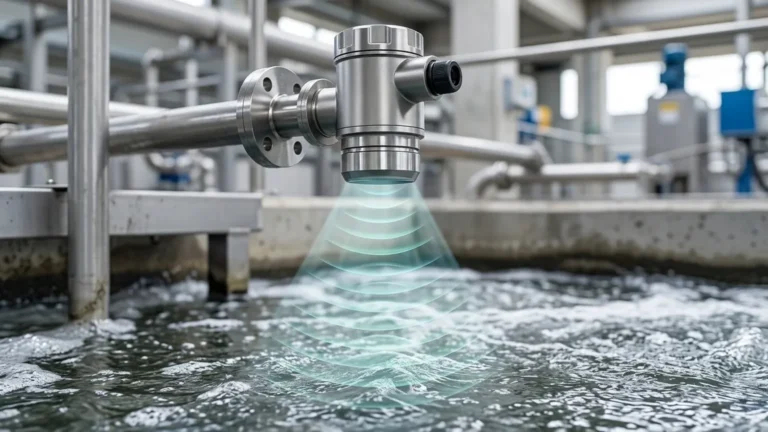
The sensor emits a high-frequency sound pulse (typically between 40 kHz and 200 kHz) toward the surface of a material. This pulse reflects off the surface and returns to the transducer. The distance is calculated using the following formula:
$$D = \frac{c \times t}{2}$$
Where:
* D is the distance to the liquid surface.
* c is the speed of sound in the medium (approximately 343 m/s in air at 20°C).
* t is the time elapsed between emission and reception.
Environmental Variables
The speed of sound is not a constant; it is highly dependent on the temperature of the air through which it travels. In air, the speed of sound increases by approximately 0.6 m/s for every degree Celsius increase in temperature. Professional Ultrasonic Level Meters typically include integrated temperature sensors to compensate for this variance automatically, ensuring accuracy across seasonal shifts.
Technical Profile of the Ultrasonic Level Sensor JSN-SR04T
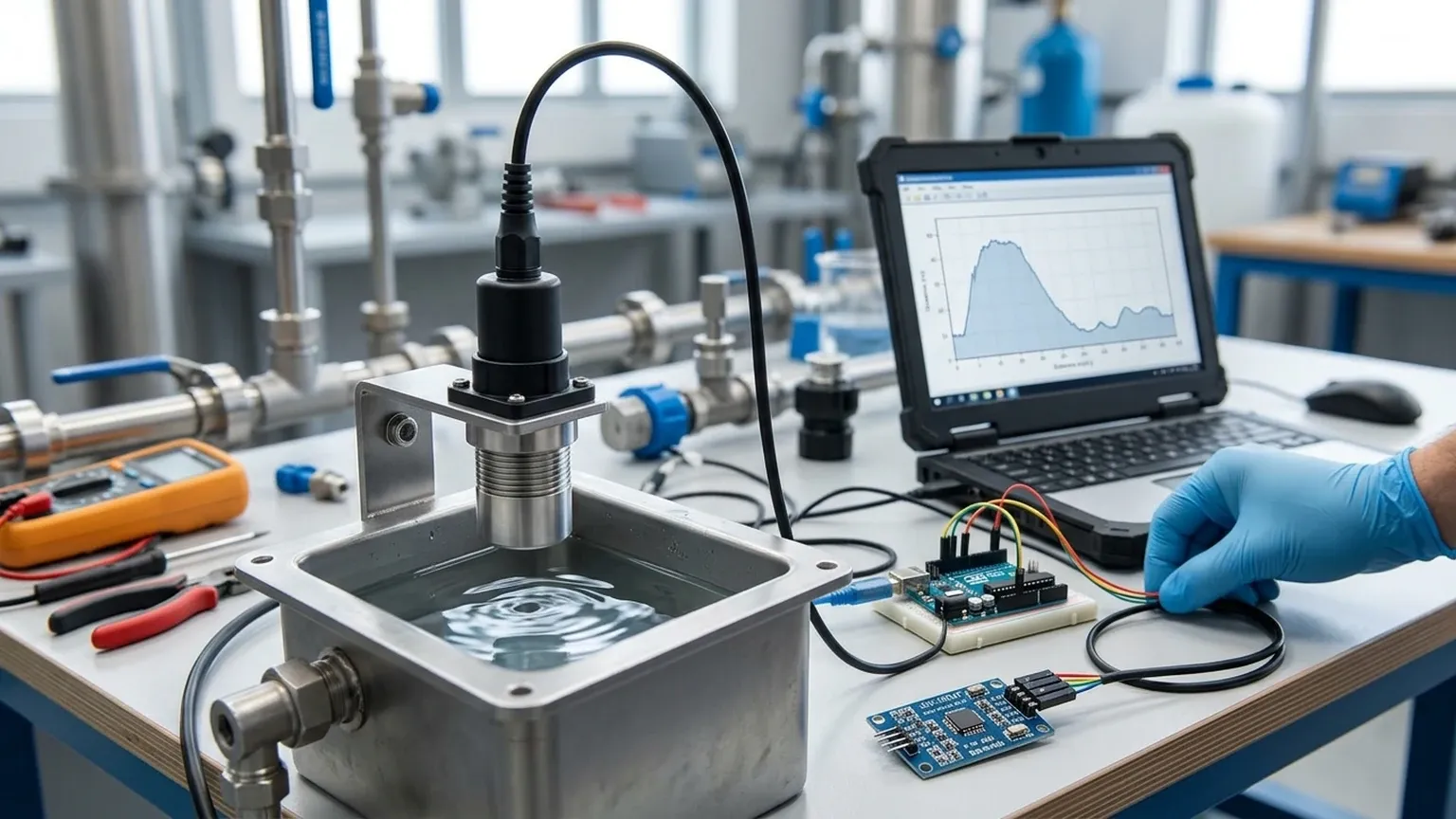
The ultrasonic level sensor jsn-sr04t is a waterproof ultrasonic range-finding module. Unlike standard hobbyist sensors (such as the HC-SR04), the JSN-SR04T features a separate, sealed probe connected to a control board via a cable. This design allows the transducer to be mounted in damp or outdoor environments while the electronics remain protected.
Key Specifications
* Operating Voltage: DC 3.0V to 5.5V
* Operating Current: Less than 8mA
* Acoustic Frequency: 40 kHz
* Measurement Range: 20 cm to 600 cm (approx. 8 inches to 19.6 feet)
* Resolution: 1 mm
* Beam Angle: Approximately 75 degrees
* Probe Protection: IP67 (transducer only)
Advantages and Limitations
The primary advantage of the JSN-SR04T is its waterproof probe, making it suitable for basic water tank monitoring or vehicle reversing systems. However, its wide beam angle can lead to "false echoes" if mounted in narrow tanks with internal obstructions like ladders or agitators. Furthermore, the control board itself is not waterproof and requires an additional enclosure for industrial use.
Industrial Comparison: JSN-SR04T vs. Professional Level Meters
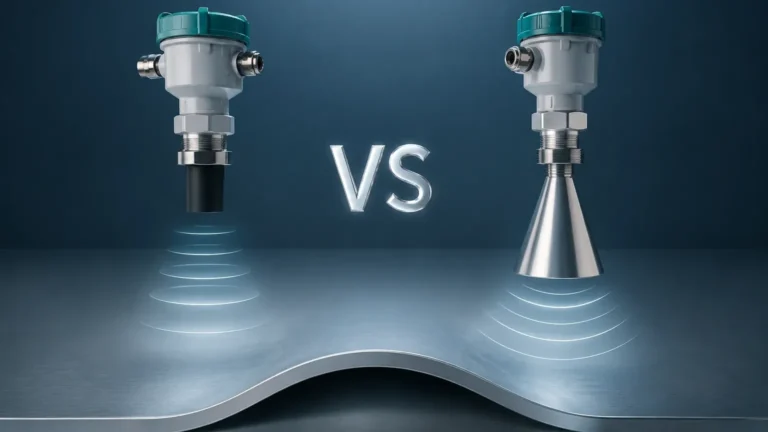
When transitioning from a pilot project to a full-scale industrial installation, engineers must evaluate whether a modular sensor like the JSN-SR04T meets the operational demands of the facility. Industrial-grade Ultrasonic Level Meters are designed for longevity, harsh chemical exposure, and integration with PLC/SCADA systems.
Selection Table: Modular vs. Industrial Sensors
| Feature | JSN-SR04T Module | Industrial Ultrasonic Meter (e.g., Welk Series) |
| :— | :— | :— |
| Output Signal | TTL Pulse / Serial | 4-20mA, RS485 (Modbus), HART |
| Housing | Exposed PCB | IP66/IP68 NEMA 4X Enclosure |
| Accuracy | ±1% to ±5% (uncompensated) | ±0.2% to ±0.5% (compensated) |
| Temp. Compensation | None (External logic required) | Integrated Automatic Compensation |
| False Echo Filtering | None | Advanced Signal Processing (DSP) |
| Mounting | Bracket/Custom | Threaded (NPT/G) or Flanged |
| Range | Up to 6m | Up to 30m+ |
Installation Considerations for Ultrasonic Sensors
Correct installation is the most critical factor in ensuring the accuracy of any ultrasonic level sensor. Whether using the ultrasonic level sensor jsn-sr04t or a high-end industrial unit, the following guidelines apply:
1. The Dead Zone (Blocking Distance)
Every ultrasonic sensor has a "dead zone" immediately in front of the transducer face where it cannot accurately measure. For the JSN-SR04T, this is typically 20 cm (approx. 8 inches). If the liquid level rises into this zone, the sensor will return erratic data. In industrial designs, this zone is minimized, but the sensor must still be mounted at a height that accounts for the maximum liquid level.
2. Beam Angle and Clearance
The beam of an ultrasonic sensor is cone-shaped. For a sensor with a 75-degree beam angle like the JSN-SR04T, the footprint of the signal expands significantly as the distance increases.
* Calculation: At a distance of 4 meters, a 75-degree beam has a diameter of several meters.
* Requirement: Ensure there are no pipes, walls, or brackets within this cone, as they will cause premature reflections.
3. Mounting Orientation
The transducer must be mounted perfectly perpendicular to the liquid surface. If the sensor is tilted, the sound wave will bounce away from the receiver, resulting in a "signal lost" error. For solids or powders, which form a conical heap, specialized Ultrasonic Level Meters with high-gain receivers are usually required.
Overcoming Environmental Challenges
In B2B applications such as wastewater treatment or chemical processing, environmental factors can interfere with acoustic signals.
Foam and Turbulence
Surface foam is a significant challenge for ultrasonic technology. Foam absorbs the sound pulse rather than reflecting it. If the process involves heavy agitation or chemical foaming, a radar level meter or a hydrostatic pressure transmitter may be more appropriate. However, for light foam, increasing the gain of an industrial ultrasonic meter can sometimes overcome the attenuation.
Vapor and Pressure
High-pressure environments or tanks with heavy solvent vapors change the density of the air. Since the speed of sound depends on medium density, these conditions can cause errors exceeding 10%. Industrial Ultrasonic Level Meters are typically rated for atmospheric pressure. For pressurized vessels, radar technology is generally preferred as electromagnetic waves are not affected by air density.
Integration and Data Acquisition
The ultrasonic level sensor jsn-sr04t typically outputs a TTL signal or a serial data stream. This is ideal for microcontroller integration (Arduino, ESP32) but is incompatible with standard industrial control loops.
For industrial environments, the signal must be converted or a dedicated meter must be used that provides:
* 4-20mA Current Loop: The industry standard for long-distance, noise-immune analog signaling.
* Modbus RTU: Allows for multiple sensors to be daisy-chained on a single twisted-pair cable for digital communication with a PLC.
Frequently Asked Questions (FAQ)
Q: Can the JSN-SR04T be used for fuel level measurement?
A: It is not recommended. The JSN-SR04T is not explosion-proof (ATEX/IECEx certified). Fuel vapors are volatile, and using a non-certified electronic component in such an environment poses a significant safety risk. For fuel, use a certified industrial Ultrasonic Level Meter or a magnetic level gauge.
Q: How do I clean the probe of the ultrasonic level sensor jsn-sr04t?
A: Since the probe is IP67 rated, it can be wiped with a damp cloth. Avoid using abrasive materials or harsh solvents that could damage the piezoelectric face. In industrial applications, many sensors feature a self-cleaning function via the vibration of the transducer face.
Q: What is the maximum cable length for the JSN-SR04T probe?
A: The standard cable is usually 2.5 meters. Extending this cable can introduce capacitance and noise, potentially degrading the signal. If longer distances are required between the tank and the controller, an industrial meter with a 4-20mA output is necessary, as it can transmit signals over hundreds of meters without loss.
Conclusion
The ultrasonic level sensor jsn-sr04t is a versatile and affordable solution for non-critical, waterproof distance sensing in controlled environments. However, for industrial process control where accuracy, durability, and integration are paramount, professional Ultrasonic Level Meters remain the industry standard. By understanding the principles of sound propagation and the limitations of each sensor type, engineers can design more robust and reliable level monitoring systems.