How Deep Is 7 Meters
How Deep Is 7 Meters
In the realm of industrial automation and process control, understanding spatial dimensions is more than a matter of simple measurement—it is about selecting the right technology to ensure safety, efficiency, and accuracy. When engineers and facility managers ask, "how deep is 7 meters?" they are often evaluating the suitability of a storage tank, a wastewater sump, or a chemical reactor for specific instrumentation.
Seven meters (approximately 22.96 feet) represents a common "medium-range" depth in industrial applications. It is deep enough to require specialized non-contact sensing but shallow enough that various technologies compete for the application. This guide explores the physical reality of a 7-meter depth and provides a technical framework for choosing the most effective Ultrasonic Level Meters and other instrumentation for these environments.
Visualizing the Scale: How Deep is 7 Meters?
To visualize how deep 7 meters is in a practical context, consider that a standard residential story is approximately 3 meters high. Therefore, a 7-meter vessel or pit is roughly equivalent to a two-and-a-half-story building.
In industrial settings, this depth is frequently encountered in:
* Municipal Wastewater: Lift stations and wet wells often range between 5 and 10 meters deep.
* Chemical Storage: Vertical cylindrical tanks for acids, bases, or deionized water often utilize 7-meter heights to maximize volume while maintaining a manageable footprint.
* Agriculture: Silos and liquid fertilizer tanks commonly hit the 7-meter mark.
* Hydrology: Small dams, irrigation channels, and cooling water intake screens.
When measuring a 7-meter depth, the hydrostatic pressure at the bottom (assuming water with a density of 1,000 kg/m³) is approximately 0.686 bar (9.95 psi). This pressure is a critical factor if considering contact-based measurement methods.
Measurement Principles: Ultrasonic Technology
Before recommending specific hardware, it is essential to understand how non-contact measurement works at this scale. Ultrasonic level meters are the industry standard for 7-meter applications due to their balance of cost and performance.
The Time-of-Flight (ToF) Principle
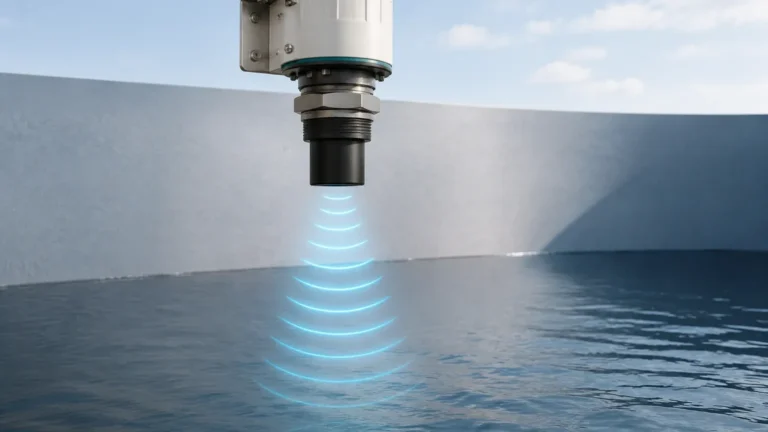
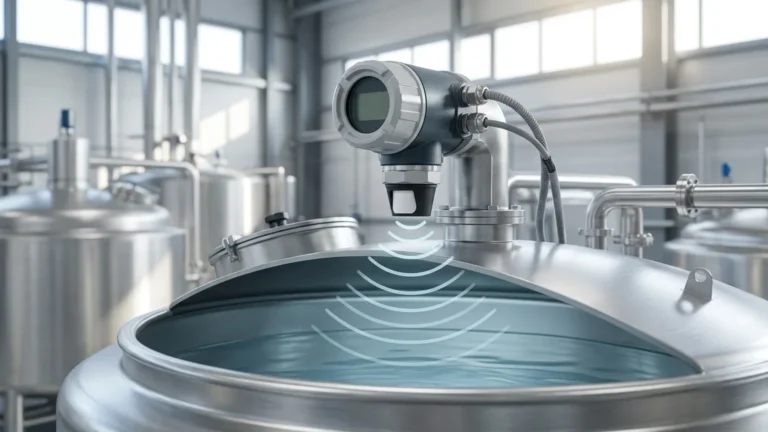
Ultrasonic sensors operate on the Time-of-Flight principle. The sensor’s transducer emits a high-frequency sound pulse (typically between 20 kHz and 200 kHz). This pulse travels through the air, hits the surface of the medium (liquid or solid), and reflects back to the transducer.
The distance is calculated using the formula:
Distance = (Speed of Sound × Time Delay) / 2
Because the speed of sound is affected by air temperature, professional-grade meters include integrated temperature sensors to compensate for these changes, ensuring that the 7-meter measurement remains accurate even as the ambient environment shifts.
Comparing Technologies for 7-Meter Depths
While ultrasonic sensors are highly effective for a 7-meter range, other technologies like radar and hydrostatic transmitters are also used. The following table compares these options for a standard 7-meter application.
Selection Table: 7-Meter Level Measurement
| Feature | Ultrasonic Level Meters | Radar (60GHz/80GHz) | Hydrostatic Transmitter |
| :— | :— | :— | :— |
| Measurement Type | Non-contact (Sound) | Non-contact (Microwave) | Contact (Pressure) |
| Ideal Range | 0.25m to 15m | 0.1m to 120m | 0m to 200m |
| Accuracy | ±0.25% to ±0.5% of span | ±1mm to ±3mm | ±0.1% to ±0.5% of span |
| Cost | Low to Moderate | High | Moderate |
| Foam Tolerance | Poor (Absorbs signal) | Moderate to Good | Excellent (Ignores foam) |
| Vapor Sensitivity | High (Affects sound speed) | Low | None |
| Maintenance | Very Low | Very Low | Moderate (Requires cleaning) |
Why Ultrasonic is Often Preferred for 7 Meters
For a depth of 7 meters, ultrasonic technology is often the "sweet spot." Radar is frequently overkill for simple water or chemical storage at this depth, while hydrostatic sensors require the probe to be submerged, making them susceptible to corrosion or clogging if the liquid contains solids (common in wastewater).
Ultrasonic sensors for this range are typically designed with a medium frequency. A 40 kHz or 50 kHz transducer provides enough power to bridge the 14-meter round trip (7m down and 7m back) while maintaining a narrow enough beam angle to avoid hitting the sides of the tank.

Critical Installation Considerations for 7-Meter Applications
To ensure an accurate reading of exactly how deep 7 meters is in your specific vessel, several installation factors must be addressed:
1. The Blanking Distance (Dead Zone)
Every ultrasonic sensor has a "blanking distance"—a zone directly beneath the transducer where it cannot measure. For a sensor rated for 10 meters (to safely cover a 7-meter depth), the blanking distance is usually between 0.25m and 0.4m. If the tank is filled above this point, the sensor will lose its signal or provide an erroneous reading. Always mount the sensor high enough to account for the maximum expected fill level.
2. Beam Angle and Obstructions
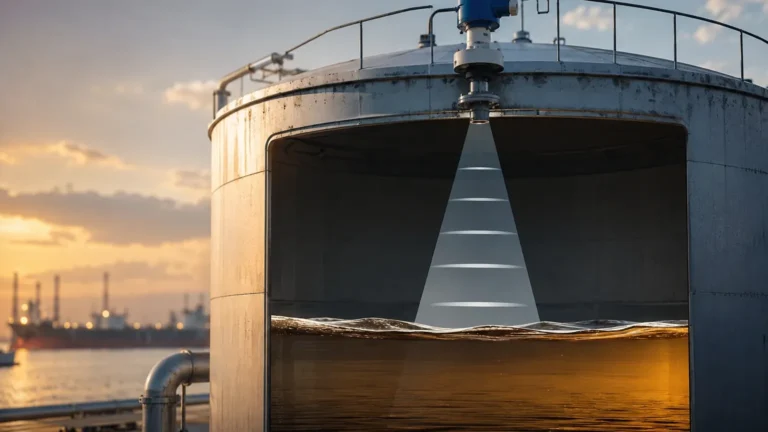
The ultrasonic pulse spreads out like a cone. At a depth of 7 meters, a sensor with a 10-degree beam angle will have a footprint of approximately 1.2 meters at the bottom. If there are ladders, pipes, or agitators within this cone, they will create "false echoes."
Solution: Use a sensor with false-echo suppression software, which allows the meter to "learn" the fixed obstructions and ignore them, focusing only on the moving liquid level.
3. Mounting Position
* Avoid the Center: In round tanks, mounting in the exact center can result in multiple reflections that confuse the sensor.
* Avoid the Wall: Mounting too close to the wall can cause the signal to clip the side, especially if there is buildup on the wall.
* Perpendicularity: The sensor must be mounted perfectly perpendicular to the liquid surface. A tilt of even a few degrees can cause the reflected signal to miss the transducer entirely at 7 meters.
Limitations and Environmental Factors
While ultrasonic meters are robust, they are not universal. When measuring a 7-meter depth, be aware of these limitations:
* Vacuum/High Pressure: Sound requires a medium (air) to travel. Ultrasonic sensors will not work in a vacuum and may fail in high-pressure environments where air density changes significantly.
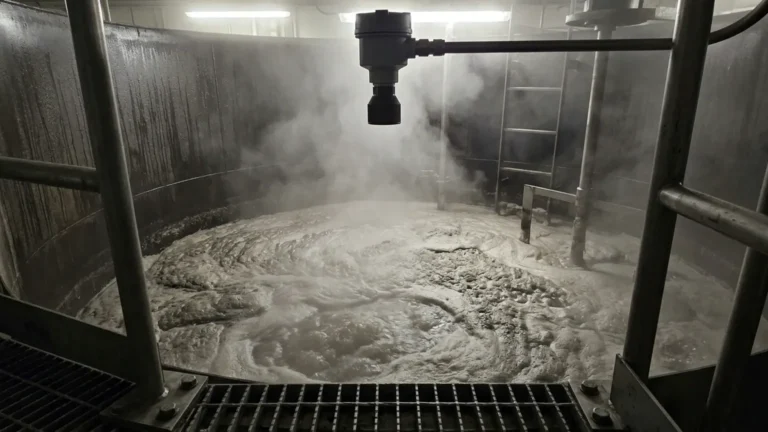
* Heavy Foam: Thick, protein-based foam acts as an acoustic insulator, absorbing the sound pulse rather than reflecting it. If your 7-meter tank has constant heavy foam, radar or hydrostatic sensors are better choices.
* Extreme Turbulence: If the surface is extremely turbulent, the sound waves may scatter. Modern digital filtering can mitigate some of this, but a stilling well may be required for severe cases.
Frequently Asked Questions (FAQ)
Q: How deep is 7 meters in terms of sensor selection?
A: In the sensor industry, 7 meters is considered a medium range. You should select a sensor with a maximum range of at least 10 meters to ensure the signal remains strong even at the bottom of the tank (the furthest point).
Q: Can an ultrasonic sensor measure 7 meters of solids, like grain?
A: Yes, but the range is usually reduced. Solids absorb more sound and do not reflect it as cleanly as liquids. For 7 meters of grain or sand, you would typically use a sensor rated for 15 or 20 meters in liquid applications.
Q: Does temperature affect the measurement of a 7-meter depth?
A: Significantly. The speed of sound changes by about 0.6 m/s per degree Celsius. Over a 7-meter distance, a 10°C temperature shift without compensation could result in an error of nearly 10 centimeters. Always ensure your meter has internal or external temperature compensation.
Q: Is 7 meters too deep for a battery-powered sensor?
A: Not necessarily. Many IoT-enabled ultrasonic sensors can measure 7-meter depths using internal batteries, provided the measurement frequency is not too high (e.g., measuring once every 15 minutes rather than every second).
Conclusion
Determining how deep is 7 meters is the first step in a larger engineering evaluation. At this depth, precision is attainable and cost-effective through the use of ultrasonic technology, provided the environmental conditions—such as foam, vapor, and physical obstructions—are accounted for.
For facilities requiring reliable, non-contact measurement, Ultrasonic Level Meters offer a proven solution that balances ease of installation with long-term durability. By following proper mounting guidelines and understanding the physics of sound, you can ensure that your 7-meter process remains under control, safe, and efficient.