How Large Is 7 Meters
How Large Is 7 Meters: A Technical Guide for Level Measurement Applications
In the realm of industrial automation and process control, distance is more than just a physical dimension; it is a critical parameter that dictates the selection of instrumentation. When process engineers ask, "how large is 7 meters?" they are typically evaluating the suitability of a sensor for a specific tank, silo, or open-channel application.
Seven meters (approximately 22.97 feet) represents a significant "mid-range" threshold in level measurement. It is a distance that exceeds the reach of simple short-range sensors but remains within the optimal performance envelope of high-quality non-contact instruments. Understanding the scale of 7 meters and how it interacts with ultrasonic technology is essential for ensuring accurate, reliable data in water treatment, chemical processing, and industrial storage.
Visualizing the Scale: How Large Is 7 Meters in Industrial Environments?
To answer the question of how large is 7 meters in a practical sense, it is helpful to compare this distance to common industrial structures.
* Vertical Height: 7 meters is roughly equivalent to a two-story commercial building. In a warehouse or factory setting, a 7-meter ceiling height is standard for medium-scale operations.
* Storage Tanks: Many standard chemical storage tanks and medium-sized fuel tanks are designed with a height between 5 and 8 meters. A 7-meter range covers the entire working volume of these vessels, including the necessary clearance at the top.
* Wastewater Infrastructure: In municipal water treatment, 7 meters is a common depth for wet wells, pump stations, and small-scale aeration tanks.
* Logistics: A standard 20-foot shipping container is approximately 6 meters long; 7 meters extends just beyond the length of such a container.
When applying Ultrasonic Level Meters to a 7-meter application, the engineer must account for the total round-trip distance the sound wave must travel—14 meters—and the potential for signal attenuation over that span.
Measurement Principles of Ultrasonic Level Meters
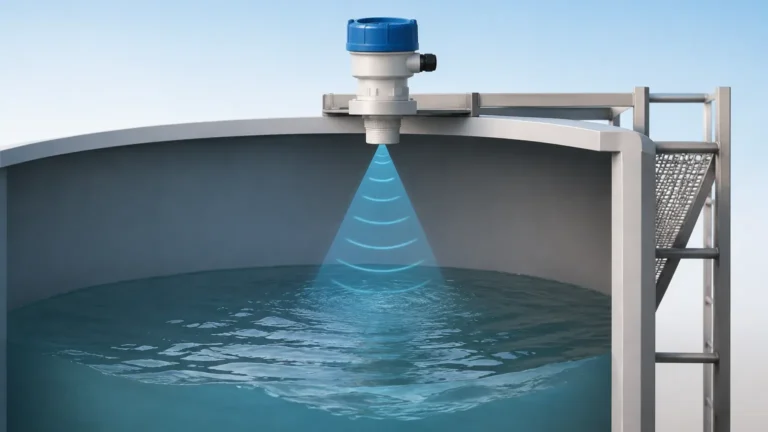
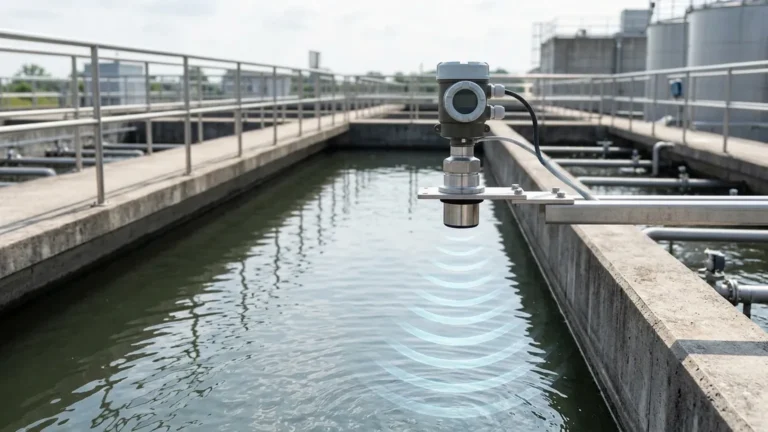
Ultrasonic level measurement is a non-contact technology based on the Time-of-Flight (ToF) principle. The instrument, typically mounted at the top of a vessel, emits a series of high-frequency ultrasonic pulses. These pulses travel through the air, strike the surface of the material (liquid or solid), and reflect back to the sensor.
The Time-of-Flight Formula
The distance (D) from the sensor to the material surface is calculated using the formula:
D = (c × t) / 2
Where:
* c is the speed of sound in the medium (typically air, approx. 343 m/s at 20°C).
* t is the total time elapsed between the emission of the pulse and the reception of the echo.
The division by two accounts for the fact that the pulse travels to the surface and back. For a 7-meter distance, the elapsed time is approximately 40.8 milliseconds. While this seems instantaneous, the electronics within the meter must be precise enough to resolve microsecond differences to maintain accuracy within millimeters.
Why 7 Meters is a Critical Benchmark for Ultrasonic Sensors
In the design of ultrasonic transducers, 7 meters is often a "sweet spot." Sensors designed for this range typically operate at frequencies between 40 kHz and 60 kHz.
1. Signal Strength: Lower frequencies (like 40 kHz) have longer wavelengths, which are less susceptible to attenuation by dust or light steam compared to high-frequency (100+ kHz) short-range sensors. This ensures that even at a 7-meter distance, the returning echo is strong enough to be distinguished from background noise.
2. Beam Divergence: As the distance increases, the ultrasonic beam spreads out. At 7 meters, a standard 10-degree beam angle creates a "footprint" or detection area on the material surface. If the tank is too narrow or contains internal obstructions (like ladders or agitators), this beam spread can cause false reflections.
3. Power Consumption: 7-meter sensors are frequently available in two-wire, loop-powered configurations (4-20mA), making them easy to integrate into existing PLC or SCADA systems without requiring dedicated power lines.
Selection Criteria for 7-Meter Level Measurement
Choosing the right instrument for a 7-meter application requires more than just checking the maximum range on a datasheet. Engineers should evaluate the following criteria:
Material State and Surface Profile
* Liquids: Calm liquids are ideal for ultrasonic measurement. However, if the surface is turbulent or covered in foam, the sound waves may be scattered or absorbed. In such cases, a sensor with a higher power output or a different technology (like radar) may be required.
* Solids: Measuring solids at 7 meters is more challenging. Solids like grain or plastic pellets often form a conical pile, which reflects the sound away from the sensor. For solids, it is standard practice to de-rate the sensor's effective range by 30-50%.
Selection Table: Ultrasonic vs. Application Requirements
| Feature | Requirement for 7m Range | Consideration |
| :— | :— | :— |
| Frequency | 40 kHz – 60 kHz | Balances range and resolution. |
| Beam Angle | < 10° | Minimizes interference from tank walls. |
| Accuracy | ±0.25% to ±0.5% of range | Standard for industrial-grade units. |
| Temperature Comp. | Integrated Sensor | Critical for maintaining accuracy over 7m. |
| Housing Material | PVDF or PP | Depends on chemical compatibility. |
Installation Guidelines and the "Dead Zone" Challenge
Correct installation is paramount when dealing with a 7-meter span. One of the most misunderstood concepts is the Blocking Distance, also known as the "Dead Zone."
The Dead Zone
Every ultrasonic sensor has a minimum distance (typically 0.25m to 0.5m) within which it cannot measure. This is because the transducer cannot act as both a transmitter and a receiver simultaneously; it needs a few milliseconds to stop vibrating after sending a pulse before it can "listen" for the return.
If a tank is 7 meters deep and you need to measure until it is completely full, the sensor must be mounted high enough so that the maximum liquid level never enters the dead zone. If the liquid reaches the dead zone, the meter may report a full tank or an error code.
Mounting Considerations
* Perpendicularity: The sensor must be mounted perfectly perpendicular to the liquid surface. Even a 2 or 3-degree tilt can cause the echo to miss the transducer entirely at a 7-meter distance.
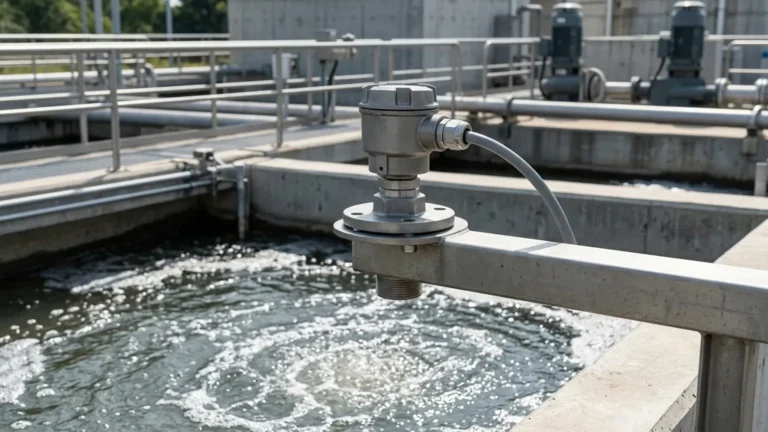
* Nozzle Geometry: If mounting on a nozzle, the nozzle's height and diameter must be calculated to ensure the ultrasonic beam does not hit the edges of the nozzle before entering the tank.
* Avoid the Center: In cylindrical tanks with domed tops, mounting the sensor in the exact center can result in "multiple echoes" as the sound waves bounce off the curved walls and converge at the center.
Environmental Factors Affecting Accuracy at 7 Meters
Because ultrasonic waves travel through the air, the properties of that air directly impact the measurement. Over a 7-meter distance, small environmental changes are magnified.
Temperature Fluctuations
The speed of sound changes by approximately 0.6 meters per second for every degree Celsius change in temperature. In a 7-meter tank, a 10°C temperature shift without compensation could result in an error of nearly 12 centimeters (approx. 4.7 inches). Welk ultrasonic level meters include integrated temperature sensors to automatically adjust the calculation in real-time.
Pressure and Vacuum
Ultrasonic sensors rely on air molecules to transmit sound. They do not work in a vacuum and are generally limited to applications near atmospheric pressure (typically 0.7 to 3 bar). For high-pressure vessels, radar technology is the preferred alternative.
Vapor and Dust
Heavy vapors (like those from concentrated nitric acid) change the density of the air, altering the speed of sound. Similarly, heavy dust in a 7-meter silo can attenuate the signal. Understanding the medium is as important as understanding the distance.
Comparison of 7-Meter Measurement Technologies
While ultrasonic is the most cost-effective solution for many 7-meter applications, it is helpful to compare it with other common technologies.
| Technology | Pros | Cons |
| :— | :— | :— |
| Ultrasonic | Non-contact, low cost, easy installation. | Affected by foam, temperature, and heavy vapor. |
| Radar (80GHz) | Not affected by vapor or temperature; extremely accurate. | Higher initial cost. |
| Hydrostatic | Simple, works regardless of surface foam. | Contact-based; requires mounting at the bottom of the tank. |
| Laser | Extremely narrow beam; works in tight spaces. | Sensitive to dust and clear liquids. |
Frequently Asked Questions (FAQs)
Q: Can a 7-meter ultrasonic sensor be used in a tank that is 10 meters deep?
A: No. If the distance to the material surface exceeds the sensor's rated range, the pulse will either not return with enough strength to be detected or will be ignored by the software. Always select a sensor with a range slightly larger than your maximum tank depth.
Q: How does wind affect an ultrasonic measurement in an open-channel flow at 7 meters?
A: Wind can "blow" the sound waves away from the receiver, especially over longer distances. For outdoor 7-meter applications, using a protective shroud or selecting a sensor with a stronger pulse can mitigate this effect.
Q: Is 7 meters too large for a battery-powered sensor?
A: Not necessarily. Many modern IoT-enabled ultrasonic sensors can measure up to 7 or 10 meters while running on internal batteries for several years, provided the measurement frequency (sampling rate) is kept low.
Q: What happens if there is an agitator in the 7-meter tank?
A: Agitators create turbulence and can cause false echoes. Advanced ultrasonic meters feature "False Echo Suppression" software, which allows the user to map out static obstructions so the meter ignores them.
Conclusion
Understanding how large is 7 meters is the first step in designing a robust level control system. At this scale, ultrasonic level meters offer an ideal balance of performance and value, provided that environmental factors and installation geometries are properly managed. By selecting high-quality instrumentation and following engineering best practices, operators can achieve precise, maintenance-free level monitoring across a wide range of industrial applications.