Ultrasonic Water Level Sensor Jsn Sr04t
Ultrasonic Water Level Sensor JSN-SR04T: Engineering Guide and Industrial Alternatives
In the field of fluid management and process automation, non-contact level measurement has become the preferred method for monitoring tanks, sumps, and open channels. Among the various technologies available, ultrasonic sensing stands out for its balance of cost-effectiveness and reliability. For engineers and developers in the early stages of system design, the ultrasonic water level sensor JSN-SR04T is a frequently encountered component.
This guide provides a comprehensive technical analysis of the JSN-SR04T module, its operational principles, and a comparison with industrial-grade Ultrasonic Level Meters used in professional water treatment and chemical processing environments.
Understanding Ultrasonic Measurement Principles
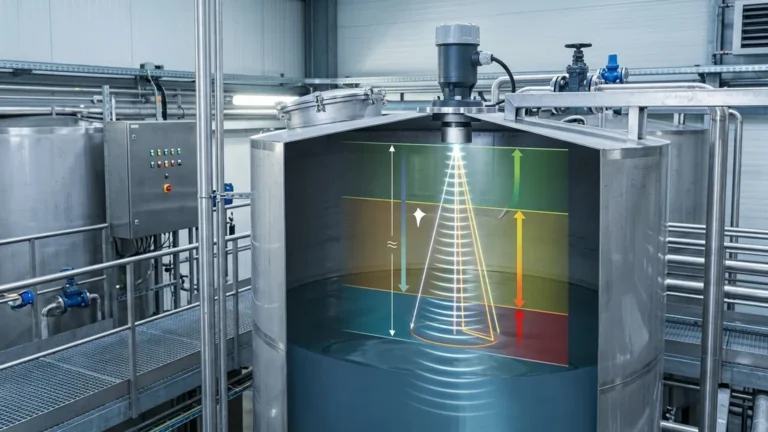
Before selecting a specific sensor, it is essential to understand the physics governing ultrasonic level detection. Ultrasonic sensors operate on the "Time of Flight" (ToF) principle.
The Time of Flight (ToF) Mechanism
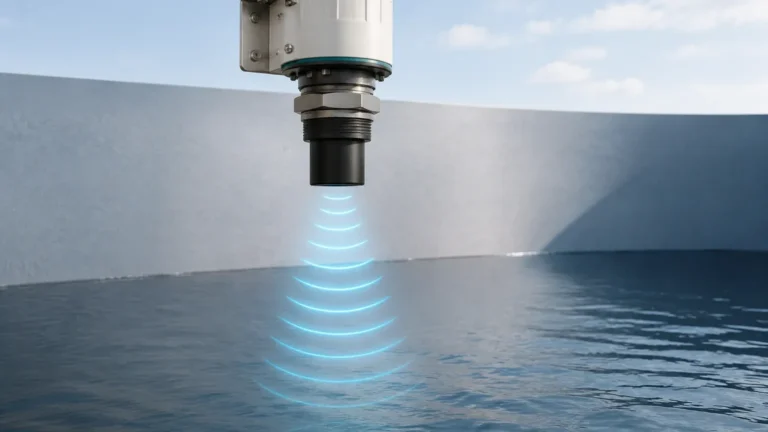
An ultrasonic transducer emits a high-frequency sound pulse (usually between 40 kHz and 75 kHz). This sound wave travels through the air until it hits the surface of the liquid, which acts as a reflective boundary. The pulse bounces back to the sensor, where it is detected by the receiver.
The distance from the sensor to the liquid surface is calculated using the following formula:
$$D = \frac{t \times c}{2}$$
Where:
* D is the distance to the liquid.
* t is the time elapsed between emission and reception.
* c is the speed of sound in the medium (approximately 343 m/s in air at 20°C).
Since the sound wave must travel to the surface and back, the total distance is divided by two to find the level. In industrial applications, the device then subtracts this distance from the total tank height to determine the actual liquid level or volume.
Environmental Variables
The speed of sound is not constant; it fluctuates based on the temperature of the air through which it travels. The approximate relationship is:
$$c \approx 331.5 + 0.6 \times T$$
(Where $T$ is the temperature in Celsius). Professional-grade sensors incorporate integrated temperature compensation to maintain accuracy across changing seasons or process conditions.
Technical Profile: Ultrasonic Water Level Sensor JSN-SR04T
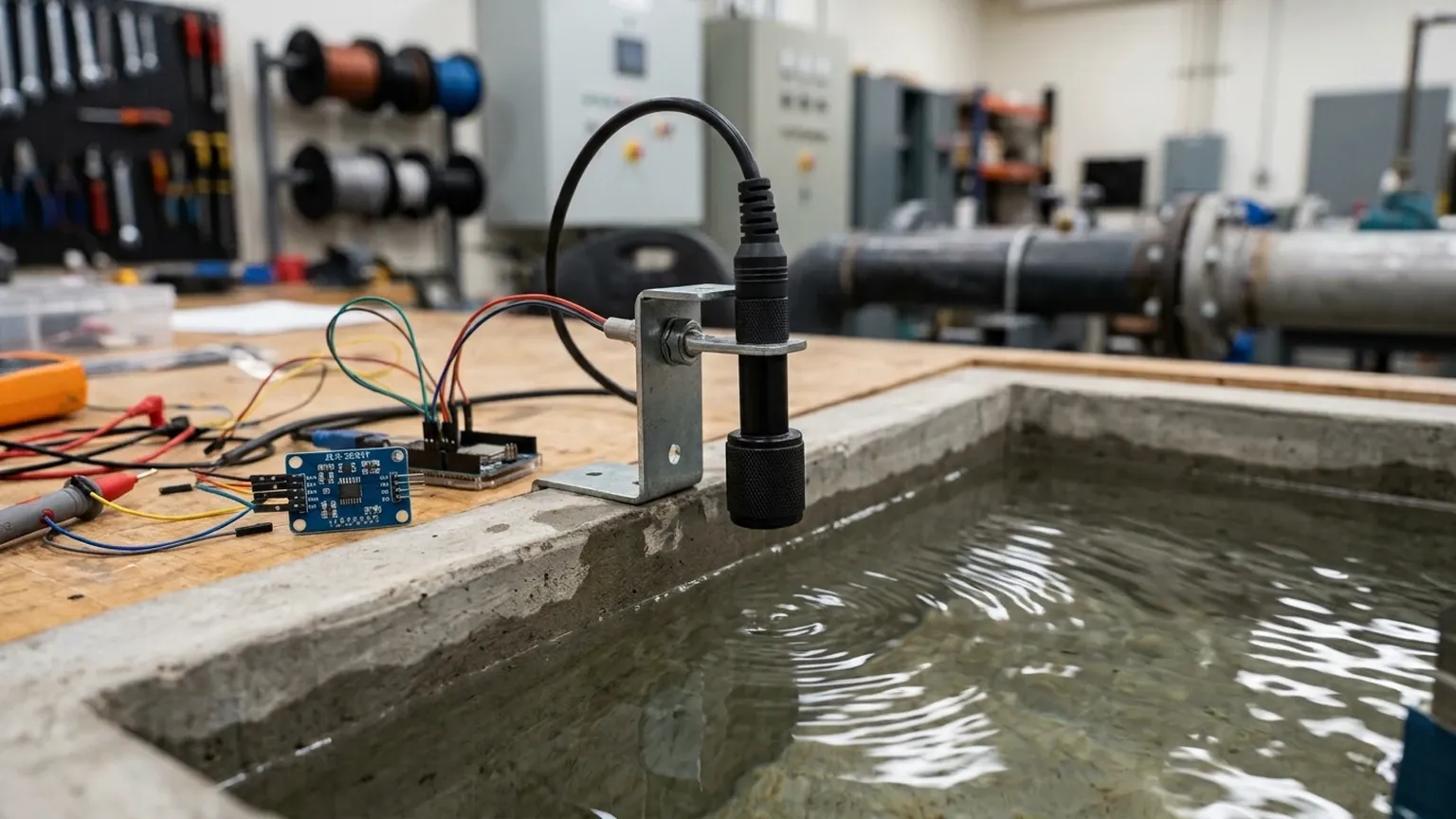
The JSN-SR04T is a popular waterproof ultrasonic rangefinder module. Unlike the common HC-SR04 used in indoor robotics, the JSN-SR04T features a split design where the ultrasonic transducer is connected to a separate control board via a shielded cable.
Key Specifications
* Operating Voltage: DC 3.0V to 5.5V
* Working Current: Less than 8mA
* Acoustic Frequency: 40 kHz
* Maximum Range: 4.5 meters (approx. 14.7 feet)
* Minimum Range (Dead Zone): 20 cm to 25 cm
* Resolution: Approx. 0.5 cm
* Sensor Angle: Less than 75 degrees
* Operating Temperature: -20°C to 70°C
Hardware Configuration and Modes
The JSN-SR04T is versatile due to its multiple operating modes, which can often be adjusted by changing a resistor (R27) on the PCB:
1. Mode 1 (Trigger/Echo): Standard pulse-in/pulse-out logic compatible with most microcontrollers.
2. Mode 2 (Automatic Serial): The module continuously outputs distance data via TTL serial every 100ms.
3. Mode 3 (Low Power Serial): The module outputs distance data only when queried via a serial command.
Industrial vs. Prototyping Sensors: A Comparison
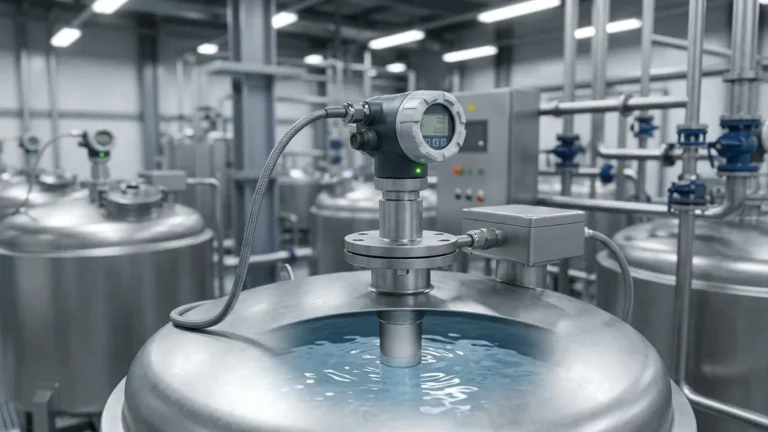
While the ultrasonic water level sensor JSN-SR04T is excellent for proof-of-concept projects or simple IoT monitoring in non-critical environments, industrial facilities require more robust solutions. Industrial Ultrasonic Level Meters are designed to withstand chemical vapors, high pressure, and electrical noise.
| Feature | JSN-SR04T Module | Industrial Ultrasonic Meter (Welk) |
| :— | :— | :— |
| Housing | Exposed PCB / Waterproof Probe | Fully Sealed IP67/IP68 Enclosure |
| Output Signal | TTL / Serial (5V) | 4-20mA / HART / RS485 Modbus |
| Accuracy | ±1% to 5% depending on conditions | ±0.2% to 0.5% of full range |
| Dead Zone | 20-25 cm | 10-20 cm (optimized) |
| Beam Angle | ~75° (Wide) | 5° to 12° (Narrow) |
| Power Supply | 5V DC | 24V DC / 220V AC |
| Certifications | None | CE, RoHS, Explosion-proof (Ex-rated) |
Why Beam Angle Matters
A significant limitation of low-cost sensors like the JSN-SR04T is the wide beam angle. A 75-degree beam will likely hit the side walls of a narrow tank or internal pipes, creating "false echoes" that result in incorrect readings. Industrial sensors utilize a narrow beam (often under 10 degrees) to focus directly on the liquid surface, avoiding obstructions.
Installation Considerations and Best Practices
Successful deployment of any ultrasonic sensor requires careful physical placement. Whether using a JSN-SR04T or a professional meter, the following guidelines apply:
1. Managing the Dead Zone
Every ultrasonic sensor has a "dead zone" or "blind zone" directly in front of the transducer where it cannot accurately measure. For the JSN-SR04T, this is roughly 20-25 cm. If the water level rises into this zone, the sensor will report erratic data or the maximum range value.
Solution: Mount the sensor in a "standpipe" or on a bracket above the maximum possible fill line to ensure the liquid never enters the dead zone.
2. Avoiding Obstructions
The path between the sensor and the liquid must be clear. Avoid placing the sensor near:
* Inflow pipes (which cause surface turbulence).
* Ladders or internal tank supports.
* Agitators or mixers.
3. Surface Conditions
Ultrasonic waves require a solid or liquid surface to bounce back. If the liquid surface is covered in heavy foam, the sound waves may be absorbed rather than reflected, leading to a "loss of echo." In such cases, a guided wave radar or a hydrostatic pressure transmitter may be more appropriate.
4. Mounting Orientation
The transducer must be mounted perfectly perpendicular to the liquid surface. Even a few degrees of tilt can cause the reflected signal to bounce away from the receiver, significantly reducing the effective range and accuracy.
Limitations of the JSN-SR04T in Professional Environments
While the JSN-SR04T probe is waterproof (IP67), the control board is not. In industrial settings where humidity is high or wash-down procedures occur, the exposed electronics will fail rapidly. Furthermore, the 5V TTL signal used by these modules is highly susceptible to electromagnetic interference (EMI) from nearby pumps and motors.
For B2B applications such as municipal water treatment, chemical storage, or factory automation, integrated Ultrasonic Level Meters provide the necessary durability. These units combine the transducer and the processing electronics into a single, shielded housing that outputs an industry-standard 4-20mA signal, which can travel hundreds of meters to a PLC (Programmable Logic Controller) without signal degradation.
Frequently Asked Questions (FAQ)
Can the JSN-SR04T measure the level of solids?
It can measure relatively flat, hard solids (like grain in a silo), but the accuracy is lower than with liquids. The angle of repose of the solid material often scatters the ultrasonic signal.
How do I extend the cable of the JSN-SR04T?
The module comes with a 2.5m shielded cable. While it can be extended, doing so increases resistance and potential noise interference. For distances beyond 5 meters, an industrial sensor with a 4-20mA or RS485 output is recommended.
Is the JSN-SR04T suitable for outdoor use?
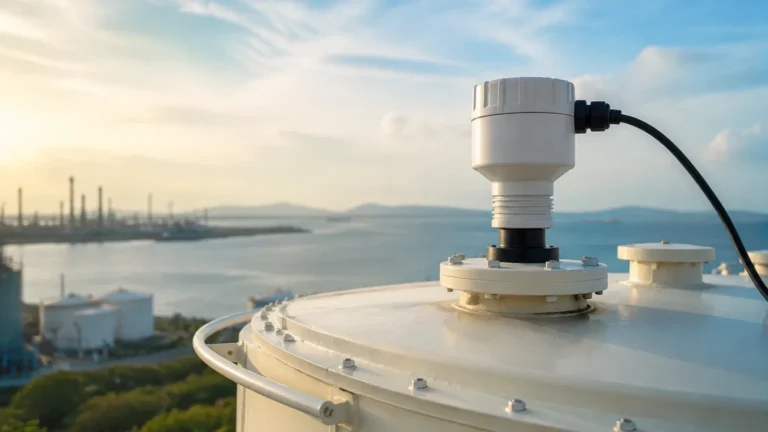
The probe is weather-resistant, but the PCB must be housed in a NEMA-rated or IP-rated enclosure. Additionally, direct sunlight on the probe can cause temperature fluctuations that skew the readings if compensation is not used in the software.
What is the best way to filter noisy data from the sensor?
In software (such as Arduino or ESP32), it is common to use a "Median Filter." By taking five to ten readings in quick succession and selecting the median value, you can eliminate outliers caused by surface ripples or momentary interference.
Conclusion
The ultrasonic water level sensor JSN-SR04T serves as an excellent entry point for understanding non-contact measurement and developing prototypes. Its waterproof probe and low power consumption make it a versatile tool for basic monitoring. However, for industrial reliability, precision, and integration with control systems, professional Ultrasonic Level Meters remain the standard.
When selecting a level measurement solution, engineers must weigh the initial cost against the long-term requirements for accuracy, maintenance, and environmental resilience. For mission-critical infrastructure, investing in industrial-grade instrumentation ensures data integrity and operational safety.