Sanitary Thermometer
Sanitary Thermometer
In hygienic processing industries such as food and beverage, dairy, biotechnology, and pharmaceuticals, temperature control is a critical factor for both product quality and consumer safety. A sanitary thermometer is a specialized temperature measurement device designed specifically to meet the stringent cleanliness and sterilization requirements of these sectors. Unlike standard industrial thermometers, these instruments must feature crevice-free designs and high-grade materials to prevent bacterial growth and allow for effective cleaning-in-place (CIP) and sterilization-in-place (SIP) procedures.
Accurate temperature monitoring is not only essential for process control but also serves as a vital secondary data point for other instrumentation. For instance, in complex automation systems, temperature data is often used to compensate for density changes in fluids, which directly impacts the accuracy of level measurement sensors found on the Main Page of industrial instrumentation providers.
Measurement Principles of Sanitary Thermometers
Before selecting a sanitary thermometer, it is essential to understand the underlying physical principles used to detect temperature changes. The two most common technologies used in modern hygienic applications are Resistance Temperature Detectors (RTDs) and Thermocouples.
Resistance Temperature Detectors (RTD)
RTDs operate on the principle that the electrical resistance of a metal increases as its temperature rises. Most sanitary applications utilize the Pt100 sensor, which consists of a platinum element that has a resistance of 100 ohms at 0°C.
* Accuracy: RTDs are highly accurate and provide excellent repeatability over long periods.
* Stability: They offer superior long-term stability compared to thermocouples.
* Linearity: The resistance-to-temperature relationship is relatively linear, simplifying signal processing.
Thermocouples
Thermocouples consist of two dissimilar metal wires joined at one end (the sensing junction). When there is a temperature gradient between the sensing junction and the reference junction, a small voltage (millivolts) is generated via the Seebeck effect.
* Response Time: Thermocouples generally have a faster response time than RTDs because the sensing junction can be smaller.
* Temperature Range: They can measure much higher temperatures than RTDs, though this is rarely required in standard sanitary food processes.
* Durability: They are robust and resistant to high levels of vibration.
Bimetallic Principles
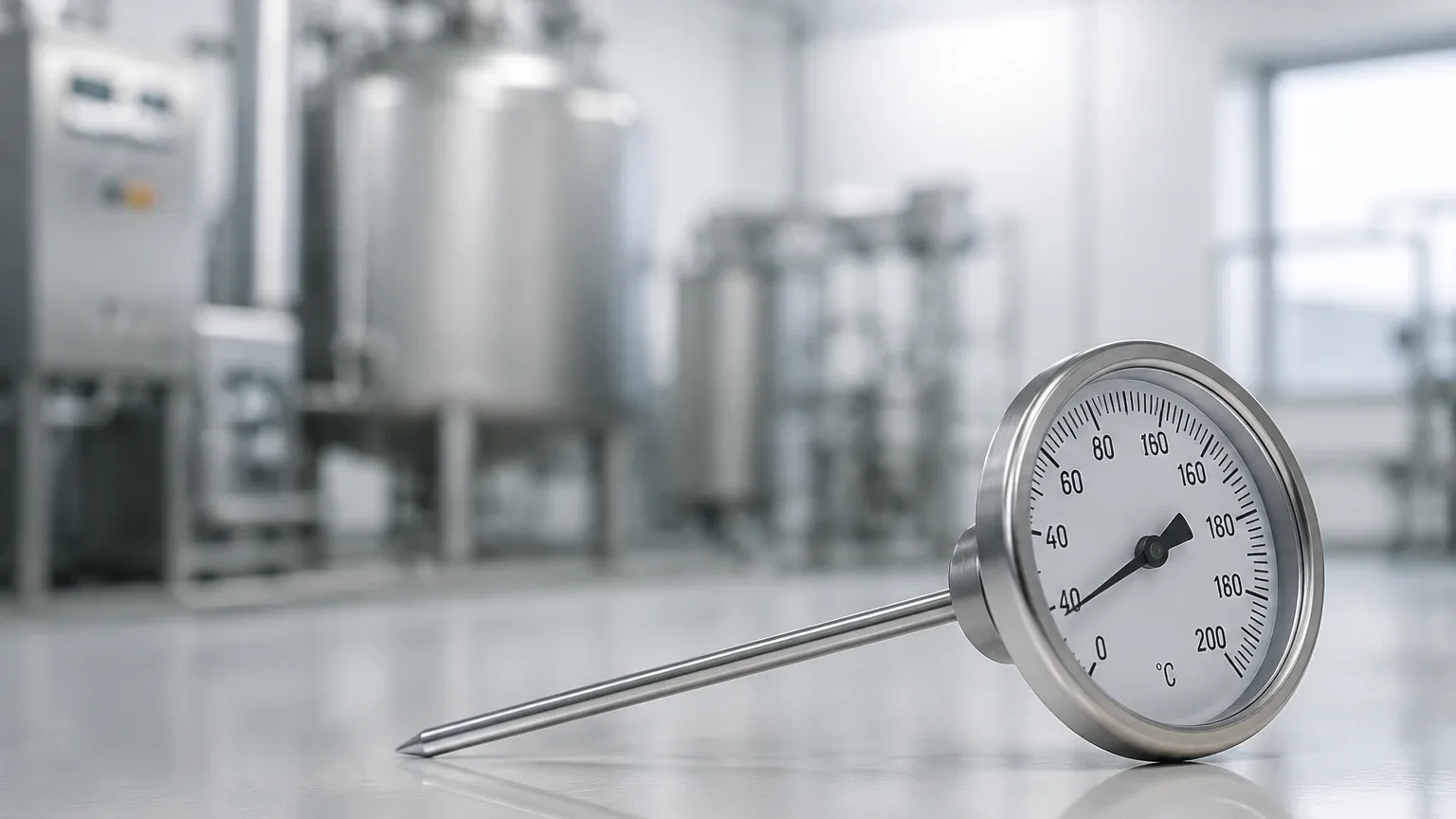
For local indication without the need for electrical power, bimetallic thermometers are used. These consist of two different metals bonded together in a coil. As temperature changes, the metals expand at different rates, causing the coil to twist and move a mechanical pointer. While useful for manual checks, they lack the precision and data integration capabilities of electronic sensors.
Key Design Features of Sanitary Instrumentation
The "sanitary" designation is defined by specific mechanical design characteristics that ensure the instrument does not become a source of contamination.
Materials of Construction
The standard material for any wetted part of a sanitary thermometer is 316L stainless steel. This low-carbon alloy provides excellent corrosion resistance against both the process media and the harsh chemicals used during CIP cycles. In some highly acidic environments, exotic alloys like Hastelloy may be required.
Surface Finish
Surface roughness is a critical metric. Sanitary standards, such as 3-A or EHEDG, typically require wetted surfaces to have a roughness average (Ra) of 0.8 μm (32 μin) or better. Many manufacturers provide electropolished finishes reaching Ra 0.4 μm to further reduce the risk of microbial attachment.
Process Connections
Sanitary thermometers avoid threaded connections because the threads create microscopic gaps where bacteria can hide. Instead, they use:
* Tri-Clamp (Tri-Clover): The most common connection, using a gasket and a heavy-duty clamp to create a flush, leak-proof seal.
* Varivent: A specialized flange system often used in European beverage applications.
* Sanitary Weld-In: A permanent connection where the thermowell or sensor is welded directly into the tank wall or pipe.
Selection Criteria for Sanitary Thermometers
When specifying a sanitary thermometer for a process line, engineers must evaluate several technical parameters to ensure the device is fit for purpose.
| Criteria | Description | Typical Requirement |
| :— | :— | :— |
| Temperature Range | The minimum and maximum temperatures the sensor will encounter. | -50°C to +200°C (Standard) |
| Accuracy Class | The allowable margin of error. | Class A (±0.15°C) or Class B (±0.30°C) |
| Output Signal | How the data is transmitted to the PLC/SCADA. | 4-20 mA, HART, IO-Link, or Modbus |
| Insertion Length | The depth the probe extends into the pipe or tank. | Must reach the center of the flow |
| Response Time | How quickly the sensor reacts to a change. | T90 < 5 seconds (Application dependent) |
Installation Considerations and Best Practices
Proper installation is as important as the instrument's quality. Incorrect placement can lead to inaccurate readings or the creation of "dead zones" where product can stagnate.
Dead Leg Prevention
In sanitary piping, a "dead leg" is a section of pipe that does not have flow through it. If a thermometer is installed in a T-junction, the length of the branch (L) should ideally be no more than two times the diameter (D) of the pipe (the 2:1 rule). This ensures that the cleaning solution reaches the sensor during CIP.
Probe Orientation
* In-Pipe: In small-diameter pipes (less than 50 mm), the probe should be installed at an elbow or an angle to ensure the tip is fully immersed in the fluid without restricting flow.
* In-Tank: For level measurement applications, thermometers are often mounted near the bottom of the tank. However, they must be positioned away from agitators and spray balls to prevent mechanical damage.
Thermowell Usage
A thermowell is a protective sleeve that allows the sensor to be removed without breaking the process seal or emptying the tank. In sanitary applications, the thermowell must be a "stepped" or "tapered" design to allow for rapid heat transfer and must meet the same Ra surface finish requirements as the sensor itself.
Limitations of Sanitary Thermometers
While highly effective, these instruments have limitations that engineers must account for:
1. Thermal Lag: If a heavy-duty thermowell is used, there will be a delay between the actual temperature change in the fluid and the sensor's reading.
2. Vibration Sensitivity: In high-velocity flow lines, long insertion probes can suffer from fatigue failure due to vortex shedding. In these cases, shorter, high-strength probes are necessary.
3. Calibration Drift: Frequent SIP cycles (exposure to 121°C+ steam) can cause sensors to drift over time, necessitating regular calibration schedules.
Integration with Level Measurement Systems
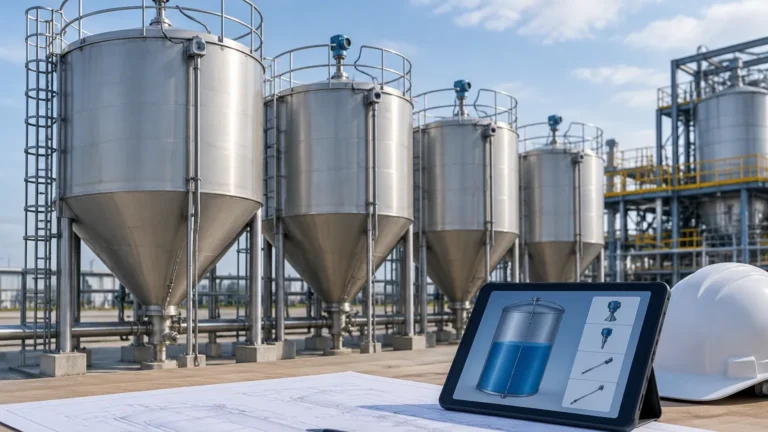
In industrial automation, temperature and level are often inextricably linked. For example, when using hydrostatic level transmitters to measure the volume of milk in a silo, the density of the milk changes based on its temperature. Without an accurate sanitary thermometer providing real-time data to the control system, the level measurement would be mathematically incorrect. This synergy is a core component of the solutions offered by manufacturers like Welk, who specialize in comprehensive measurement instrumentation for liquid processing. For more details on how these sensors integrate into broader automation architectures, you can Review product options and application support.
Frequently Asked Questions (FAQ)
Q: How often should a sanitary thermometer be calibrated?
A: Most pharmaceutical standards require annual or semi-annual calibration. In food and beverage, the frequency is often determined by the criticality of the process point (HACCP) and the results of previous drift analysis.
Q: What is the difference between 3-A and EHEDG?
A: 3-A is a US-based standard focused primarily on the design and cleanability of equipment. EHEDG (European Hygienic Engineering & Design Group) is a European organization that provides similar guidelines but often requires more rigorous physical testing of the equipment's cleanability.
Q: Can I use a standard NPT threaded thermometer in a food plant?
A: Generally, no. Threads are considered "non-sanitary" because they cannot be cleaned to a microbiological level. They are usually only permitted in non-product zones (e.g., utility steam or cooling water lines).
Q: Does electropolishing change the accuracy of the thermometer?
A: No. Electropolishing is a surface treatment that removes a microscopic layer of metal to create a mirror-like finish. It improves cleanability but does not affect the internal RTD or thermocouple element's electrical properties.
Q: Why is 4-20 mA with HART preferred over simple analog signals?
A: HART allows for digital communication over the same two wires as the analog signal. This enables remote diagnostics, device configuration, and the transmission of secondary variables, which is vital for modern Industry 4.0 environments.