Radar Level Transmitter in Pune
In the rapidly expanding industrial landscape of Western India, precision in process control is a fundamental requirement for operational efficiency. For engineers and procurement specialists seeking a radar level transmitter in pune, understanding the technical nuances of microwave-based measurement is essential. Pune’s diverse industrial base—ranging from automotive manufacturing and chemical processing to sophisticated water treatment facilities—requires robust instrumentation that can withstand varying process conditions while maintaining high accuracy.
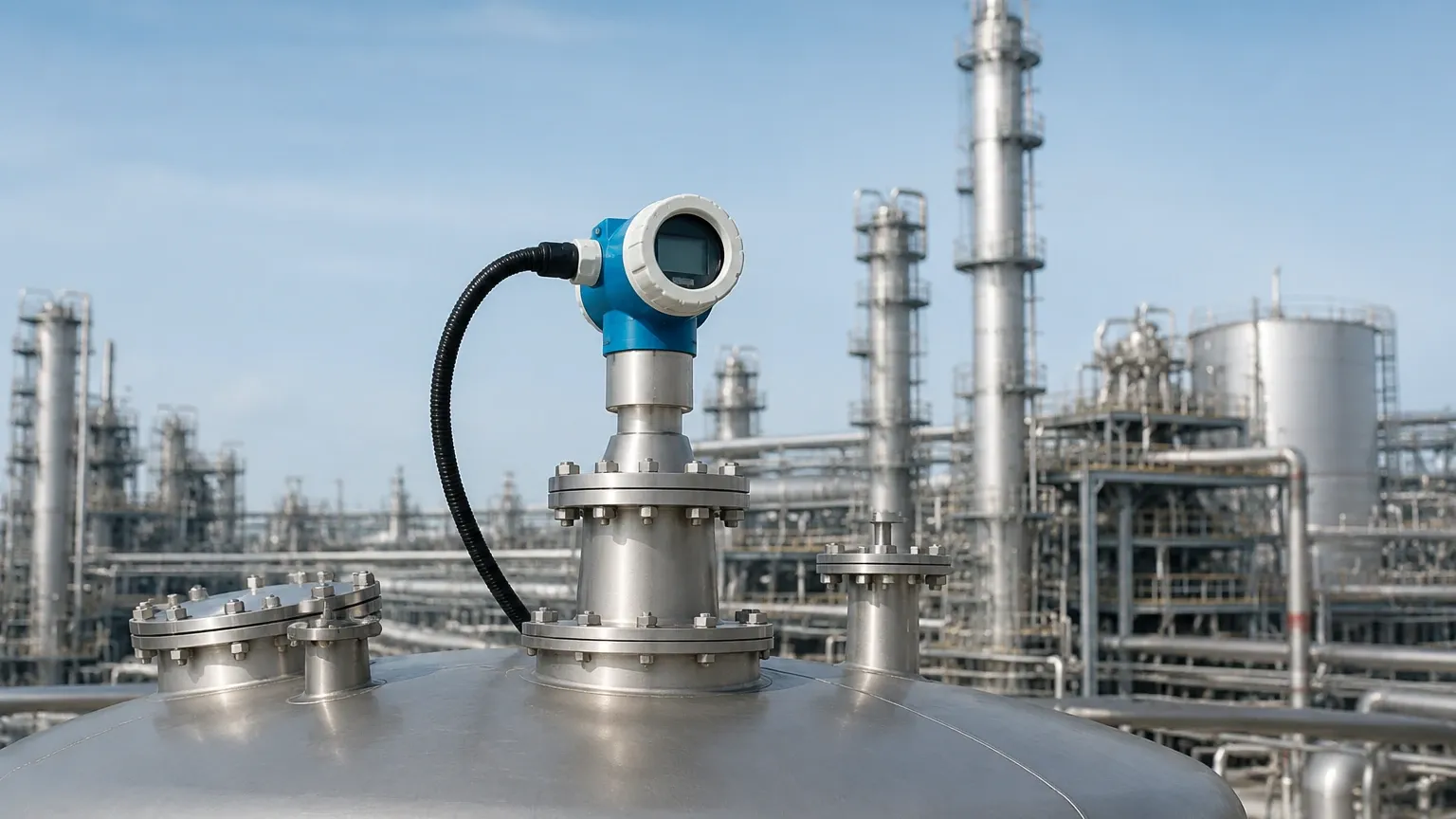
Radar level measurement has emerged as the preferred technology for challenging environments where ultrasonic sensors or mechanical gauges fail. This article provides a comprehensive engineering guide to the principles, selection, and application of Radar Level Meters in modern industrial settings.
Measurement Principles of Radar Technology
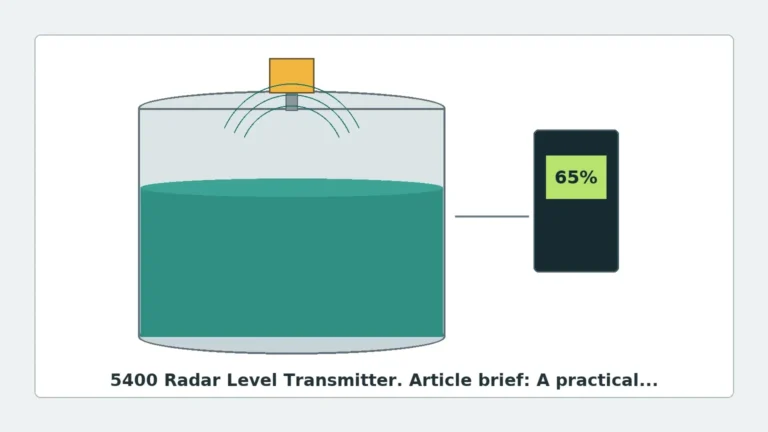
Radar level transmitters operate on the principle of electromagnetic wave propagation. Unlike ultrasonic sensors, which rely on sound waves and are affected by air temperature, pressure, and vapor composition, radar signals are largely immune to these environmental factors. There are two primary methods used in industrial radar level measurement: Pulse Radar and Frequency Modulated Continuous Wave (FMCW).
Pulse Radar (Time of Flight)
In pulse radar systems, the transmitter emits short microwave pulses toward the medium's surface. These pulses travel at the speed of light, reflect off the surface, and return to the sensor. The device measures the time interval between transmission and reception (Time of Flight). The distance ($D$) is calculated using the formula:
$D = (c \times t) / 2$
Where $c$ is the speed of light and $t$ is the measured time. While effective, pulse radar typically offers lower resolution compared to FMCW technology.
Frequency Modulated Continuous Wave (FMCW)
FMCW radar transmits a continuous signal with a constantly changing frequency. When the reflected signal is received, it is compared with the signal being transmitted at that exact moment. The frequency difference ($Δf$) is directly proportional to the distance. FMCW is widely regarded as the superior technology for high-precision applications, such as custody transfer or monitoring in narrow tanks, because it provides a more stable and accurate signal-to-noise ratio.
Frequency Bands: 26GHz vs. 80GHz
The frequency of the radar signal significantly impacts performance.
- 26GHz Radar: Often used for liquid applications with moderate turbulence. It has a wider beam angle, which can be advantageous in some large vessels but may pick up interference from internal tank structures.
- 80GHz Radar: The current industry standard for high precision. It features a very narrow beam angle (often as small as 3 degrees), allowing it to avoid obstacles like agitators, heating coils, and internal ladders. It is also highly effective for measuring solids and powders.
Selection Criteria for Industrial Applications
Choosing the correct radar level transmitter in pune requires a detailed analysis of the process medium and the vessel geometry. Engineers must evaluate the following parameters before procurement:
Dielectric Constant (εr)
The dielectric constant of the material is the most critical factor in radar measurement. It determines the strength of the reflected signal. Materials with high dielectric constants (e.g., water, εr ≈ 80) reflect signals strongly. Materials with low dielectric constants (e.g., hydrocarbons, oils, εr < 2) reflect very little energy. For low εr fluids, Guided Wave Radar (GWR) or high-frequency FMCW radar with specialized signal processing is often required.
Process Conditions
- Temperature and Pressure: High-pressure reactors or cryogenic storage tanks require specialized flange connections and seal materials (such as Kalrez or PTFE) to prevent leakage and protect the electronics.
- Vapor and Dust: While radar penetrates most vapors, extremely dense steam or heavy dust in silos can attenuate the signal. High-frequency 80GHz units are generally better at penetrating dust than lower-frequency models.
Vessel Geometry
The presence of internal obstructions (agitators, baffles, or cooling coils) can create "false echoes." Advanced radar transmitters include software for "false echo suppression," allowing the sensor to map out fixed obstructions and ignore their reflections.
Comparative Selection Table
| Feature | Guided Wave Radar (GWR) | Non-Contact Radar (26GHz) | Non-Contact Radar (80GHz) |
| :— | :— | :— | :— |
| Measurement Style | Contact (Probe) | Non-Contact | Non-Contact |
| Best For | Low Dielectric Liquids, Small Tanks | Large Liquid Tanks | Solids, Powders, Narrow Tanks |
| Accuracy | ±2 mm to ±5 mm | ±3 mm to ±10 mm | ±1 mm |
| Beam Angle | N/A (Follows Probe) | 10° – 20° | 3° – 8° |
| Max Range | Up to 30m | Up to 35m | Up to 120m |
| Foam Resistance | Good (penetrates foam) | Moderate | Limited |
Installation Guidelines and Best Practices
Proper installation is paramount to the reliability of any radar level transmitter in pune. Even the most advanced sensor will fail if positioned incorrectly.
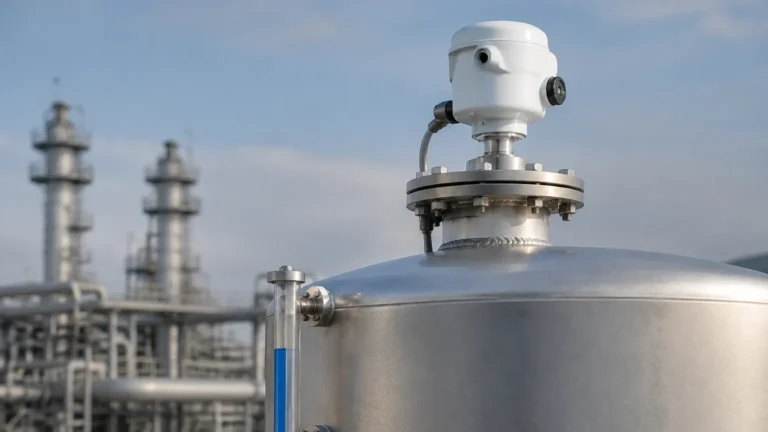
1. Nozzle Dimensions: The nozzle height should be kept as short as possible. If the nozzle is too long or narrow, it can cause internal reflections that interfere with the measurement of the actual level, particularly when the tank is nearly full (the "dead zone").
2. Positioning: The transmitter should not be mounted in the center of a domed tank, as this can concentrate reflected signals and cause errors. Conversely, it should not be mounted too close to the tank wall (maintain at least 200mm to 500mm distance depending on the beam angle) to avoid side-lobe interference.
3. Avoid the Inflow: Never install the sensor directly above the point where the tank is filled. The turbulence and entrained air in the inflow stream will scatter the radar signal.
4. Orientation: For non-contact radar, the antenna must be perpendicular to the product surface. For solids, a swivelling flange may be necessary to aim the beam at the material's angle of repose.
Application Risks and Limitations
While radar is highly versatile, it is not a universal solution. Engineers must be aware of specific limitations:
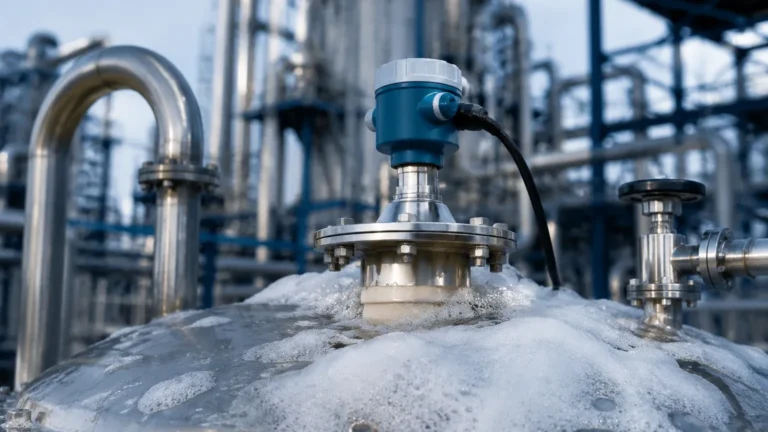
- Heavy Foam: Thick, dense foam (like that found in some chemical fermentation processes) can absorb the radar signal entirely. In such cases, Guided Wave Radar, which uses a physical probe to guide the signal through the foam to the liquid interface, is a more reliable choice.
- Extreme Turbulence: Rapidly moving liquid surfaces can scatter the radar beam. This can be mitigated by using a stilling well or a bypass pipe, which provides a calm surface for measurement.
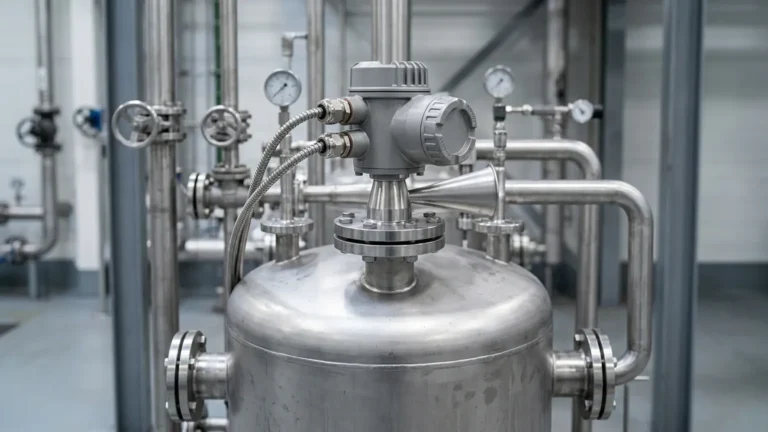
- Condensation: Heavy condensation on the antenna can attenuate the signal. Many modern 80GHz transmitters use convex lens antennas made of PTFE to shed droplets more effectively than traditional horn antennas.
Industrial Use Cases in the Pune Region
Pune’s industrial zones, including Chakan, Pimpri-Chinchwad, and Talegaon, host various sectors where radar level technology is critical:
Chemical and Pharmaceutical Processing
In these sectors, corrosive fluids and strict hygiene standards are common. Radar transmitters with PTFE-coated antennas or flange-mounted GWR probes are used to monitor solvent tanks and reactors without risking contamination or instrument degradation.
Water and Wastewater Treatment
Municipal and industrial wastewater plants in Pune utilize non-contact radar for open channel flow measurement and sump level monitoring. Since radar does not touch the medium, it is unaffected by the debris, grease, and corrosive gases (like H2S) typical of sewage environments.
Food and Beverage
For dairy or beverage processing, sanitary-grade radar sensors with Tri-clamp connections are used. These sensors must withstand Clean-in-Place (CIP) cycles involving high-temperature caustic washes and steam sterilization.
Frequently Asked Questions (FAQ)
Q: Can a radar level transmitter measure the interface between two liquids?
A: Yes, Guided Wave Radar (GWR) is particularly effective for interface measurement (e.g., oil over water). The signal reflects off the upper layer (low dielectric) and continues to the lower layer (high dielectric), providing levels for both.
Q: Is radar safe for use in hazardous areas?
A: Most industrial radar transmitters are available with ATEX, IECEx, or local PESO certifications for use in explosive atmospheres (Zone 0, 1, or 2). Intrinsically safe (Ex ia) and explosion-proof (Ex d) versions are standard options.
Q: How does dust affect radar measurement in silos?
A: High-frequency 80GHz radar is highly effective in dusty environments. The shorter wavelength allows the signal to pass between dust particles more effectively than lower-frequency signals or ultrasonic waves.
Q: What is the maintenance requirement for a radar level meter?
A: Non-contact radar is virtually maintenance-free because it has no moving parts and does not touch the process media. Periodic inspection of the antenna for heavy buildup or condensation is recommended in extreme environments.
Conclusion
For industrial operators in Pune, selecting a radar level transmitter involves balancing technical requirements with cost-effectiveness. By understanding the dielectric properties of the medium, the constraints of the vessel, and the advantages of different frequency bands, engineers can ensure long-term reliability. Whether managing water resources or complex chemical reactions, Radar Level Meters provide the precision necessary for modern industrial automation. When sourcing a radar level transmitter in pune, always verify the manufacturer’s specifications regarding beam angle, dielectric limits, and hazardous area certifications to ensure the device is fit for purpose.