Flow Calibration Equipment
Flow Calibration Equipment
In industrial automation and process control, the accuracy of fluid measurement is a cornerstone of operational efficiency, safety, and regulatory compliance. Flow calibration equipment refers to the specialized systems and instruments used to verify, adjust, and document the accuracy of flow meters. Whether in water treatment, chemical processing, or oil and gas production, ensuring that a flow meter performs within its specified tolerance is critical for mass balance, billing, and process stability.
This guide examines the technical principles of flow calibration, the types of equipment utilized in modern laboratories and field settings, and the essential criteria for selecting the appropriate calibration system for specific industrial applications.
Fundamental Principles of Flow Calibration
Before selecting flow calibration equipment, it is necessary to understand the two primary methods used to establish a reference standard: gravimetric and volumetric measurement.
Gravimetric Calibration
The gravimetric method is widely considered the most accurate approach for liquid flow calibration. It involves measuring the mass of a fluid that passes through the meter under test over a specific period. By using high-precision weighing scales and a calibrated timer, the mass flow rate can be calculated.
If volumetric flow is required, the fluid's density must be precisely determined based on its temperature and pressure. The formula used is:
Flow Rate (Q) = Mass (m) / [Density (ρ) × Time (t)]
This method is often used in primary standards laboratories because mass measurement is inherently more stable and less susceptible to environmental changes than volume measurement.
Volumetric Calibration
Volumetric calibration involves comparing the reading of the meter under test against a known volume. This can be achieved using a calibrated tank (prover) or a master meter. In a volumetric tank system, the fluid level is measured as it fills a vessel of a certified volume.
In many industrial setups, level measurement instruments such as high-accuracy radar level meters or hydrostatic transmitters are integrated into these tanks to automate the volume calculation. For engineers seeking to integrate these components into their systems, reviewing the Main Page of specialized instrument manufacturers can provide insights into the sensors required for such precision setups.
Key Types of Flow Calibration Equipment
Flow calibration systems range from portable field units to massive laboratory rigs. The choice of equipment depends on the required uncertainty level, the fluid type, and the flow range.
1. Master Meters
A master meter is a high-precision flow meter that has been calibrated against a primary standard. It is placed in series with the meter under test. The performance of the test meter is then compared directly to the master meter's output.
* Coriolis Master Meters: Preferred for their high accuracy (often ±0.05% or better) and ability to measure mass flow directly.
* Turbine Master Meters: Commonly used for low-viscosity liquids and gases where high repeatability is required.
2. Piston Provers
Piston provers are used for high-precision volumetric calibration, particularly for low to medium flow rates. They consist of a precision-bore cylinder and a piston equipped with seals. As fluid enters the cylinder, the piston moves, and its displacement is measured by a linear encoder. Because the cross-sectional area of the cylinder is known, the volume displaced is calculated with extreme accuracy.
3. Bell Provers
Specifically designed for gas flow calibration, a bell prover consists of a vertical tank partially filled with oil, with an inverted "bell" inside. As gas is introduced or removed, the bell rises or falls. The change in the bell's position corresponds to a specific volume of gas. These are standard in utility meter testing.
4. Gravimetric Weighing Systems
These systems include a reservoir, a pump, a test section for the meter, a diverter valve, and a weighing scale. The diverter valve is a critical component; it ensures that the fluid is directed into the weigh tank for a precisely timed interval, minimizing "start-stop" errors.
Technical Selection Criteria
Selecting the right flow calibration equipment requires a detailed analysis of the process requirements. The following table summarizes key evaluation factors:
| Criteria | Description | Importance |
| :— | :— | :— |
| Uncertainty | The total error margin of the calibration system. | Must be at least 3 to 4 times better than the meter under test. |
| Flow Range (Turndown) | The ratio between the maximum and minimum flow the equipment can handle. | Ensures the system can calibrate meters across their entire operating range. |
| Fluid Compatibility | Resistance to corrosion, viscosity effects, and temperature. | Prevents equipment damage and maintains accuracy across different media. |
| Repeatability | The ability of the equipment to produce the same result under identical conditions. | Critical for identifying drift in the meter under test. |
| Traceability | The documentation linking the equipment to national standards (e.g., NIST). | Essential for ISO 9001 and regulatory compliance. |
Installation and Operational Considerations
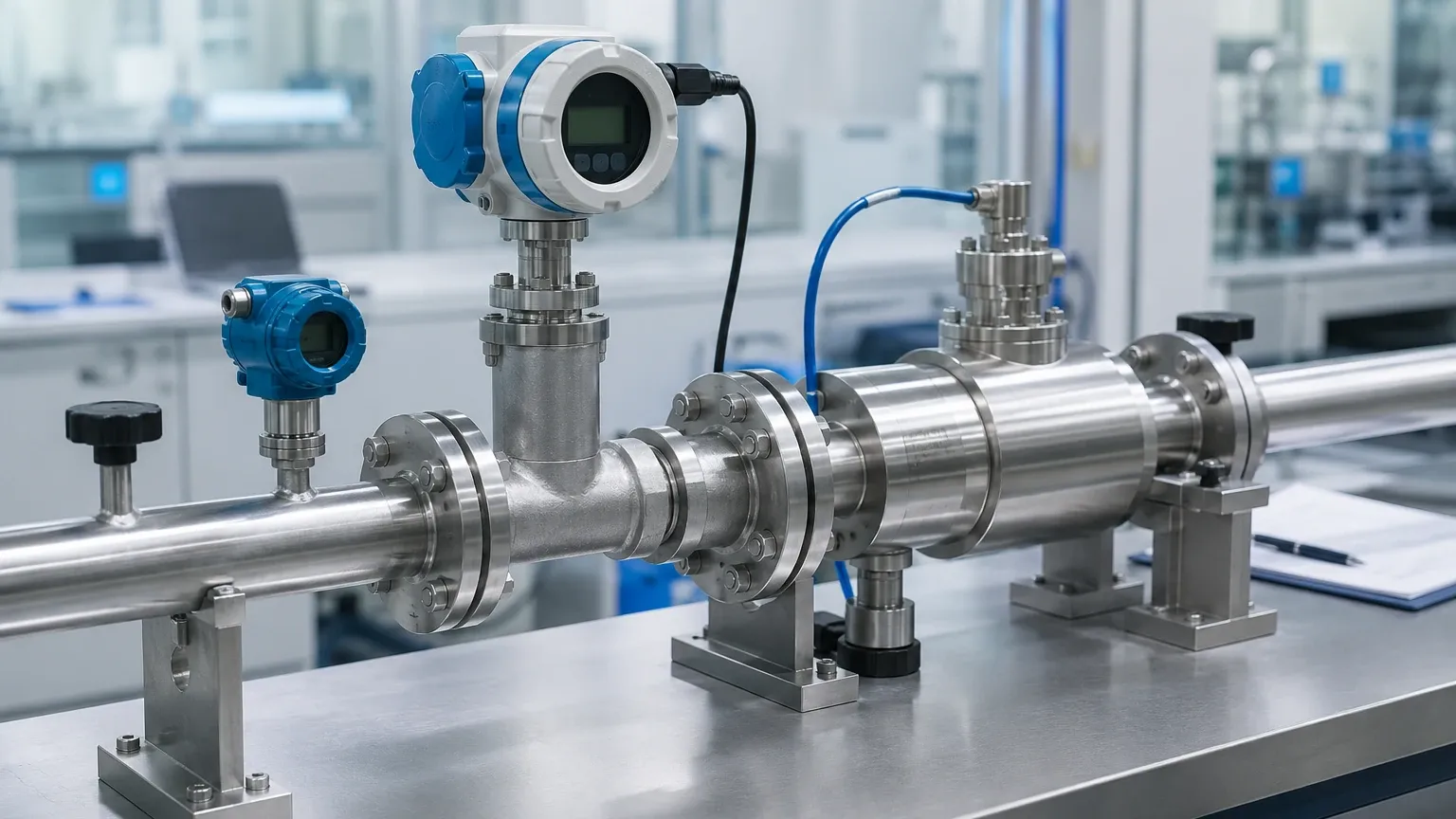
The performance of flow calibration equipment is highly dependent on its installation environment. Even the most expensive gravimetric system will produce inaccurate data if the installation is flawed.
Straight Pipe Runs
To ensure a fully developed flow profile, most flow calibration rigs require significant straight pipe runs upstream and downstream of the meter under test. Typically, 10 to 20 pipe diameters upstream and 5 diameters downstream are required. If space is limited, flow conditioners (vane or perforated plate types) must be used.
Vibration and Noise Control
For gravimetric systems, mechanical vibrations from pumps or nearby industrial machinery can interfere with the weighing scales. Isolation pads and flexible couplings are often necessary to decouple the weighing section from the rest of the plant.
Temperature and Pressure Stability
Fluid density and viscosity change with temperature. In high-precision flow calibration equipment, heat exchangers are often used to maintain a constant fluid temperature. Pressure should also be monitored and stabilized, especially in gas calibration, where compressibility is a major factor.
Common Risks and Limitations
While modern flow calibration equipment is highly advanced, several factors can introduce measurement uncertainty:
1. Entrained Air: In liquid systems, air bubbles can significantly skew both volumetric and gravimetric readings. Air eliminators must be installed upstream of the calibration section.
2. Diverter Timing Error: In gravimetric systems, the time it takes for the diverter valve to switch the flow to the weigh tank must be accounted for. This is often corrected using a "double-chronometry" method.
3. Fluid Properties: Calibrating a meter with water and then using it for a high-viscosity oil can lead to errors if the meter is sensitive to Reynolds number changes. Calibration should ideally be performed using the actual process fluid or a fluid with similar physical properties.
4. Leakage: Any leak between the meter under test and the reference standard will result in a direct calibration error. Regular pressure testing of the rig is mandatory.
The Role of Level Measurement in Calibration Rigs
In many volumetric flow calibration setups, the accuracy of the calibration depends on the precision of the level measurement within the prover tank. For instance, in a "standing start-and-finish" volumetric method, the liquid level is measured at the beginning and end of the test.
Modern rigs often utilize non-contacting radar level sensors or high-resolution hydrostatic transmitters to determine these levels. These instruments provide digital feedback to the control system, allowing for automated calculations of the volume collected. For engineers designing these systems, sourcing reliable level sensors is as important as the flow reference itself. Technical specifications for such sensors can be found on the Main Page of industrial instrument providers, where various technologies like ultrasonic and radar are compared for their suitability in precision vessels.
Frequently Asked Questions (FAQ)
Q: How often should flow calibration equipment be re-certified?
A: Most industrial standards suggest an annual re-certification of the primary or secondary standards within the calibration rig. However, the interval may be shorter if the equipment is used in harsh environments or for high-criticality billing applications.
Q: Can I calibrate a gas flow meter using liquid flow calibration equipment?
A: No. The physics of gas flow (compressibility, Joule-Thomson effect) are fundamentally different from liquid flow. Gas meters require specialized gas provers or master meters designed for compressible fluids.
Q: What is the difference between calibration and validation?
A: Calibration involves comparing a device to a standard and adjusting it to match. Validation (or verification) is the process of checking the device against a standard to confirm it is still within its specified accuracy limits without necessarily making adjustments.
Q: What is the "TUR" in calibration?
A: TUR stands for Test Uncertainty Ratio. It is the ratio of the accuracy of the meter being tested to the accuracy of the calibration standard. A TUR of 4:1 is the industry standard, meaning the calibration equipment is four times more accurate than the meter under test.
Conclusion
Flow calibration equipment is an essential investment for any facility where fluid measurement impacts the bottom line or safety. By understanding the principles of gravimetric and volumetric measurement, and by carefully considering factors like uncertainty, fluid compatibility, and installation requirements, engineers can ensure their processes remain accurate and compliant. As industrial systems become more integrated, the synergy between flow measurement and supporting technologies like level sensing continues to grow, providing more robust data for process optimization.