Flow Measuring Instruments
Flow Measuring Instruments
Flow measuring instruments are fundamental components in industrial process control, enabling the precise monitoring and management of liquids, gases, and steam. While level measurement focuses on the volume or height of a medium within a vessel, flow measurement quantifies the movement of that medium through a conduit or open channel. For engineers and plant operators, selecting the correct flow meter is as critical as choosing a reliable level transmitter to ensure process efficiency, safety, and billing accuracy.
In many industrial environments, such as water treatment, chemical processing, and oil and gas, flow and level measurement work in tandem. For instance, measuring the flow rate into a tank while monitoring the level within it allows for comprehensive mass balance and leak detection. This guide explores the core principles of flow measurement, selection criteria, and the practical considerations necessary for successful implementation in industrial automation.
Core Principles of Flow Measurement
To select the appropriate instrument, one must first understand the physical principles used to derive flow data. Flow measuring instruments generally categorize into volumetric flow meters and mass flow meters.
Electromagnetic Flow Meters
Electromagnetic meters operate on Faraday’s Law of Electromagnetic Induction. When a conductive liquid flows through a magnetic field generated by the meter, it produces a voltage proportional to the velocity of the fluid. This technology is highly effective for water, wastewater, and corrosive chemicals, provided the medium has a minimum conductivity (typically >5 μS/cm).
Ultrasonic Flow Meters
Ultrasonic instruments use sound waves to determine velocity. There are two primary types:
1. Transit-time: Measures the time difference between signals sent upstream and downstream. It is ideal for clean liquids.
2. Doppler: Measures the frequency shift of signals reflected off particles or bubbles in the fluid. It is preferred for slurries or aerated liquids.
Vortex Flow Meters
Vortex meters utilize the Von Kármán effect. As fluid passes a "shedder bar" inside the meter, vortices are created. The frequency of these vortices is directly proportional to the flow velocity. These are robust instruments often used for steam and high-velocity gas applications.
Differential Pressure (DP) Flow Meters
DP meters rely on Bernoulli’s principle. By placing a restriction (like an orifice plate or Venturi tube) in the pipe, a pressure drop is created. The square root of the pressure difference between the upstream and downstream sides is proportional to the flow rate. While traditional, they remain a staple in high-pressure oil and gas applications.
Coriolis Mass Flow Meters
Unlike volumetric meters, Coriolis meters measure mass flow directly. They use the vibrating tube principle, where the fluid's inertia causes the tube to twist. This twist is measured and converted into a highly accurate mass flow reading, unaffected by changes in fluid density or viscosity.
The Relationship Between Level and Flow
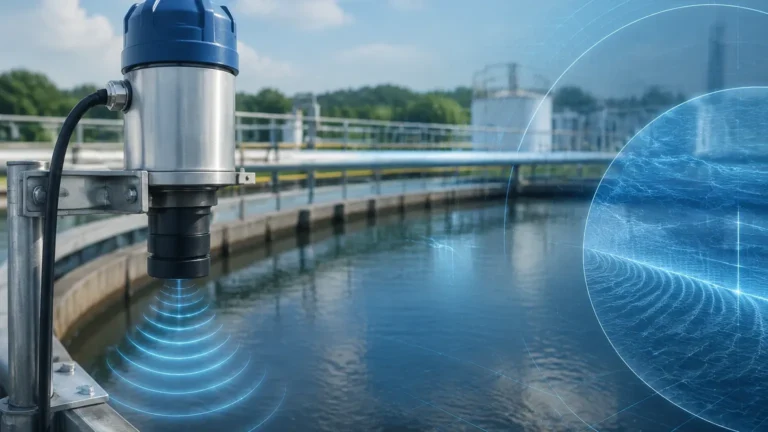
In many infrastructure projects, flow is measured in open channels rather than closed pipes. This is where level measurement technology directly intersects with flow calculation. By using an ultrasonic or radar level sensor to measure the "head" (liquid height) behind a weir or flume of known dimensions, the flow rate can be calculated using standardized hydraulic equations.
For complex industrial setups requiring both tank inventory management and pipeline monitoring, it is essential to Review product options and application support to ensure that the selected instruments—whether for level or flow—are compatible with the site's communication protocols and environmental conditions.
Selection Criteria for Flow Measuring Instruments
Choosing the wrong instrument can lead to significant measurement errors, increased maintenance, or premature device failure. Engineers should evaluate the following criteria before procurement:
1. Fluid Characteristics: Is the fluid conductive? Is it a gas, liquid, or steam? What is its viscosity and density?
2. Accuracy and Repeatability: Does the process require ±0.1% accuracy (e.g., custody transfer) or is ±2% sufficient for general monitoring?
3. Process Conditions: What are the maximum and minimum operating pressures and temperatures? Ensure the meter body and liners can withstand these extremes.
4. Flow Range (Turndown Ratio): The ratio between the maximum and minimum flow the meter can accurately measure. For example, a 10:1 turndown ratio means a meter rated for 100 m³/h can measure down to 10 m³/h.
5. Installation Constraints: Does the site have enough straight pipe run to stabilize the flow profile?
Flow Meter Selection Comparison Table
| Technology | Typical Accuracy | Fluid Type | Advantages | Limitations |
| :— | :— | :— | :— | :— |
| Electromagnetic | ±0.5% | Conductive Liquids | No moving parts; low pressure drop | Requires conductive fluid |
| Ultrasonic (Transit-time) | ±1.0% | Clean Liquids | Non-invasive; no pressure drop | Sensitive to bubbles/solids |
| Vortex | ±1.0% | Gas, Steam, Liquids | Robust; handles high temp | Requires high velocity to start |
| Coriolis | ±0.1% | Liquids, Gases | Direct mass flow; very accurate | High initial cost; size limits |
| Differential Pressure | ±1.0% to 2.0% | Liquids, Gas, Steam | Industry standard; low cost | Permanent pressure loss |
| Thermal Mass | ±1.0% | Gases | Measures mass flow of gas | Sensitive to moisture/dirt |
Installation Considerations
Proper installation is as important as the technology itself. Even the most expensive flow measuring instruments will provide inaccurate data if installed incorrectly.
Straight Pipe Requirements
Most flow meters require a specific length of straight pipe upstream and downstream to ensure a fully developed, non-turbulent flow profile. Typically, this is expressed in pipe diameters (D). A common requirement is 10D upstream and 5D downstream. If the installation follows a pump or a 90-degree elbow, these requirements may increase significantly.
Orientation and Piping
* Liquid Service: The pipe must remain full at all times. For horizontal pipes, the meter should be installed at a low point. For vertical pipes, flow should always be upward to prevent air pockets.
* Gas Service: The pipe should be kept dry. In horizontal runs, the meter should be installed at a high point to prevent condensate accumulation.
Grounding and Interference
Electromagnetic flow meters are particularly sensitive to electrical noise. Proper grounding to the process fluid is mandatory, often achieved through grounding rings or electrodes, to prevent stray currents from interfering with the low-voltage signal generated by the flow.

Limitations and Common Risks
While modern flow measuring instruments are highly advanced, they are not universal solutions. Understanding their limitations prevents operational failures.
* Pressure Drop: Instruments like orifice plates or turbine meters introduce a restriction that causes a permanent loss of pressure in the system. This may require higher pump energy, increasing long-term operational costs.
* Scaling and Coating: In chemical or wastewater applications, the buildup of minerals or biological film on electrodes (in Mag meters) or sensors can drift the calibration or cause total signal loss.
* Vibration: Coriolis and Vortex meters are sensitive to mechanical vibrations from nearby pumps or heavy machinery. Proper support and dampening are necessary.
* Cavitation: If the pressure drops too low within the meter, liquid may vaporize (cavitation), leading to physical damage to the meter internals and erratic readings.
Frequently Asked Questions (FAQ)
Q: Can I use an ultrasonic flow meter on a pipe that is only half-full?
A: Standard transit-time ultrasonic meters require a full pipe to function correctly. If the pipe is partially full, the sound waves will reflect off the air-liquid interface, leading to an error. For partially full pipes, specialized area-velocity meters or open-channel level-to-flow methods are required.
Q: How often should flow measuring instruments be calibrated?
A: Calibration frequency depends on the criticality of the measurement and the nature of the fluid. For custody transfer (billing), annual calibration is standard. For general process monitoring, a check every 2-3 years may suffice unless the fluid is abrasive or corrosive.
Q: What is the difference between volumetric flow and mass flow?
A: Volumetric flow measures the space the fluid occupies (e.g., liters per minute), which can change with temperature and pressure. Mass flow measures the actual weight or amount of matter (e.g., kilograms per minute), which remains constant regardless of environmental changes.
Q: Are there flow meters that do not require cutting the pipe?
A: Yes, clamp-on ultrasonic flow meters can be attached to the outside of an existing pipe. These are ideal for retrofitting or for temporary measurements where process downtime must be avoided.
Conclusion
Flow measuring instruments are essential tools for modern industrial efficiency. By understanding the underlying physics—whether electromagnetic, ultrasonic, or mechanical—and adhering to strict installation guidelines, facilities can achieve high levels of process control. When integrating these systems, it is often beneficial to consult a professional manufacturer to align flow requirements with existing level measurement infrastructure. For technical specifications and hardware options, engineers should refer to the Main Page to evaluate the full range of industrial measurement solutions available for their specific application.