Hauser Near Me
Hauser Near Me
In the complex landscape of industrial process automation, the search for "hauser near me" typically signals an urgent need for high-precision instrumentation support, local technical expertise, or the rapid procurement of level measurement devices. Whether an engineer is looking for Endress+Hauser service centers or high-end alternatives that meet the same rigorous standards, the priority remains the same: ensuring process continuity, safety, and accuracy.
Selecting the right level measurement technology requires a deep understanding of the physical principles at play and a clear evaluation of local support capabilities. This guide explores the technical foundations of modern level sensing and provides a framework for evaluating instrumentation providers in your immediate region.
Core Principles of Level Measurement
Before engaging with a local supplier or service provider, it is essential to understand the measurement principles that dictate the performance of industrial instruments. Different technologies are suited to specific media, vessel geometries, and environmental conditions.
Radar Level Measurement (ToF)
Radar level meters operate on the Time-of-Flight (ToF) principle. The device emits high-frequency electromagnetic pulses (typically in the 26 GHz or 80 GHz range) toward the material surface. These pulses are reflected back to the sensor. The distance is calculated based on the time interval between transmission and reception.
* Non-contact Radar: Ideal for corrosive, hot, or agitated liquids. High-frequency 80 GHz radar offers a narrow beam angle, which is critical for avoiding internal tank obstructions like agitators or heating coils.
* Guided Wave Radar (GWR): Uses a probe (cable or rod) to guide the microwave signal. This is highly effective for low dielectric constants or applications with heavy foam and steam.
Ultrasonic Level Sensors
Ultrasonic sensors also use the ToF principle but utilize sound waves instead of electromagnetic pulses. The sensor emits an ultrasonic pulse that reflects off the surface of the medium.
* Application: Best suited for water treatment and simple liquid storage.
* Limitations: Performance can be degraded by changes in air temperature, heavy vapor, or vacuum conditions, as sound requires a medium to travel.
Hydrostatic Level Transmitters
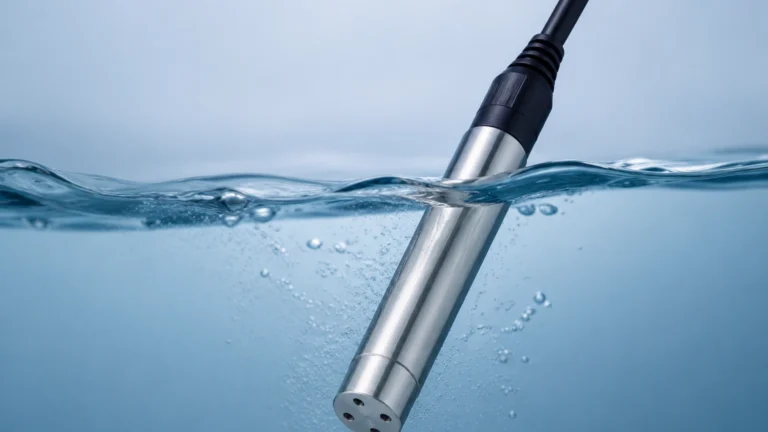
Hydrostatic measurement is based on the principle that the pressure at the bottom of a liquid column is directly proportional to the height of the liquid and its density. The formula used is $P = \rho \cdot g \cdot h$, where $P$ is pressure, $\rho$ is density, $g$ is gravity, and $h$ is height.
* Application: Widely used in vented tanks and deep wells.
* Requirement: The density of the liquid must remain relatively constant for accurate measurement.
Magnetic Level Gauges
These instruments utilize a float containing a permanent magnet that moves with the liquid level in a bypass chamber. This magnet flips external flags or interacts with a reed-chain transmitter to provide both visual and electronic level data.
Evaluating Local Instrumentation Support
When searching for "hauser near me," the goal is often to find a partner capable of providing more than just a boxed product. B2B stakeholders must evaluate local providers based on several critical service pillars:
1. Technical Consultation: Can the local representative perform a site walk-through to identify potential installation hurdles, such as "dead zones" or nozzle interference?
2. Commissioning Services: Proper setup of complex radar or ultrasonic units often requires specialized software (such as DTM/FDT frames) to map out false echoes. Local technicians can ensure the device is optimized for the specific vessel geometry.
3. Calibration and Certification: For industries like chemical processing or oil and gas, periodic calibration is mandatory. Local labs or mobile calibration units reduce downtime significantly.
4. Inventory Availability: In emergency breakdown scenarios, having a local distributor with stock of common flange sizes (e.g., DN50, DN80, or DN100) and pressure ratings (PN16 to PN40) is invaluable.
Selection Criteria for Industrial Level Meters
Choosing the correct instrument involves balancing technical requirements with cost-effectiveness. The following table provides a general comparison of technologies often sought when looking for high-quality instrumentation.
| Technology | Typical Accuracy | Max Range | Media Suitability | Primary Advantage |
| :— | :— | :— | :— | :— |
| 80 GHz Radar | ±1 mm | 120 m | Liquids, Solids, Slurries | High precision, ignores obstructions |
| Ultrasonic | ±0.25% of range | 15 m | Water, Wastewater | Cost-effective, non-contact |
| Hydrostatic | ±0.1% to 0.5% | 200 m (H2O) | Clean liquids, oils | Simple installation, reliable |
| Magnetic Gauge | ±5 mm | 6 m+ | Corrosive/Hazardous liquids | Visual power-free indication |
| Level Switch | N/A (Point) | N/A | Almost all media | Overfill protection/Pump control |
Installation Considerations and Best Practices
Even the most advanced instrument from a top-tier manufacturer will fail if installed incorrectly. When working with local engineers, ensure the following factors are addressed:
Nozzle Positioning
For radar and ultrasonic sensors, the nozzle should be positioned such that the signal beam does not hit the tank wall. A general rule for 26 GHz radar is to keep the nozzle at least 200 mm from the wall, though 80 GHz units with narrower beams allow for closer placement.
Obstruction Mapping
Internal structures like ladders, pipes, and agitators create "false echoes." Modern level meters allow for "Background Subtraction" or "Envelope Mapping," where the sensor is taught to ignore reflections from fixed internal objects. This is a critical step during commissioning.
Environmental Protection
In outdoor installations or wash-down environments, ensure the housing meets IP67 or IP68 standards. For hazardous areas, local providers must supply ATEX, IECEx, or SIL-certified equipment to comply with safety regulations.

Common Risks in Local Procurement
While finding a "hauser near me" provides convenience, there are risks associated with local procurement that must be managed:
* Limited Technical Depth: Some local distributors may act only as sales agents without deep engineering knowledge. Always verify the technical credentials of the support staff.
* Incompatible Specifications: Ensure that local stock matches your specific process connections (NPT vs. BSP threads, or ANSI vs. DIN flanges) and material requirements (316L Stainless Steel, PTFE, or Hastelloy).
* Lead Time Discrepancies: Just because a provider is local does not mean the product is in stock. Always confirm whether the unit is shipping from a local warehouse or an international manufacturing hub.
Why Engineering Context Matters
In the B2B sector, the cost of an instrument is often dwarfed by the cost of the downtime caused by its failure. Therefore, the search for local support is a search for reliability. Professional manufacturers like Welk emphasize the importance of providing not just the hardware, but the customized OEM/ODM services that allow an instrument to fit perfectly into an existing automation architecture.
For those evaluating their options and looking for detailed technical specifications or application support, it is helpful to Review product options and application support on the Main Page of a specialized manufacturer's site. This allows engineers to compare data sheets and performance curves before committing to a local purchase.
FAQ: Industrial Level Measurement
Q: Can radar level meters measure through plastic tanks?
A: Yes, non-contact radar can often see through plastic or fiberglass tank tops, allowing the sensor to be mounted outside the tank, provided the material is not conductive and does not contain metal reinforcement.
Q: What is the difference between 26 GHz and 80 GHz radar?
A: 80 GHz radar has a much narrower beam angle (around 3 to 6 degrees) compared to 26 GHz (around 10 to 15 degrees). This makes 80 GHz superior for small tanks, narrow nozzles, or vessels with many internal obstructions.
Q: How often should hydrostatic sensors be calibrated?
A: In standard water applications, annual calibration is typical. However, in corrosive chemical applications where the diaphragm might experience coating or wear, semi-annual checks are recommended.
Q: Are ultrasonic sensors affected by wind?
A: In outdoor applications, strong wind can deflect the sound waves, leading to signal loss. In such cases, using a stilling well or switching to radar technology is advised.
Conclusion
Finding a "hauser near me" is the first step toward securing the technical support required for modern industrial operations. By understanding the underlying measurement principles—from the electromagnetic precision of radar to the mechanical reliability of magnetic gauges—engineers can make informed decisions that go beyond geographical proximity. Whether you choose a global brand or a specialized manufacturer like Welk, the focus must remain on accuracy, durability, and the specific needs of your process environment. For more information on selecting the right technology for your facility, visit the Main Page for a comprehensive overview of industrial solutions.