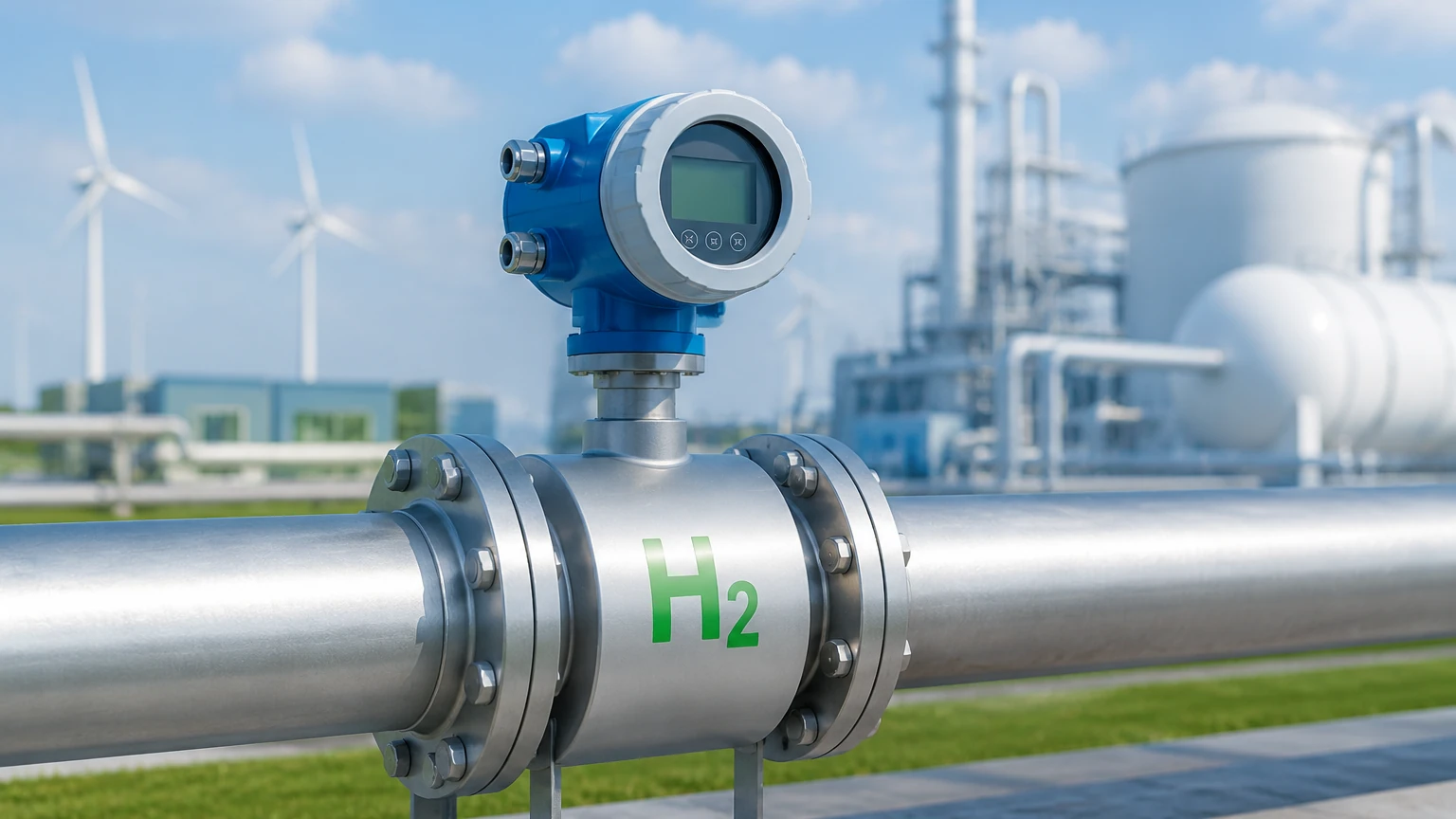
Hydrogen Flow Meter
Hydrogen Flow Meter
In the rapidly evolving landscape of industrial energy and chemical processing, the accurate measurement of hydrogen has become a critical requirement. As the smallest and lightest element, hydrogen presents unique physical properties that challenge traditional instrumentation. Selecting a hydrogen flow meter requires a deep understanding of fluid dynamics, material science, and safety protocols to ensure long-term reliability and precision. This guide examines the primary measurement principles, selection criteria, and installation best practices for hydrogen flow applications in B2B industrial environments.
Measurement Principles for Hydrogen Flow
Before selecting a specific instrument, it is essential to understand the physical principles used to derive flow data. Hydrogen’s low density and high diffusivity mean that not every flow technology is suitable for every application.
Coriolis Mass Flow Meters
Coriolis meters are often considered the gold standard for hydrogen measurement, particularly in high-pressure refueling stations. They operate on the principle of the Coriolis effect: as hydrogen flows through a vibrating tube, it causes a phase shift in the vibration proportional to the mass flow rate.
* Advantages: Direct mass measurement (independent of pressure and temperature changes), high accuracy (often within ±0.5% of rate), and no moving parts in the flow stream.
* Limitations: High initial cost and potential for signal noise in very low-density gas applications.
Thermal Mass Flow Meters
Thermal mass flow meters utilize the thermal properties of hydrogen to measure flow. A typical sensor consists of two RTDs (Resistance Temperature Detectors); one is heated, and the other measures the fluid temperature. The flow of hydrogen carries heat away from the heated sensor, and the power required to maintain a specific temperature differential is proportional to the mass flow.
* Advantages: Excellent low-end sensitivity and no pressure drop.
* Limitations: Accuracy can be affected by changes in gas composition and moisture content.
Vortex Shedding Flow Meters
Vortex meters operate on the Karman Vortex Street principle. As hydrogen flows past a bluff body (a non-streamlined object) in the pipe, vortices are shed alternately from each side. The frequency of these vortices is directly proportional to the flow velocity.
* Advantages: Robust design with no moving parts and a wide turndown ratio.
* Limitations: Requires a minimum Reynolds number to function, which can be difficult to achieve with low-density hydrogen at low pressures.
Differential Pressure (DP) Flow Meters
DP meters, such as orifice plates or Venturi tubes, measure the pressure drop across a restriction in the pipe. According to Bernoulli’s equation, the square root of the pressure drop is proportional to the flow rate.
* Advantages: Well-understood technology with standardized designs (ISO 5167).
* Limitations: Significant permanent pressure loss and requires separate pressure and temperature compensation for mass flow calculation.
Technical Evaluation and Selection Criteria
When evaluating a hydrogen flow meter, engineers must look beyond the basic flow rate. The following criteria are vital for ensuring the instrument performs within the specific constraints of a hydrogen system.
Pressure and Temperature Ranges
Hydrogen is often stored and transported at extreme pressures (up to 700 bar / 10,150 psi) or cryogenic temperatures (-253°C / -423°F). The chosen flow meter must be rated for these extremes. For high-pressure gas, Coriolis meters are preferred, while cryogenic liquid hydrogen often requires specialized vacuum-jacketed turbine or Coriolis meters.
Accuracy and Repeatability
In custody transfer applications, such as hydrogen refueling, accuracy is paramount. Even a 1% error can result in significant financial discrepancies over time. For process control, repeatability may be more important than absolute accuracy to ensure consistent chemical reactions or combustion.
Turndown Ratio
The turndown ratio (the ratio of maximum to minimum measurable flow) is critical in systems with fluctuating demand. Thermal mass meters offer some of the highest turndown ratios (up to 100:1), whereas DP meters are typically limited to 4:1 or 5:1 without changing the orifice plate.
Comparison Table of Flow Meter Technologies
| Technology | Measurement Type | Accuracy (Typical) | Turndown | Pressure Drop | Best Use Case |
| :— | :— | :— | :— | :— | :— |
| Coriolis | Direct Mass | ±0.1% to ±0.5% | 20:1 | Medium | High-pressure refueling, Custody transfer |
| Thermal Mass | Mass | ±1.0% | 100:1 | Negligible | Leak detection, Low-pressure process gas |
| Vortex | Volumetric | ±1.0% | 10:1 | Low | High-velocity steam or gas distribution |
| Differential Pressure | Volumetric | ±1.0% to ±2.0% | 4:1 | High | Constant flow industrial burners |
| Ultrasonic | Volumetric | ±1.0% | 50:1 | Zero | Large diameter pipelines, Flare gas |
Installation and Safety Considerations
Hydrogen is highly flammable and has a wide flammability range (4% to 75% in air). Proper installation is not just a matter of performance, but of safety.
1. Straight Run Requirements: Most volumetric meters (Vortex, DP, Ultrasonic) require significant straight pipe runs (typically 10-20 diameters upstream and 5 diameters downstream) to eliminate turbulence and ensure a fully developed flow profile. Coriolis and Thermal Mass meters are generally less sensitive to piping configurations.
2. Hazardous Area Ratings: All electronic components must carry appropriate explosion-proof or intrinsically safe certifications (e.g., ATEX, IECEx, or UL Class I, Div 1/2).
3. Leak Prevention: Hydrogen molecules are small enough to pass through materials and leak through the smallest gaps. Use welded connections where possible. For flanged connections, use specialized hydrogen-rated gaskets.
4. Orientation: For liquid hydrogen, the meter should be installed in a way that prevents gas pockets from forming. For gas, ensure the meter is installed to prevent condensate buildup on the sensors.
Managing Risks: Hydrogen Embrittlement and Leakage
A primary concern in hydrogen systems is "hydrogen embrittlement." This is a process where hydrogen atoms diffuse into the metal lattice of the meter body or internal components, causing them to become brittle and crack under stress.
To mitigate this risk, the wetted parts of a hydrogen flow meter should be constructed from compatible materials. 316L Stainless Steel is the industry standard for many applications, though high-pressure or high-temperature environments may require specialized alloys like Hastelloy C-276 or Inconel.
Furthermore, because hydrogen is a "searching gas," leak testing using helium or hydrogen-nitrogen mixes (forming gas) is recommended during the commissioning phase to ensure the integrity of the flow meter housing and connections.
Integrating Flow and Level Measurement in Hydrogen Systems
In a complete industrial automation ecosystem, flow measurement is rarely used in isolation. To maintain a full mass balance of a hydrogen storage facility, flow data must be correlated with level data. While the flow meter tracks the movement of hydrogen through the lines, level measurement instruments monitor the actual inventory within storage tanks.
For instance, in liquid hydrogen (LH2) storage, hydrostatic level transmitters or high-frequency radar level meters provide real-time data on tank volume. By comparing the integrated flow from a hydrogen flow meter against the change in level recorded by instruments found on the Main Page, operators can detect leaks, verify delivery volumes, and optimize supply chain logistics. This dual-layered approach is essential for safety and efficiency in green hydrogen production plants and chemical refineries.
Frequently Asked Questions (FAQ)
Q: Can I use a standard air flow meter for hydrogen?
A: Generally, no. Hydrogen’s low density and high thermal conductivity require specific calibration. Using a meter calibrated for air on hydrogen will result in significant measurement errors and may pose a safety risk if the materials are not compatible with hydrogen.
Q: What is the impact of hydrogen purity on flow measurement?
A: Thermal mass flow meters are particularly sensitive to gas composition. If the hydrogen is mixed with nitrogen or CO2, the thermal properties change, and the meter must be re-calibrated or use a multivariable sensor to maintain accuracy.
Q: How often should a hydrogen flow meter be calibrated?
A: For custody transfer, annual calibration is standard. For process monitoring, the interval depends on the technology. Coriolis meters are stable and may only need verification every 2-3 years, while DP meters may require more frequent checks of the secondary pressure transmitter.
Q: Is pressure compensation necessary for all hydrogen meters?
A: Pressure compensation is necessary for volumetric meters (Vortex, DP, Ultrasonic) if you need to calculate mass flow or standard volume (Nm³/h). Coriolis and Thermal Mass meters measure mass flow directly and do not strictly require external pressure compensation for the mass calculation itself, though pressure data is often monitored for safety.
Conclusion
Selecting the right hydrogen flow meter involves balancing the need for precision against the harsh physical realities of hydrogen handling. By understanding the underlying measurement principles—whether mass-based like Coriolis and Thermal or volumetric-based like Vortex and DP—engineers can specify solutions that offer both safety and performance. When integrated with reliable level measurement systems, such as those detailed on the Main Page, hydrogen flow meters become a cornerstone of modern industrial energy management, ensuring that this critical resource is accounted for accurately from production to end-use.