How to Measure a Wave Height
How to Measure a Wave Height
In industrial process control and environmental monitoring, understanding how to measure a wave height is critical for ensuring the safety of offshore structures, the efficiency of water treatment processes, and the accuracy of level data in agitated tanks. While the concept of a wave—the vertical distance between a crest and the preceding trough—is simple, the execution of precise measurement in a dynamic environment requires a deep understanding of sensor physics and signal processing.
For engineers and plant managers, selecting the right instrumentation involves balancing the need for high-frequency sampling with the environmental constraints of the application. This guide explores the technical principles, equipment selection, and installation strategies necessary to capture accurate wave data in both open-water and industrial process environments.
Core Principles of Wave Height Measurement
To determine how to measure a wave height effectively, one must first define the parameters being tracked. In most B2B and engineering contexts, we are concerned with "Significant Wave Height" (SWH), which is the average height of the highest one-third of waves in a specific period, or the instantaneous wave height used to trigger safety shutdowns or adjust pump speeds.
Measurement technologies generally fall into two categories: contact and non-contact. Contact methods, such as hydrostatic pressure sensors or wave staffs, interact directly with the medium. Non-contact methods, including radar and ultrasonic sensors, use time-of-flight (ToF) principles to map the surface from a distance.
The Time-of-Flight Principle
Most modern wave measurement relies on the ToF principle. A sensor emits a pulse (either electromagnetic or acoustic) toward the water surface. The pulse reflects off the surface and returns to the receiver. By knowing the constant speed of the pulse (the speed of light for radar or the speed of sound for ultrasonic), the device calculates the distance based on the travel time. In wave height applications, the sensor must sample at a high enough frequency (typically 4Hz to 10Hz or higher) to capture the peak and trough of a moving wave.
Hydrostatic Pressure Principle
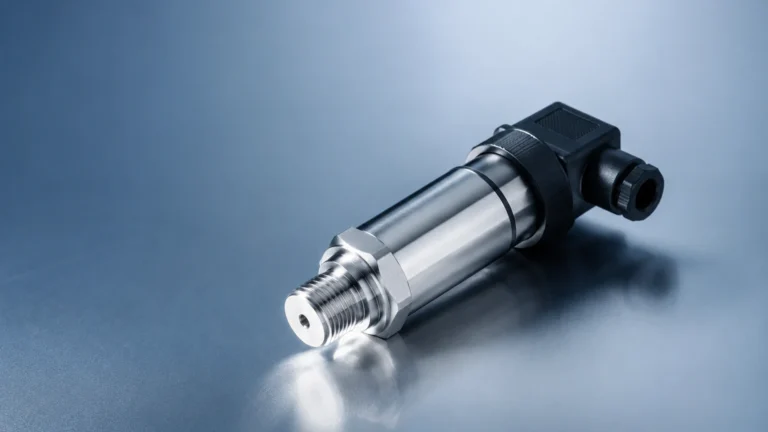
Hydrostatic transmitters measure the pressure exerted by the column of liquid above the sensor. As a wave passes over a submerged sensor, the pressure increases at the crest and decreases at the trough. By converting this pressure change back into a height equivalent, the wave profile can be reconstructed. However, this method requires mathematical correction for water density and atmospheric pressure fluctuations.
Selecting the Right Technology for Wave Measurement
Choosing the appropriate instrument depends on the specific requirements of the site, such as the presence of foam, the distance to the surface, and the required precision. For a comprehensive overview of available technologies, engineers often Review product options and application support to match sensor capabilities with environmental challenges.
Radar Level Meters (Non-Contact)
Radar is widely considered the gold standard for measuring wave height in industrial and marine environments. High-frequency radar (such as 80GHz) provides a narrow beam angle, which is essential for focusing on a specific point on the water surface without interference from tank walls or structural supports.
* Advantages: Unaffected by temperature changes, wind, or vacuum conditions. High sampling rates allow for real-time wave profiling.
* Limitations: Can be affected by extremely heavy foam which may absorb the radar signal, though modern FMCW (Frequency Modulated Continuous Wave) radars are increasingly adept at filtering these signals.
Ultrasonic Level Sensors (Non-Contact)
Ultrasonic sensors are a cost-effective solution for shorter distances and less volatile environments. They work by emitting sound waves and measuring the echo.
* Advantages: Lower cost and easy installation.
* Limitations: The speed of sound is affected by air temperature and humidity. Significant wind can "blow" the sound pulse away, leading to signal loss. They are generally not recommended for high-precision wave measurement in open-sea conditions but are suitable for indoor basins or slow-moving channels.
Hydrostatic Level Transmitters (Contact)
These sensors are submerged at a fixed depth. They are often used in tide gauges and for measuring significant wave height in coastal engineering.
* Advantages: Not affected by surface foam or floating debris. Very stable for long-term monitoring.
* Limitations: Requires immersion, making them susceptible to biofouling and corrosion. They measure the "weight" of the water, so they may miss the fine details of rapid capillary waves.
Technical Comparison Table
| Feature | Radar (FMCW) | Ultrasonic | Hydrostatic |
| :— | :— | :— | :— |
| Measurement Range | Up to 120m | Up to 30m | Up to 200m (depth) |
| Accuracy | ±1mm to ±5mm | ±0.25% of range | ±0.1% to ±0.5% |
| Sampling Rate | High (up to 20Hz) | Moderate (1-5Hz) | High (Continuous) |
| Environmental Sensitivity | Low | High (Wind/Temp) | Low (Submerged) |
| Maintenance | Minimal | Low | Moderate (Fouling) |
How to Measure a Wave Height: Installation Considerations
Correct installation is as important as sensor selection. Even the most accurate radar meter will provide poor data if it is mounted incorrectly.
Mounting Angle and Position
For non-contact sensors, the beam must be perpendicular to the average water surface. If the sensor is tilted, the return signal strength drops significantly. In applications where wave slopes are steep, a wider dynamic range in the receiver is necessary to capture the "off-axis" reflections.
The Role of Stilling Wells
In many industrial level applications, waves are considered "noise" that needs to be eliminated to find the average level. However, if the goal is specifically how to measure a wave height, a stilling well might seem counterintuitive.
* When to use a stilling well: Use a perforated stilling well to damp out high-frequency "chop" or surface turbulence while allowing the main wave frequency to enter. This stabilizes the reading and protects the sensor from debris.
* When to avoid: If you need to measure the exact instantaneous crest of a fast-moving wave, a stilling well may introduce a mechanical lag that smooths out the data too much.
Signal Filtering and Data Processing
Modern industrial level meters include built-in software filters. When measuring wave height, these filters must be adjusted. Standard "damping" settings, which average the level over 30-60 seconds, must be turned off or reduced to a minimum (e.g., <1 second) to allow the output to follow the wave profile in real-time.

Common Risks and Limitations
When determining how to measure a wave height, engineers must account for several physical phenomena that can degrade data quality:
1. Multi-path Reflections: In confined spaces like narrow tanks, the radar or ultrasonic signal may bounce off the walls before hitting the water, creating "ghost" waves in the data.
2. Aeration and Foam: Heavy foam acts as an insulator. For ultrasonic sensors, foam can completely absorb the sound. For radar, it may cause a signal shift or decrease the amplitude of the return echo.
3. Vessel Motion: If the sensor is mounted on a floating platform or ship, the measurement will be the relative distance between the sensor and the water. To get the absolute wave height, the data must be compensated using an IMU (Inertial Measurement Unit) to subtract the vessel's heave, pitch, and roll.
4. Minimum Dead Band: All non-contact sensors have a "dead zone" (blocking distance) directly beneath the sensor where measurements cannot be taken. Ensure the highest possible wave crest does not enter this zone.
Practical Steps for Project Confirmation
Before finalizing an instrumentation purchase for wave measurement, project teams should confirm the following technical details:
* Maximum Expected Wave Amplitude: Ensure the sensor’s dynamic range can handle the distance from the lowest trough to the highest possible crest (including storm surges or tank overfills).
* Media Characteristics: Is the liquid pure water, wastewater, or a chemical? This affects density (for hydrostatic) and reflectivity (for radar).
* Output Requirements: Do you need a 4-20mA analog signal representing the average height, or a digital output (Modbus, HART, or RS485) providing a high-speed data stream for external analysis?
* Power Availability: High-frequency sampling consumes more power. This is a critical consideration for remote, battery-powered, or solar-powered monitoring stations.
Frequently Asked Questions (FAQ)
Q: Can I use a standard level transmitter to measure wave height?
A: Yes, provided the sampling rate is high enough and the damping/filtering settings are minimized. Most standard industrial transmitters are set by default to smooth out waves; these settings must be changed in the field.
Q: What is the best frequency for radar wave measurement?
A: 80GHz radar is generally preferred because its narrow beam (often as small as 3 degrees) allows for precise targeting of the water surface and better performance in the presence of structural interference.
Q: How does wind affect wave height measurement?
A: Wind primarily affects ultrasonic sensors by dispersing the sound waves. For radar, wind does not affect the signal, but it does create "capillary waves" (small ripples) on the surface, which can actually help radar performance by providing a more diffuse, detectable surface for the signal to reflect off of.
Q: Is it better to measure wave height from above or below?
A: Non-contact measurement from above (Radar) is usually preferred for ease of maintenance and to avoid sensor fouling. However, submerged hydrostatic sensors are better in environments with extreme surface foam or where the surface is frequently obstructed by floating debris.
By understanding the physics of the environment and the limitations of each sensor type, engineers can implement a robust system for how to measure a wave height that provides reliable data for years of operation. For specific application engineering and hardware selection, it is recommended to consult with a specialist manufacturer to ensure the chosen device meets the unique demands of the installation site.