Mass Flow Meter for Gases
Mass Flow Meter for Gases
In industrial process control and automation, the measurement of gas flow is a critical requirement for ensuring operational efficiency, safety, and cost-effectiveness. While volumetric flow measurement has historically been the standard, it presents significant challenges when dealing with gases. Gases are highly compressible; their volume changes drastically with fluctuations in temperature and pressure. Consequently, a volumetric reading without compensation is often insufficient for precise process control or custody transfer.
To address these challenges, engineers and plant managers increasingly turn to the mass flow meter for gases. These instruments provide a direct measurement of the mass of the gas moving through a pipe, independent of changes in ambient or process conditions. This guide explores the fundamental principles, selection criteria, and installation requirements for these essential industrial tools.
Understanding Gas Flow: Mass vs. Volume
Before selecting a measurement technology, it is vital to understand why mass measurement is preferred in gas applications. According to the Ideal Gas Law ($PV = nRT$), the volume ($V$) of a gas is inversely proportional to pressure ($P$) and directly proportional to absolute temperature ($T$). In a typical industrial environment, a 1 bar change in pressure or a 10°C change in temperature can result in a significant error in volumetric flow readings.
To obtain a "standardized" volumetric reading (such as Standard Cubic Meters per Hour, $Nm^3/h$), traditional volumetric meters require external pressure and temperature transmitters and a flow computer to perform real-time compensation. A mass flow meter for gases simplifies this architecture by measuring the mass directly or by incorporating internal compensation, reducing the number of potential failure points and lowering total installation costs. For professionals looking to integrate these technologies into broader industrial systems, reviewing comprehensive product options and application support on the Main Page can provide further technical insights.
Thermal Mass Flow Measurement Principles
Thermal mass flow meters are among the most common instruments used for gas applications, particularly in aeration, compressed air monitoring, and natural gas distribution. They operate based on the thermal properties of the gas.
The Heat Transfer Principle
Most thermal mass flow meters utilize two sensors: a velocity sensor (which is heated) and a reference temperature sensor. As gas flows past the heated sensor, it carries away heat molecules—a process known as convective heat transfer. The rate of heat loss is directly proportional to the mass flow rate of the gas.
There are two primary methods used in thermal measurement:
1. Constant Temperature Differential: The instrument maintains a fixed temperature difference between the heated sensor and the reference sensor. The electrical power required to maintain this differential is measured and converted into a mass flow reading.
2. Constant Power: A fixed amount of power is supplied to the heated sensor, and the resulting temperature difference between the two sensors is measured.
Because heat transfer depends on the density and thermal properties of the gas, these meters are calibrated for specific gas compositions. They are exceptionally sensitive to low flow rates, making them ideal for leak detection.
Coriolis Mass Flow Measurement Principles
For applications requiring the highest possible accuracy, Coriolis mass flow meters are the gold standard. Unlike thermal meters, Coriolis meters are truly independent of the gas properties, including density, viscosity, and conductivity.
The Coriolis Effect
The meter consists of one or more vibrating tubes. When gas flows through these tubes, the Coriolis force causes the tubes to twist or shift in phase. The magnitude of this phase shift is directly proportional to the mass flow rate. Sensors at the inlet and outlet of the tubes detect this shift with extreme precision.
While Coriolis meters are highly accurate (often within 0.5% of the reading for gases), they typically involve a higher initial investment and can cause a higher pressure drop compared to thermal dispersion models. They are most frequently used in high-value gas measurement, such as hydrogen fueling or chemical dosing.
Key Evaluation Criteria for Gas Mass Flow Meters
Selecting the right mass flow meter for gases requires a detailed analysis of the process environment. Engineers should evaluate the following criteria:
1. Accuracy and Repeatability
Accuracy is the proximity of the measurement to the true value, while repeatability is the ability of the meter to provide the same result under identical conditions. In B2B industrial settings, repeatability is often more critical for process consistency than absolute accuracy.
2. Turndown Ratio (Rangeability)
The turndown ratio defines the range over which the meter can measure accurately. For example, a meter with a 100:1 turndown ratio can measure a maximum flow of 1000 kg/h and a minimum flow of 10 kg/h. Thermal meters typically offer much higher turndown ratios than Coriolis or differential pressure meters.
3. Pressure Drop
Every instrument placed in a flow line creates some resistance. In low-pressure gas systems, a high pressure drop can impede the process or increase energy costs for compressors. Thermal insertion meters offer negligible pressure drop, whereas Coriolis meters may have significant resistance due to the internal tube geometry.
4. Gas Composition and Purity
Thermal meters are gas-specific. If the gas composition changes (e.g., a shift in the methane-to-ethane ratio in natural gas), the meter must be recalibrated or use a correction factor. Coriolis meters are generally unaffected by composition changes.
Comparison Table: Choosing the Right Technology
| Feature | Thermal Mass Flow Meter | Coriolis Mass Flow Meter | Differential Pressure (Compensated) |
| :— | :— | :— | :— |
| Direct Mass Measurement | Yes (Indirect via heat) | Yes (Direct) | No (Requires P & T) |
| Accuracy (Gas) | ±1% to ±3% of reading | ±0.5% of reading | ±1% to ±2% of Full Scale |
| Turndown Ratio | Up to 100:1 or higher | 20:1 to 50:1 | 5:1 to 10:1 |
| Pressure Drop | Very Low | Moderate to High | Moderate |
| Low Flow Sensitivity| Excellent | Poor | Poor |
| Typical Applications| Compressed air, Flare gas | Chemical dosing, Hydrogen | Steam, High-pressure gas |
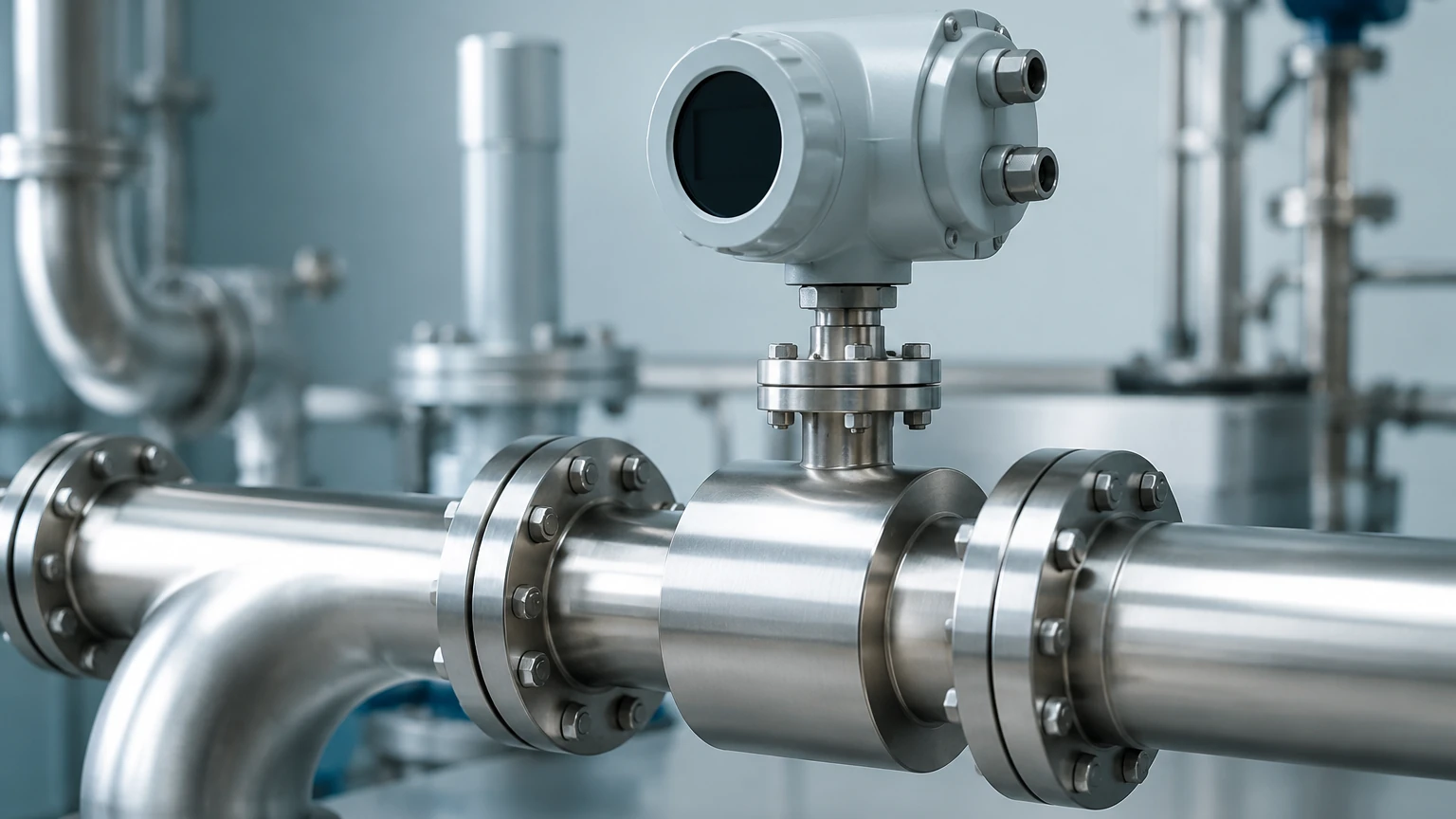
Installation Best Practices and Considerations
Proper installation is as important as the technology selection itself. Even the most advanced mass flow meter for gases will fail to perform if installed incorrectly.
Straight Pipe Requirements
Most flow meters require a specific length of straight pipe upstream and downstream of the sensor to ensure a fully developed, laminar flow profile. Turbulence caused by elbows, valves, or reducers can lead to significant measurement errors.
* Upstream: Typically 10 to 20 pipe diameters (D).
* Downstream: Typically 5 diameters (5D).
If space is limited, flow conditioners or honeycombs can be installed to stabilize the flow in shorter runs.
Mounting Orientation
For gas applications, the preferred orientation is often horizontal. If the gas contains any moisture or entrained liquids, the meter should be installed in a way that prevents liquid from pooling around the sensors. In vertical lines, the flow should ideally be upward to ensure any moisture is carried away by the gas stream.
Cleanliness and Moisture
Thermal mass flow meters are sensitive to sensor coating. If the gas is "dirty" or contains oil mist, deposits can form on the heated sensor, insulating it and causing the meter to under-read. Regular maintenance and the use of knockout pots or filters upstream can mitigate this risk.
Limitations and Common Challenges
While mass flow meters offer superior performance, they are not without limitations:
* Gas Mixtures: For thermal meters, unknown or fluctuating gas mixtures require complex "K-factor" adjustments. If the specific heat of the gas changes unexpectedly, the accuracy is compromised.
* High Velocities: All meters have a maximum velocity limit. Exceeding this can lead to sensor damage or "flat-lining" of the output signal.
* Condensation: The presence of liquid droplets in a gas stream is a common source of error. In thermal meters, a droplet hitting the heated sensor causes a sudden "spike" in the flow reading as the liquid absorbs a large amount of energy to evaporate.
Frequently Asked Questions (FAQ)
Q: Can a mass flow meter for gases be used for steam?
A: Standard thermal mass flow meters are generally not suitable for steam due to the high temperatures and the risk of condensation. However, specialized Coriolis meters or multivariable vortex meters are often used for steam mass flow measurement.
Q: Do these meters require periodic recalibration?
A: Yes. In regulated industries or high-precision applications, annual calibration is recommended. Thermal meters, in particular, should be checked if the gas composition has changed or if the sensors show signs of fouling.
Q: What is the difference between an insertion meter and an inline meter?
A: Inline meters are integrated into the piping via flanges or threads and are used for smaller pipe sizes (typically under 100 mm). Insertion meters are installed through a nozzle on the side of the pipe and are more cost-effective for large diameter ducts and pipes.
Conclusion
Selecting a mass flow meter for gases is a strategic decision that impacts the accuracy of energy audits, the quality of chemical reactions, and the safety of gas distribution networks. By understanding the underlying physics—whether it be thermal dispersion or the Coriolis effect—engineers can match the technology to the specific needs of their application.
When evaluating providers, it is essential to consider not only the hardware but also the technical support and customization options available. For those seeking reliable, accurate, and cost-effective measurement solutions, exploring the specialized industrial instruments available at the Main Page is a recommended next step for any engineering project. Proper selection, combined with adherence to installation best practices, ensures long-term reliability and a high return on investment for industrial gas measurement systems.