Wastewater Flow Sensor
Wastewater Flow Sensor
In industrial and municipal water management, the selection of a wastewater flow sensor is a critical engineering decision that impacts regulatory compliance, operational efficiency, and cost accounting. Wastewater presents a unique set of challenges compared to clean water: it often contains suspended solids, corrosive chemicals, varying pH levels, and organic matter that can lead to scaling or biological growth. Furthermore, wastewater is frequently transported through open channels or partially filled pipes, requiring specialized measurement techniques that differ from standard closed-pipe pressurized systems.
Selecting the correct technology requires a deep understanding of the hydraulic conditions and the physical properties of the effluent. As a professional manufacturer of industrial level and flow measurement instruments, Welk provides high-precision solutions designed to withstand these rigorous environments. For a comprehensive overview of available technologies, engineers can refer to the Main Page for technical specifications and product configurations.
Understanding Wastewater Flow Measurement Principles
Before selecting a wastewater flow sensor, it is essential to understand the physics of how flow is calculated in different hydraulic scenarios. Flow measurement generally falls into two categories: closed-pipe (pressurized) and open-channel (gravity-fed).
Open-Channel Flow (The Level-to-Flow Relationship)
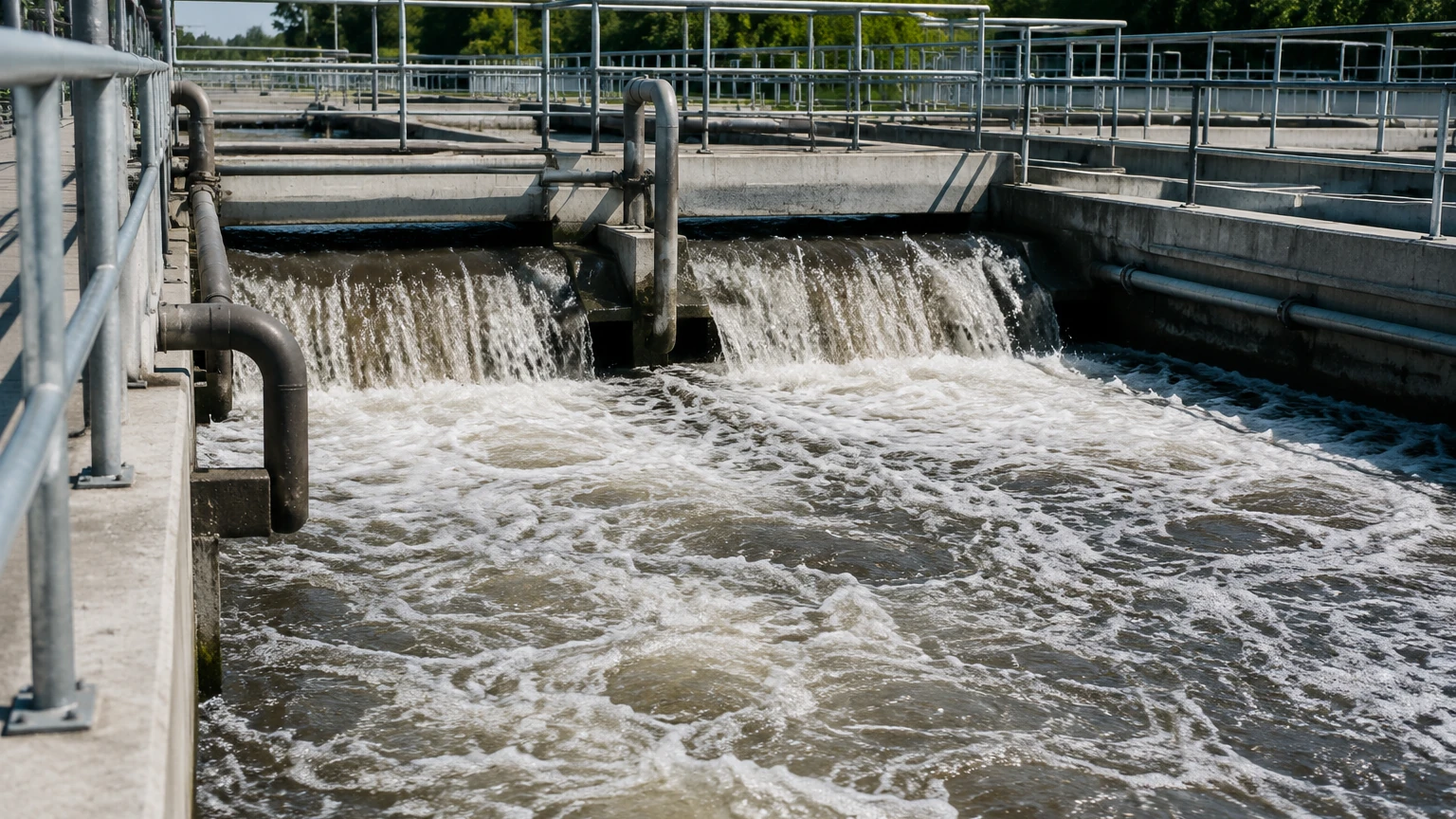
Most municipal wastewater systems and industrial discharge points utilize open channels or non-pressurized pipes. In these scenarios, flow rate ($Q$) is not measured directly by a single velocity sensor but is derived from the liquid level ($h$). This is achieved by installing a primary device—such as a flume or a weir—that creates a known relationship between the head (level) and the flow rate.
Mathematical models, such as the Manning equation or specific discharge curves for Parshall flumes, allow a level sensor (ultrasonic or radar) to function as a wastewater flow sensor. The sensor measures the distance to the water surface, and the integrated electronics convert this level measurement into a volumetric flow rate (e.g., cubic meters per hour or liters per second).
Area-Velocity Method
In channels where a primary device (flume/weir) cannot be installed, the area-velocity method is used. This requires measuring two variables: the level of the fluid (to calculate the cross-sectional area) and the average velocity of the flow. A wastewater flow sensor using this principle typically combines an ultrasonic transducer for level and a Doppler-effect sensor for velocity.
Closed-Pipe Flow
When wastewater is pumped under pressure through a completely full pipe, electromagnetic flow meters or clamp-on ultrasonic meters are preferred. These rely on Faraday’s Law of Induction or transit-time ultrasonic physics, respectively. However, in wastewater applications, the presence of air bubbles or high solids content can interfere with transit-time signals, making electromagnetic meters the industry standard for full-pipe sewage applications.
Types of Wastewater Flow Sensors and Their Applications
1. Ultrasonic Level-Based Flow Sensors
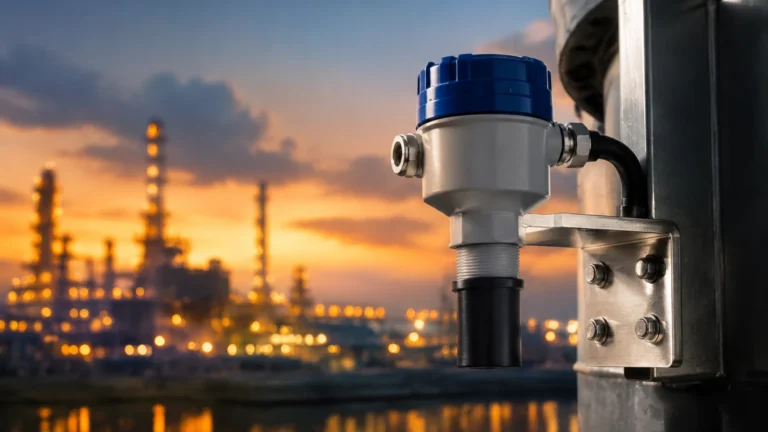
Ultrasonic sensors are the most common non-contact solution for open-channel wastewater flow. They emit high-frequency sound pulses that reflect off the liquid surface. By measuring the time-of-flight, the sensor determines the level.
* Best for: Standard municipal sewage, storm water, and non-foaming industrial effluent.
* Advantages: No moving parts, low maintenance, and relatively cost-effective.
* Limitations: Performance can be degraded by heavy foam, steam, or high-velocity wind, which can dissipate or deflect the sound waves.
2. Radar (Microwave) Flow Sensors
Radar technology, particularly 80GHz high-frequency radar, has become a preferred wastewater flow sensor for challenging environments. Unlike ultrasonic waves, radar signals are unaffected by air temperature fluctuations, pressure, or the presence of steam and dust.
* Best for: Chemical wastewater, high-temperature effluents, and applications where foam is present.
* Advantages: Extremely high accuracy (often ±2 mm for level), non-contact, and unaffected by ambient environmental conditions.
* Welk Solution: Welk’s radar level meters are frequently used in conjunction with flumes to provide high-reliability flow data in volatile industrial settings.
3. Electromagnetic Flow Meters (Magmeters)
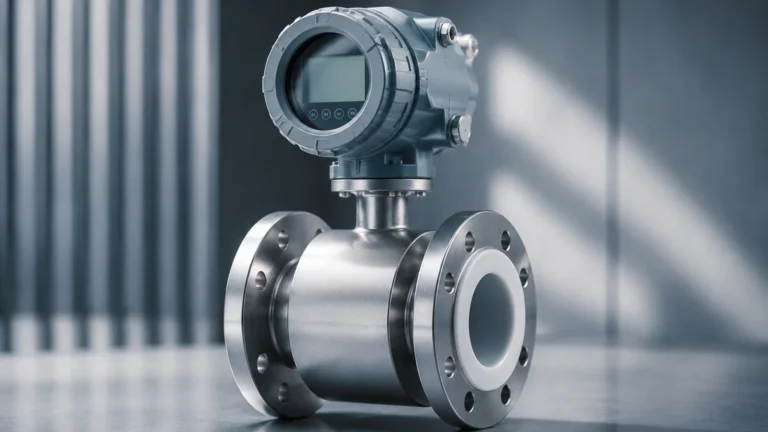
For pressurized secondary lines or sludge return lines, the electromagnetic wastewater flow sensor is the standard. It works by generating a magnetic field across the pipe; as the conductive wastewater flows through the field, it generates a voltage proportional to the velocity.
* Best for: Raw sewage, thickened sludge, and chemical dosing.
* Advantages: Highly accurate, handles high solids content, and provides no obstruction to the flow.
* Requirement: The pipe must be 100% full at all times for an accurate reading.
Technical Selection Criteria for Industrial Wastewater
When evaluating a wastewater flow sensor, engineers must confirm several parameters to ensure long-term reliability and accuracy.
1. Media Composition: Does the wastewater contain hydrocarbons? If so, ultrasonic sensors may struggle if vapors affect the speed of sound. Is the fluid corrosive? Non-contact sensors (Radar/Ultrasonic) are preferred over contact sensors to prevent hardware degradation.
2. Channel Geometry: For open channels, the dimensions of the flume or weir must be precisely known. If no primary device exists, an area-velocity sensor or the installation of a prefabricated flume is required.
3. Flow Range (Turndown Ratio): Wastewater flow is rarely constant. It peaks during morning/evening hours or during storm events. The sensor must be capable of measuring low "dry-weather" flows as accurately as high "wet-weather" surges.
4. Power Availability: Remote monitoring sites may require low-power sensors compatible with solar arrays and battery storage, often utilizing 4-20mA Loop Power or Modbus RS485 communication.
Comparison Table: Selecting the Right Flow Technology
| Technology | Measurement Principle | Contact Type | Accuracy | Best Use Case |
| :— | :— | :— | :— | :— |
| Ultrasonic | Time-of-Flight (Sound) | Non-contact | ±0.25% to 0.5% | Standard open channels, weirs |
| Radar | Time-of-Flight (Microwave) | Non-contact | ±0.1% to 0.2% | Foaming liquids, steam, chemical tanks |
| Electromagnetic | Faraday's Law | Contact (In-line) | ±0.5% | Full pipes, sludge, high solids |
| Area-Velocity | Ultrasonic + Doppler | Contact/Non-contact | ±2% to 5% | Large rivers, pipes without flumes |
Installation Guidelines and Best Practices
Proper installation is as important as the technology itself. A poorly placed wastewater flow sensor will provide inaccurate data regardless of its build quality.
Straight Run Requirements
For both in-line and open-channel sensors, a "straight run" is required to ensure laminar flow. For open channels, there should be a straight approach of at least 10 times the maximum head ($10 imes H_{max}$) upstream of the flume. For closed pipes, a typical requirement is 5 to 10 pipe diameters upstream and 3 to 5 diameters downstream from the sensor.
Sensor Positioning
* Ultrasonic/Radar: The sensor must be mounted perpendicular to the liquid surface. It should be positioned away from the side walls to avoid false reflections (the "beam angle" must be considered). For ultrasonic sensors, a "dead zone" or "blocking distance" (usually 200 mm to 500 mm) exists directly below the sensor face where measurement is impossible; the sensor must be mounted high enough to avoid the maximum possible water level entering this zone.
* Submerged Sensors: If using an area-velocity sensor, it should be placed at the bottom of the channel, slightly off-center to avoid the accumulation of heavy silt and debris.
Environmental Protection
Wastewater environments are often humid and contain hydrogen sulfide ($H_2S$), which is highly corrosive. Sensors should have a minimum ingress protection rating of IP67 or IP68. For hazardous areas (Zone 0 or Zone 1), intrinsically safe or explosion-proof certifications are mandatory.
Limitations and Environmental Challenges
Even the most advanced wastewater flow sensor faces operational hurdles:
* Grease and FOG (Fats, Oils, Grease): In municipal systems, grease can build up on contact sensors or the walls of flumes, changing the hydraulic cross-section and causing measurement drift.
* Sedimentation: In low-flow conditions, solids may settle at the bottom of the channel. This reduces the effective area, leading the flow computer to overestimate the flow rate if the level is the only measured variable.
* Signal Interference: In metal tanks or narrow concrete channels, radar and ultrasonic signals can bounce off the walls (multipath interference). Modern sensors from Welk utilize advanced algorithms to filter out these "false echoes," but careful commissioning is still required.
Frequently Asked Questions (FAQs)
Q: Can I use a standard level sensor as a wastewater flow sensor?
A: Yes, provided your flow computer or the sensor's internal software supports flow conversion formulas (like the Francis formula for weirs) and you have a primary flow device (flume/weir) installed.
Q: How often should a wastewater flow sensor be calibrated?
A: For regulatory compliance (NPDES in the US or similar international standards), annual or semi-annual calibration is typically required. Verification involves measuring the actual level manually and comparing it to the sensor’s output.
Q: What is the advantage of radar over ultrasonic for wastewater?
A: Radar is immune to air temperature gradients and wind. In many outdoor wastewater plants, the sun heating the air above the water can change the speed of sound, causing ultrasonic sensors to drift by 1-3% unless temperature compensation is perfectly tuned. Radar avoids this entirely.
Q: How do I measure flow in a pipe that is only 30% full?
A: You cannot use a standard electromagnetic meter, as it requires a full pipe. You must use either an area-velocity sensor or an ultrasonic/radar level sensor calibrated to the pipe’s specific curvature (U-shape) using a specialized flow formula.
Conclusion
Selecting a wastewater flow sensor requires balancing the need for accuracy with the reality of a harsh, variable environment. For most open-channel applications, non-contact radar or ultrasonic level-to-flow systems offer the best balance of longevity and precision. For pressurized sludge and raw sewage, electromagnetic meters remain the gold standard. By following strict installation protocols and considering the chemical and physical makeup of the effluent, engineers can ensure reliable data for years to come. For detailed technical support and to explore specific hardware options, visit the Main Page to connect with an application specialist.