Mass Flow Meters for Liquids
Mass Flow Meters for Liquids
In industrial process control, the precise measurement of fluid movement is fundamental to operational efficiency, safety, and fiscal accountability. While volumetric flow measurement remains common, many high-stakes applications in the chemical, oil and gas, and food processing industries require a more fundamental metric: mass. Mass flow meters for liquids provide a direct measurement of the quantity of matter passing through a pipe, independent of the changing physical properties of the fluid.
This guide explores the engineering principles behind mass flow measurement, compares the primary technologies available, and provides practical selection and installation criteria for process engineers and plant managers.
The Engineering Rationale for Mass Measurement
Measuring liquids by volume (e.g., liters per minute) is inherently susceptible to errors caused by changes in temperature and pressure. Most liquids expand or contract as temperature fluctuates, which alters their density. In a volumetric system, a 10°C change in temperature might result in a significant discrepancy in the actual amount of product delivered, even if the flow meter shows a constant volume.
Mass flow meters for liquids eliminate these variables. Because mass is a conserved quantity, it remains constant regardless of environmental changes. This makes mass flow measurement the preferred choice for:
* Custody Transfer: Ensuring exact billing for expensive chemicals or fuels.
* Chemical Reactions: Maintaining precise stoichiometric ratios in reactors.
* Blending and Batching: Achieving consistent product quality in multi-ingredient mixtures.
* Efficiency Monitoring: Calculating the energy balance of a system where density varies.
Measurement Principles
There are two primary technologies used for direct mass flow measurement of liquids: Coriolis and Thermal. Each operates on distinct physical principles and is suited to different industrial environments.
1. Coriolis Mass Flow Measurement
The Coriolis meter is widely considered the "gold standard" for liquid mass flow. It operates based on the Coriolis effect—the same force that influences weather patterns and ocean currents.
Inside the meter, the liquid flows through one or two vibrating tubes. These tubes are typically driven to vibrate at their resonant frequency by an electromagnetic drive coil. As the liquid moves through the vibrating tube, it experiences an inertial force (the Coriolis force) that acts perpendicular to both the direction of flow and the axis of vibration.
This force causes the tube to twist or distort. Sensors located at the inlet and outlet of the tube detect the resulting phase shift in the vibration. This phase shift is directly proportional to the mass flow rate. Simultaneously, the frequency of the vibration can be used to determine the fluid's density, and an internal RTD (Resistance Temperature Detector) measures the temperature. This allows a single Coriolis meter to provide mass flow, volume flow, density, and temperature data.
2. Thermal Mass Flow Measurement
Thermal mass flow meters measure the heat dissipation from a heated surface into the flowing liquid. The instrument typically features two sensors: one that measures the fluid temperature (reference sensor) and one that is heated to a specific temperature above the fluid (active sensor).
As the liquid flows past the heated sensor, it carries heat away. The amount of energy required to maintain the temperature differential between the two sensors is proportional to the mass flow rate. While more commonly used for gases, specific thermal mass flow meters for liquids are utilized in low-flow applications or where the fluid properties are highly consistent. However, they are sensitive to changes in the fluid’s specific heat and thermal conductivity.
Mass vs. Volumetric Flow: A Technical Comparison
To understand why an engineer might choose a mass flow meter over a volumetric one, it is necessary to look at the relationship between mass ($m$), volume ($V$), and density ($
ho$):
$$m = V \times \rho$$
In a volumetric system (such as a turbine or ultrasonic meter), the device measures $V$. To find $m$, the system must assume a constant $
ho$ or use external sensors to calculate it. Mass flow meters for liquids perform this calculation inherently or measure $m$ directly, reducing the "stack-up" error associated with multiple sensors.
| Feature | Volumetric Flow Meter | Mass Flow Meter (Coriolis) |
| :— | :— | :— |
| Primary Metric | Volume ($m^3/h$, $L/min$) | Mass ($kg/h$, $t/h$) |
| Density Sensitivity | High (Requires compensation) | None (Directly measured) |
| Viscosity Sensitivity | Significant | Minimal |
| Accuracy | 0.5% to 2.0% | 0.05% to 0.2% |
| Pressure Drop | Varies by type | Typically moderate |
| Cost | Lower | Higher |
Selection Criteria for Liquid Mass Flow Meters
Selecting the correct instrument requires a thorough evaluation of the process conditions and the physical properties of the liquid. For those integrating these systems into broader automation frameworks, reviewing comprehensive Main Page resources can help align flow data with level and pressure measurements.
Fluid Properties
* Viscosity: Coriolis meters excel with high-viscosity fluids (e.g., resins, syrups) that would stall a turbine meter.
* Corrosiveness: Ensure the wetted parts (usually 316L stainless steel, Hastelloy, or Tantalum) are compatible with the liquid.
* Cleanliness: While Coriolis meters can handle some solids, large particles can cause erosion or clogging in dual-tube designs.
Process Conditions
* Flow Range (Turndown Ratio): Mass flow meters often offer high turndown ratios (up to 100:1), meaning they remain accurate even at very low flow rates.
* Operating Pressure: Ensure the meter housing and flanges are rated for the maximum system pressure, often expressed in bar or MPa.
* Temperature Limits: Standard meters typically handle up to 200°C, though specialized high-temperature models exist.
Performance Requirements
* Accuracy: If the application is for internal process monitoring, 0.5% accuracy may suffice. For custody transfer, 0.1% or better is usually required.
* Repeatability: In batching applications, the ability of the meter to provide the same result under identical conditions is often more critical than absolute accuracy.
Practical Selection Table
| Application | Recommended Technology | Key Benefit |
| :— | :— | :— |
| Chemical Dosing | Coriolis (Small Bore) | Precision in low-volume reactions |
| Fuel Loading | Coriolis (Large Bore) | High accuracy for high-value transfer |
| Water Treatment | Volumetric + Density Comp. | Cost-effective for stable fluids |
| High-Viscosity Oil | Coriolis | Unaffected by Reynolds number changes |
| Low-Flow Lab Use | Thermal Mass | Sensitive to very slow liquid movement |
Installation and Engineering Best Practices
Proper installation is critical to maintaining the rated accuracy of mass flow meters for liquids. Unlike many volumetric meters, Coriolis meters do not strictly require long straight runs of pipe, but they are sensitive to mechanical stress and vibration.
1. Orientation
* Liquids: The meter should ideally be installed in a vertical pipe with the flow moving upward. This ensures the tubes remain full and prevents air bubbles from becoming trapped.
* Horizontal Install: If installed horizontally, the tubes should point downward (flag position) to prevent sediment buildup, or upward if the fluid contains small amounts of gas.
2. Support and Vibration
Coriolis meters operate by measuring minute vibrations. External vibration from pumps or unstable piping can interfere with the measurement. The meter should be securely supported on both the inlet and outlet sides, preferably on rigid piping that is decoupled from pump vibration using flexible connectors if necessary.
3. Avoiding Cavitation and Flashing
If the pressure drops too low inside the meter, the liquid may vaporize (flashing) or form bubbles (cavitation). This dramatically affects the density measurement and the vibration of the tubes, leading to significant errors. Always ensure the backpressure is sufficient to keep the liquid in a liquid state.
4. Zero Calibration
After installation and under full-pipe, zero-flow conditions, a "zero-point calibration" must be performed. This accounts for the specific mechanical stresses of the piping and the installation environment.
Limitations and Common Risks
While highly versatile, mass flow meters for liquids have specific limitations:
* Entrained Gas: Small amounts of air or gas (slug flow) can disrupt the oscillation of Coriolis tubes, leading to "stalling" or highly inaccurate readings. Advanced digital signal processing (DSP) can mitigate this, but it remains a challenge.
* Initial Cost: The capital expenditure for a Coriolis meter is significantly higher than for a magnetic or ultrasonic meter. The ROI must be justified by the need for accuracy or the elimination of secondary sensors.
* Pressure Drop: The curved path of many Coriolis tubes can introduce a pressure drop. Engineers must ensure the system pump can overcome this resistance at maximum flow.
Integration with Level Measurement
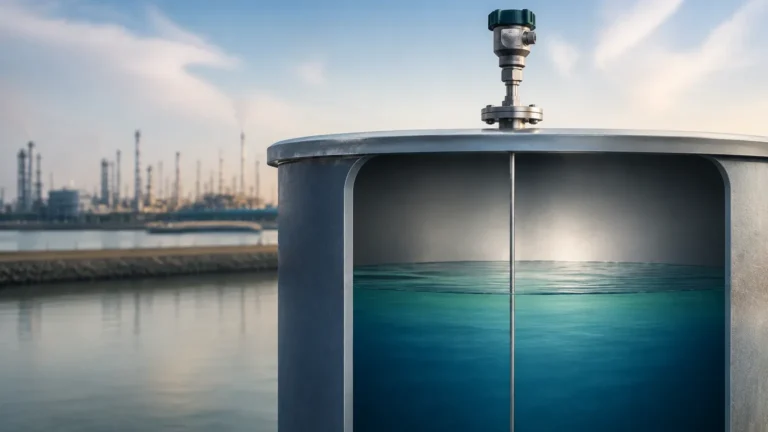
In many industrial setups, mass flow meters work in tandem with level measurement instruments. For example, in a storage tank, a mass flow meter might track the "inflow" while a radar or hydrostatic level transmitter monitors the total volume. Discrepancies between the flow meter's integrated mass and the tank's level change can indicate leaks, theft, or evaporation. For reliable level measurement solutions that complement flow systems, engineers often refer to the Main Page of specialized instrument manufacturers to ensure compatibility across the control loop.
Frequently Asked Questions (FAQs)
Q: Can mass flow meters for liquids measure flow in both directions?
A: Yes, most Coriolis mass flow meters are inherently bidirectional and can provide accurate mass flow and totalization for both forward and reverse flow.
Q: Do these meters require periodic recalibration?
A: While Coriolis meters have no moving parts to wear out, periodic verification is recommended, especially in custody transfer applications. Many modern meters offer "in-situ" verification, where the electronics check the mechanical integrity of the tubes without removing the meter from the line.
Q: What is the maximum viscosity a Coriolis meter can handle?
A: There is no hard physical limit, but as viscosity increases, the pressure drop across the meter increases. Practical limits are usually dictated by the system's pumping capacity.
Q: Are mass flow meters affected by flow profile (laminar vs. turbulent)?
A: One of the greatest advantages of Coriolis technology is that it is largely independent of the flow profile. This eliminates the need for the long straight pipe runs required by turbine or vortex meters.
Conclusion
Mass flow meters for liquids represent a significant investment in process precision. By measuring mass directly, these instruments provide a level of reliability and accuracy that volumetric meters cannot match in fluctuating environments. Whether the goal is to optimize a chemical reaction, ensure fair billing in oil transport, or maintain consistency in food production, understanding the underlying physics and installation requirements is the first step toward a successful implementation.