Thermowell Stainless Steel
Thermowell Stainless Steel
In industrial process control, the accuracy of temperature measurement is as critical as the monitoring of pressure and fluid levels. A thermowell acts as a protective barrier, allowing temperature sensors like thermocouples or RTDs (Resistance Temperature Detectors) to be inserted into a process stream without exposing them to the direct mechanical and chemical stresses of the medium. Among the various materials available, thermowell stainless steel remains the most widely specified choice due to its versatility, mechanical strength, and cost-effectiveness.
For engineers managing complex systems, understanding the nuances of stainless steel grades and thermowell design is essential for ensuring system integrity and long-term reliability. This guide explores the principles, selection criteria, and installation requirements for stainless steel thermowells in modern industrial applications.
Understanding the Role of Thermowells in Industrial Measurement
Before selecting a specific material or design, it is necessary to understand the fundamental measurement principles involved. A thermowell is essentially a pressure-tight receptacle that protects a temperature sensor from high pressures, corrosive chemicals, and high-velocity flows.
Measurement Principles and Heat Transfer
The primary function of a thermowell is to facilitate heat transfer from the process fluid to the internal sensor while maintaining a sealed environment. This occurs through conduction. The process fluid heats or cools the outer wall of the thermowell, and the thermal energy travels through the metal to the internal cavity where the sensor is housed.
However, the presence of a thermowell introduces a "thermal lag." Because the sensor is not in direct contact with the fluid, there is a delay in the response time. The thickness of the stainless steel wall and the thermal conductivity of the specific grade influence how quickly a temperature change is registered. Engineers must balance the need for a thick wall (for pressure resistance) against the need for a thin wall (for faster response times).
Integration with Level and Flow Systems
In many vessels, temperature measurement is performed alongside level monitoring. For instance, when using advanced radar or ultrasonic sensors from a Main Page to monitor chemical tanks, temperature data is often required to calculate density or compensate for vapor space changes. Thermowells ensure that these temperature readings are taken safely without risking leaks or sensor degradation.
Material Selection: Why Stainless Steel is the Industry Standard
Selecting the correct grade of thermowell stainless steel is the most significant factor in preventing premature failure. Stainless steel is preferred because of its chromium content, which forms a passive oxide layer that resists corrosion.
Common Grades and Their Applications
* Type 304 Stainless Steel: This is the most common grade for general-purpose applications. It offers good corrosion resistance to many chemical corrodents as well as industrial atmospheres. It is typically used in food processing, beverage production, and water treatment where conditions are not excessively aggressive.
* Type 316/316L Stainless Steel: This is the "workhorse" of the process industry. The addition of molybdenum (2-3%) significantly improves resistance to chlorides and pitting. Type 316L (low carbon) is preferred for applications involving welding, as it prevents carbide precipitation that can lead to intergranular corrosion. It is the standard choice for pharmaceutical, chemical, and oil and gas applications.
* Type 310 Stainless Steel: Used primarily for high-temperature environments. It contains higher levels of chromium and nickel, allowing it to maintain mechanical strength and oxidation resistance at temperatures up to 1,100°C (2,012°F).
* Type 410 Stainless Steel: A martensitic grade that can be heat-treated. It is often used in environments where high hardness and wear resistance are required, though its corrosion resistance is lower than the 300-series.
Engineering Selection Tables for Process Environments
The following table provides a general guideline for selecting stainless steel grades based on the process medium and temperature range.
| Process Medium | Recommended Stainless Steel Grade | Temperature Range (Approx.) | Typical Application |
| :— | :— | :— | :— |
| Potable Water | 304 / 304L | -196°C to 450°C | Municipal Water Systems |
| Mild Chemicals / Organic Acids | 316 / 316L | -196°C to 600°C | Food & Beverage Processing |
| Seawater / High Chloride | 316L / Duplex 2205 | -50°C to 300°C | Desalination / Marine |
| High-Temp Exhaust Gas | 310 | Up to 1,100°C | Furnaces / Incinerators |
| Concentrated Nitric Acid | 304L (Specialized) | Ambient | Fertilizer Production |
Design Specifications and Construction Types
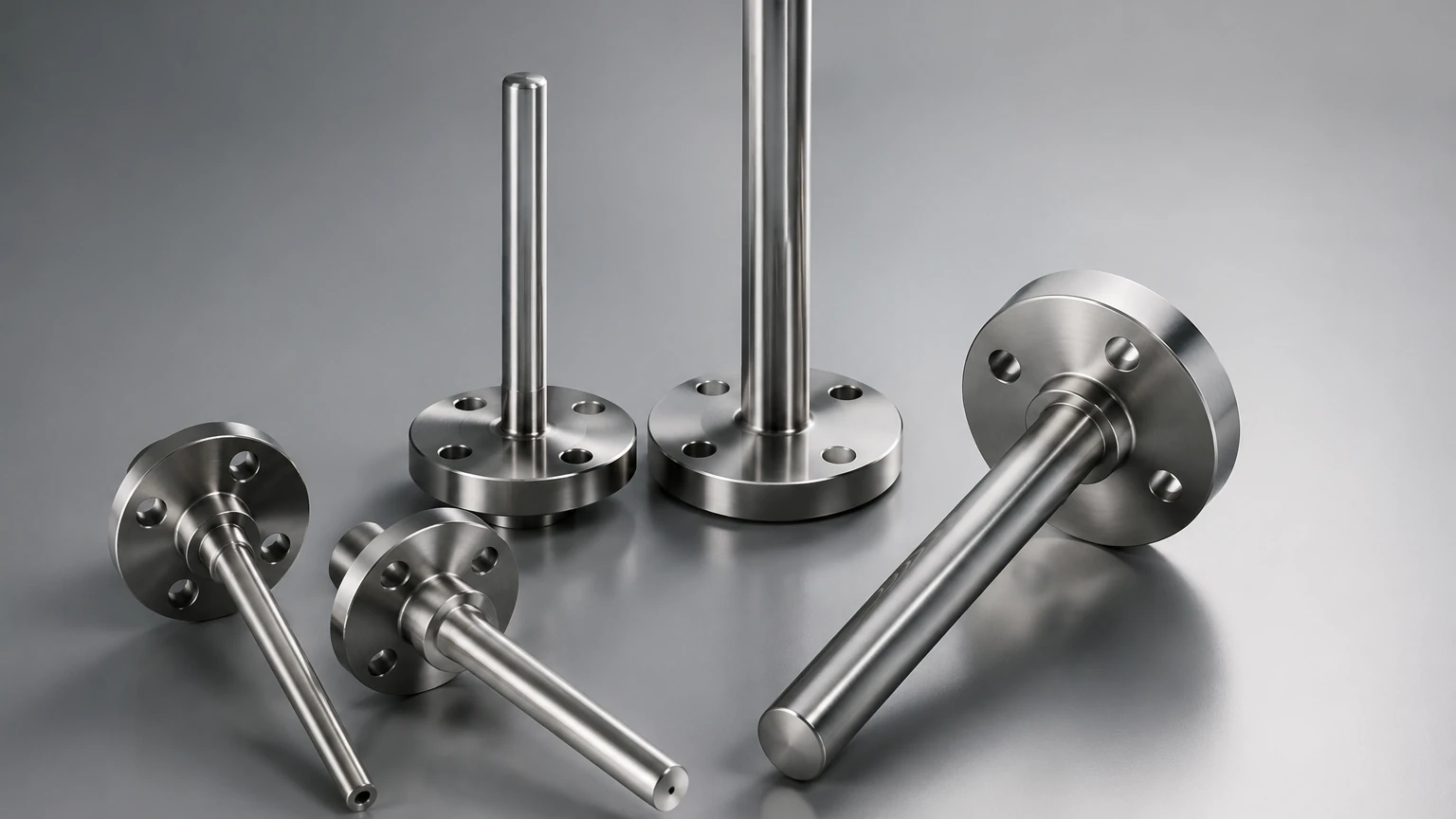
Thermowells are categorized by their connection type and the shape of their stem. The choice depends on the pressure of the system and the frequency of sensor maintenance.
Connection Types
1. Threaded Thermowells: These are screwed into a process pipe or vessel. They are cost-effective and easy to install but are generally limited to lower-pressure applications (typically below 35 bar / 500 psi) where frequent removal is required.
2. Flanged Thermowells: These feature a flange that bolts to a matching flange on the process vessel. They are the standard for high-pressure, high-temperature, and highly corrosive environments. They provide a robust seal and are easier to clean and inspect.
3. Socket Weld Thermowells: These are welded directly into the piping system. They provide a permanent, leak-proof connection suitable for high-pressure steam or hazardous chemicals where a flange might be too bulky.
Stem Profiles
* Straight: The diameter is uniform along the entire insertion length. This provides maximum strength but has the slowest response time.
* Stepped: The diameter is reduced at the tip (e.g., from 19mm to 12.7mm). This reduces the thermal mass at the sensor location, significantly improving response time.
* Tapered: The diameter gradually decreases from the base to the tip. This design offers a superior strength-to-weight ratio and is highly resistant to vibration caused by high-velocity fluid flow.
Installation Guidelines and Mechanical Considerations
Proper installation of a thermowell stainless steel component is vital for both accuracy and safety. Incorrect placement can lead to measurement errors or mechanical failure due to vortex shedding.
Insertion Length (U-Length)
The insertion length is the distance from the tip of the thermowell to the underside of the thread or flange. For accurate measurement, the sensitive portion of the sensor must be fully immersed in the process fluid.
* In Pipes: The tip should ideally reach the center one-third of the pipe diameter.
* In Tanks: The thermowell should extend far enough beyond the wall insulation to ensure that the process temperature is being measured, rather than the ambient temperature of the vessel wall.
Wake Frequency Calculations (ASME PTC 19.3 TW)
When fluid flows past a thermowell, it creates alternating vortices (vortex shedding). If the frequency of these vortices matches the natural frequency of the thermowell, resonance occurs, which can lead to catastrophic mechanical failure. Engineers must perform a wake frequency calculation according to ASME PTC 19.3 TW standards to ensure the thermowell can withstand the fluid velocity and pressure of the specific application.
Orientation
Thermowells should ideally be installed perpendicular to the flow or at a 45-degree angle pointing upstream. Installing them in an elbow (pointing upstream) is often the best way to achieve sufficient immersion depth in smaller diameter pipes (less than 100mm / 4 inches).
Limitations and Operational Risks
While stainless steel is highly durable, it is not invincible. Users must be aware of specific limitations:
1. Chloride Stress Corrosion Cracking (CSCC): In environments with high chloride concentrations and temperatures above 60°C (140°F), 304 and 316 stainless steel can develop sudden cracks. In these cases, higher nickel alloys or Duplex steels may be required.
2. Erosion: In slurries or high-velocity steam, the stainless steel surface can be eroded over time. Hard-facing or specialized coatings may be necessary to extend the service life.
3. Galvanic Corrosion: If a stainless steel thermowell is installed in a vessel made of a significantly different metal (like carbon steel) without proper isolation, galvanic corrosion can occur at the connection point.
Frequently Asked Questions (FAQs)
Q: What is the difference between 316 and 316L for thermowells?
A: 316L has a lower carbon content (max 0.03%) compared to 316 (max 0.08%). This makes 316L much better for welded thermowells, as it prevents "sensitization," which is a loss of corrosion resistance near the weld zone.
Q: How often should a stainless steel thermowell be inspected?
A: Inspection intervals depend on the severity of the process. In non-corrosive environments, an annual visual inspection during plant shutdowns is sufficient. In high-velocity or corrosive applications, thickness testing and dye-penetrant testing should be performed every 6 to 12 months.
Q: Can I use a stainless steel thermowell in sulfuric acid?
A: It depends on the concentration and temperature. While 316L has some resistance to dilute sulfuric acid at ambient temperatures, it is rapidly attacked at higher concentrations or temperatures. Specialized alloys like Alloy 20 or Hastelloy are usually required for sulfuric acid service.
Q: Does the finish of the thermowell matter?
A: Yes. A smooth surface finish (typically 16-32 Ra) is standard to minimize the buildup of process media and to reduce the risk of localized corrosion. In the pharmaceutical and food industries, a mirror-like electropolished finish is often required for sanitary reasons.
Conclusion
Thermowell stainless steel components are essential for protecting sensitive temperature instrumentation in industrial environments. By selecting the appropriate grade—such as 316L for chemical resistance or 310 for high temperatures—and adhering to strict installation standards like ASME PTC 19.3 TW, engineers can ensure both the safety of their personnel and the accuracy of their process data.
When designing a complete monitoring system, it is important to source components from reliable manufacturers who provide full material traceability and engineering support. For more information on integrating temperature and level measurement solutions, visit the Main Page to explore professional-grade industrial instruments.