Nitrate Sensor
Nitrate Sensor
In modern industrial water treatment and environmental monitoring, the nitrate sensor has become an indispensable tool for maintaining process efficiency and regulatory compliance. Nitrate ($NO_3^-$) is a primary indicator of water quality, particularly in municipal wastewater treatment, agricultural runoff management, and industrial effluent control. Monitoring nitrate levels in real-time allows operators to optimize denitrification processes, reduce chemical usage, and prevent environmental contamination.
For engineers and plant managers, selecting the right nitrate sensor involves understanding the underlying measurement physics, the specific demands of the installation environment, and how these sensors integrate with broader automation systems, including level measurement and flow control. This guide provides a comprehensive technical overview of nitrate sensing technologies, selection criteria, and practical installation strategies.
Measurement Principles of Nitrate Sensors
There are two primary technologies used for the continuous measurement of nitrate in industrial and environmental applications: Ion-Selective Electrodes (ISE) and UV Absorption (Spectrophotometry). Each technology has distinct operational characteristics that influence its suitability for specific water matrices.
1. Ion-Selective Electrode (ISE) Principle
An ISE nitrate sensor operates similarly to a pH probe. It utilizes a specialized membrane that is selectively permeable to nitrate ions. When the sensor is submerged in the process liquid, a potential difference (voltage) is generated across the membrane. This potential is proportional to the logarithm of the nitrate ion activity, as described by the Nernst Equation.
To ensure accuracy, ISE sensors typically include a reference electrode and a temperature sensor. Because chloride ions ($Cl^-$) often interfere with nitrate readings due to their similar ionic charge and size, high-quality ISE nitrate sensors frequently incorporate a chloride-selective electrode to provide real-time compensation. This dual-electrode approach allows the system to mathematically subtract the interference caused by varying chloride concentrations.
2. UV Absorption (Spectrophotometric) Principle
UV absorption sensors rely on the physical property that nitrate ions absorb ultraviolet light at specific wavelengths, typically around 210 nm. By passing a UV light beam through a known path length of water and measuring the attenuation of light at the detector, the sensor can calculate the nitrate concentration based on the Beer-Lambert Law.
Since organic matter and suspended solids (turbidity) also absorb or scatter light in the UV spectrum, professional-grade UV nitrate sensors use a multi-wavelength approach. A second wavelength, usually around 275 nm or 550 nm, is used to measure the background interference. The sensor’s internal processor then compensates the primary reading to ensure that the reported value reflects only the nitrate concentration. This method is reagent-free and highly stable over long periods.
Key Evaluation Criteria for Nitrate Sensors
When evaluating a nitrate sensor for a specific project, technical specifications must be aligned with the process conditions. The following factors are critical for long-term reliability:
Measurement Range and Resolution
Industrial nitrate sensors are typically available in ranges such as 0.1–50 mg/L $NO_3$-N (Nitrate-Nitrogen) or 0.5–1000 mg/L $NO_3^-$. For wastewater denitrification tanks, a lower range with high resolution is necessary to manage the narrow margins of the biological process. In contrast, agricultural runoff monitoring may require a wider range to capture spikes during fertilization events.
Response Time and Data Frequency
In closed-loop control systems—where the nitrate sensor triggers a pump or adjusts an aeration rate—response time is vital. UV sensors provide nearly instantaneous readings, whereas ISE sensors may have a slight lag due to the time required for ionic equilibrium at the membrane surface. For most industrial applications, a T90 response time (the time to reach 90% of the final value) of less than 60 seconds is preferred.
Compensation and Interference Management
As mentioned, chloride is the primary interferent for ISE sensors. For UV sensors, the primary challenges are "matrix effects" caused by chemical compounds that absorb at the same wavelength as nitrate. Understanding the chemical composition of the process water is essential before selecting a technology. If the water has high turbidity, a UV sensor with an integrated cleaning wiper or an ultrasonic cleaning system is mandatory.
Industrial Applications and Integration
Nitrate sensors are rarely used in isolation. They are typically part of a larger instrumentation suite that includes dissolved oxygen (DO) sensors, pH meters, and level measurement instruments.
Wastewater Treatment (BNR)
In Biological Nutrient Removal (BNR) processes, nitrate sensors are installed in the anoxic zone to monitor the efficiency of denitrification. By linking the nitrate sensor output to the internal mixed liquor recycle (IMLR) pumps, plants can ensure that enough nitrate is returned to the anoxic zone without wasting energy on over-pumping.
Integration with Level Measurement
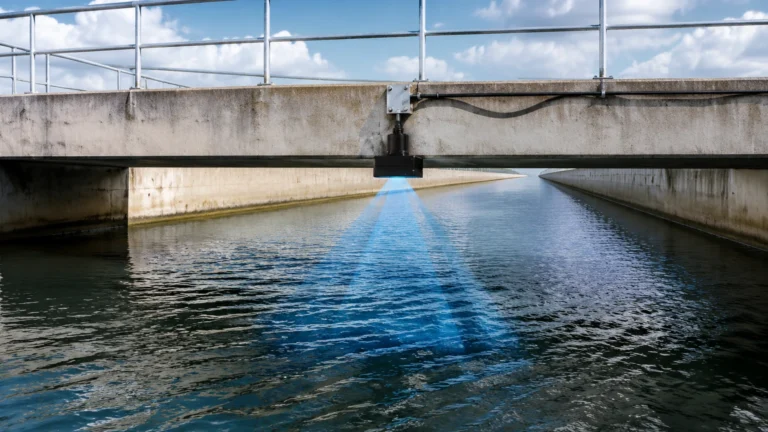
In batch processing or tank-based treatment, nitrate concentration data must be paired with volume data. For instance, in a sequencing batch reactor (SBR), knowing the nitrate concentration is only half the equation; the operator also needs to know the exact volume of the fluid to calculate the total mass of nitrogen being processed. This is where high-precision level instruments, such as those found on the Main Page, become critical. Radar level meters or ultrasonic sensors provide the necessary height data to convert concentration (mg/L) into total load (kg).
Selection Table: ISE vs. UV Absorption
| Feature | Ion-Selective Electrode (ISE) | UV Absorption (Reagent-free) |
| :— | :— | :— |
| Initial Cost | Lower | Higher |
| Maintenance Requirement | High (Frequent calibration/cleaning) | Low (Automatic cleaning available) |
| Consumables | Membranes/Electrolytes (6-12 months) | None (Lamp life 5-10 years) |
| Interferences | Chloride, Potassium, Temperature | Turbidity, Dissolved Organics |
| Calibration | Weekly or Bi-weekly | Monthly or Quarterly |
| Best For | Small plants, portable monitoring | Large municipal plants, remote sites |

Installation Considerations and Best Practices
Proper installation is the most significant factor in the longevity of a nitrate sensor. Industrial environments are harsh, and sensors are prone to fouling, scaling, and mechanical damage.
1. Flow Dynamics: The sensor should be placed in an area with representative flow. Avoid "dead zones" where solids might settle, but also avoid areas of extreme turbulence that could cause cavitation or physical wear on the sensor head.
2. Submersion Depth: Sensors should be submerged at a depth that prevents air bubble interference. Bubbles can cling to the optical windows of a UV sensor or the membrane of an ISE sensor, leading to false low or erratic readings.
3. Orientation: Many sensors perform best when installed at a 45-degree angle pointing into the flow. This orientation helps prevent the accumulation of debris on the sensor face and allows bubbles to slide off the surface.
4. Cleaning Systems: In wastewater applications, biofilm growth is inevitable. Automated cleaning systems—such as compressed air blasts or mechanical wipers—are highly recommended to reduce manual intervention and maintain data integrity.
Common Risks and Limitations
While nitrate sensors are highly advanced, they are not "set and forget" devices. Users should be aware of the following risks:
* Drift: ISE sensors are susceptible to electronic drift and membrane aging. Without regular calibration against a laboratory standard, the accuracy will degrade over time.
* Optical Coating: For UV sensors, even a thin film of oil or grease can significantly alter the light absorption path. In industrial effluents containing fats, oils, or grease (FOG), specialized pre-treatment or aggressive cleaning cycles are required.
* Temperature Sensitivity: Ionic activity and optical properties change with temperature. While most sensors have internal thermistors for compensation, extreme temperature fluctuations can still introduce errors if the compensation algorithms are not robust.
Confirmation Checklist Before Procurement
Before finalizing a nitrate sensor specification, project teams should confirm the following:
* Water Matrix Analysis: Has a laboratory analysis of the typical chloride, TOC (Total Organic Carbon), and turbidity levels been performed?
* Power and Communication: Is there sufficient power at the installation site? Does the sensor support required protocols like 4-20mA, Modbus RS485, or Profibus?
* Mounting Hardware: Are the mounting brackets compatible with the existing tank railings or open channels? Is a telescopic arm required for maintenance access?
* Consumables Budget: For ISE sensors, has the annual cost of replacement electrodes and calibration standards been factored into the OPEX?
Frequently Asked Questions (FAQ)
Q: How often does a nitrate sensor need calibration?
A: ISE sensors typically require calibration every 1 to 2 weeks due to electrode drift. UV absorption sensors are much more stable and may only require a "check" calibration every 3 to 6 months, depending on the stability of the water matrix.
Q: Can a nitrate sensor measure ammonia or nitrite?
A: A dedicated nitrate sensor only measures $NO_3^-$. However, many industrial controllers allow for multiple sensor inputs, enabling the simultaneous monitoring of Ammonium ($NH_4^+$) and Nitrite ($NO_2^-$) using different probes to provide a complete nitrogen profile.
Q: What is the typical lifespan of these sensors?
A: The body of the sensor can last 10+ years. For ISE sensors, the electrode cartridges are consumables and usually last 6 to 18 months. For UV sensors, the light source (Xenon flash lamp or LED) typically lasts 5 to 10 years before requiring factory service.
Q: Is a pump required for the sensor to work?
A: Most modern nitrate sensors are designed for in-situ submersion, meaning they can be placed directly into a tank or channel without a pump. However, for high-purity water or very pressurized lines, a flow-through cell and bypass line may be used.
By selecting the appropriate technology and ensuring robust integration with level and flow systems, industrial operators can achieve precise control over their nitrogen management. For more information on the level measurement technologies that complement water quality monitoring, Review product options and application support to see how integrated instrumentation improves process reliability.