Immersion Sensor Holder
Immersion Sensor Holder
In industrial level measurement, the accuracy of a sensor is only as reliable as its physical stability within the process environment. For applications involving open tanks, sumps, wastewater treatment basins, and deep wells, the immersion sensor holder serves as the critical interface between the electronic instrument and the liquid medium. Whether supporting a hydrostatic pressure transmitter or an ultrasonic transducer, a well-engineered holder ensures that the sensor remains in the correct orientation, protected from mechanical stress and accessible for routine maintenance.
Selecting the appropriate immersion sensor holder requires an understanding of both the measurement technology being employed and the hydraulic dynamics of the vessel. Without a robust mounting solution, sensors are prone to drifting, signal noise caused by turbulence, and physical damage from floating debris.
Measurement Principles and Holder Integration
Before selecting a mounting system, it is essential to understand how different level measurement technologies interact with their physical environment. The immersion sensor holder is designed to complement these specific principles.
Hydrostatic Level Measurement
Hydrostatic transmitters operate on the principle that the pressure at a specific depth is proportional to the height of the liquid column above it (P = ρgh). These sensors are typically lowered into a tank via a vented cable. However, in tanks with agitators or high inflow rates, a suspended sensor will swing, leading to erratic pressure readings and potential cable fatigue. An immersion sensor holder, often in the form of a stilling well or a rigid pipe, provides a stable environment, ensuring the sensor's diaphragm remains at a fixed datum point.
Ultrasonic and Radar Measurement
While often considered non-contact, certain applications require ultrasonic or radar sensors to be positioned closer to the liquid surface via an extension arm or a submerged mounting bracket to avoid internal obstructions like ladders or pipes. In these cases, the immersion sensor holder acts as an extension of the vessel's rim, providing a perpendicular mounting surface that is crucial for the signal's time-of-flight accuracy.
For engineers looking to integrate these technologies into their existing infrastructure, reviewing the comprehensive product ranges on the Main Page of a specialized manufacturer provides a starting point for matching sensor types with compatible mounting hardware.
Common Types of Immersion Sensor Holders
Immersion holders are not one-size-fits-all components. They are categorized based on their mechanical design and how they facilitate sensor access.
1. Rigid Pipe Holders (Stilling Wells)
This is the most common form of an immersion sensor holder for hydrostatic transmitters. It consists of a vertical pipe (typically PVC, PP, or Stainless Steel) with holes at the bottom to allow liquid equalization. The sensor is lowered into the pipe, which shields it from turbulence and floating solids.
2. Swing-Arm Mounts
Designed for wastewater treatment plants (WWTP), swing-arm holders allow the sensor to be moved away from the center of a basin to the walkway for cleaning. This design is essential for sensors prone to fouling, such as dissolved oxygen sensors or ultrasonic transducers that require frequent lens wiping.
3. Chain-Suspended Systems
In very deep wells or reservoirs where rigid pipes are impractical, a heavy-duty chain system can be used. The sensor is attached to a weighted holder that is lowered via a stainless steel chain. This prevents the electrical cable from bearing the weight of the sensor and the weight of the liquid column, which can cause cable stretching and internal wire breakage.
4. Flange-Mounted Extension Pipes
For closed tanks that require submerged measurement, a flange-mounted immersion sensor holder is used. The holder is bolted to a nozzle on the top of the tank, and a rigid extension pipe reaches down to the required measurement depth. This is common in chemical processing where the headspace may contain corrosive vapors.
Technical Selection Criteria
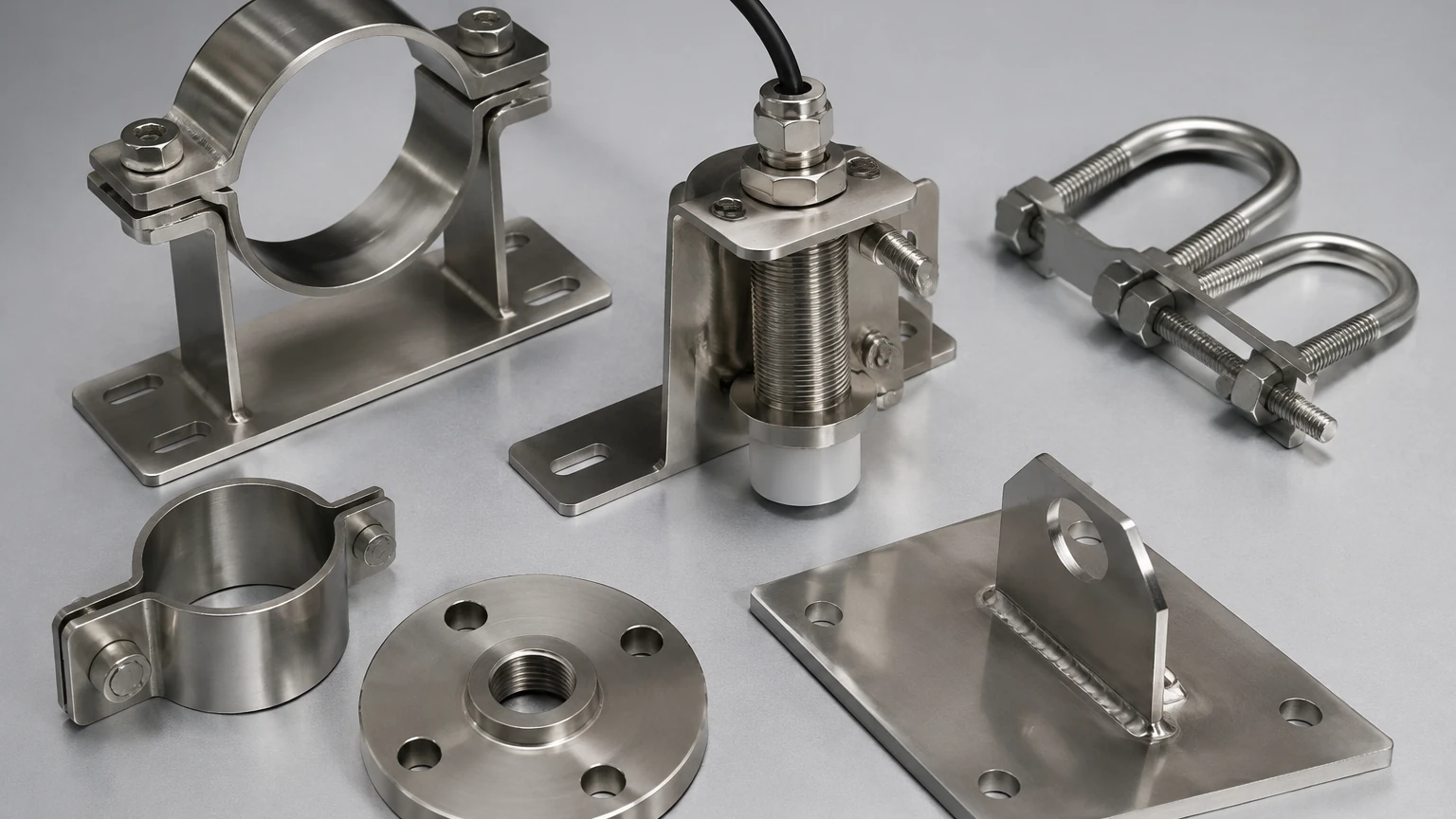
When specifying an immersion sensor holder, engineers must evaluate several factors to ensure longevity and measurement integrity. The following table outlines the primary considerations for material and design selection:
| Criteria | Options | Best For… |
| :— | :— | :— |
| Material | 316L Stainless Steel | High temperature, high pressure, and general industrial use. |
| | PVC / Polypropylene | Corrosive acids, seawater, and water treatment chemicals. |
| | PTFE Coating | Extreme chemical resistance and anti-stick properties. |
| Mounting Style | Fixed Flange | Pressurized vessels or permanent outdoor installations. |
| | Adjustable Bracket | Open sumps where the liquid level fluctuates significantly. |
| | Submersible Weight | Deep wells with minimal lateral liquid movement. |
| Length | 0.5m to 5.0m+ | Must be calculated based on the minimum liquid level (low-level cutoff). |
| Pipe Diameter | 20mm to 100mm | Must accommodate the sensor diameter plus 10-20% clearance for easy removal. |
Installation and Mounting Best Practices
Proper installation of an immersion sensor holder is as important as the sensor calibration itself. Failure to follow engineering best practices can result in "dead zones" or mechanical failure.
1. Avoid High-Turbulence Zones: Do not install the holder directly adjacent to an inflow pipe or an agitator blade. If turbulence is unavoidable, use a heavy-walled stainless steel stilling well with internal baffles.
2. Ensure Verticality: For hydrostatic sensors, the holder must be perfectly vertical. Even a slight tilt can change the effective depth of the sensor, leading to a constant offset error in the level reading.
3. Cable Management: When using an immersion sensor holder with a cable-suspended sensor, ensure the cable is secured at the top of the holder using a proper strain-relief clamp. The vent tube inside the cable must remain unobstructed to allow for atmospheric pressure compensation.
4. Grounding and Lightning Protection: For outdoor installations in metal tanks, ensure the holder is electrically bonded to the tank's grounding system to protect the sensitive electronics from static discharge and lightning strikes.
5. Access for Maintenance: Always install the holder in a location where a technician can safely reach it. If the holder is over 2 meters (approx. 6.5 feet) long, consider a hinged or telescopic design that allows the sensor to be retrieved without the use of a crane.
Operational Limitations and Common Risks
While an immersion sensor holder provides significant protection, it is not immune to process-related challenges. Engineers should be aware of the following risks:
* Fouling and Clogging: In wastewater applications, fats, oils, and grease (FOG) can build up inside the holder pipe. This can "trap" the liquid level inside the pipe, causing the sensor to report a static level even as the tank empties. Regular flushing or the use of large-diameter pipes can mitigate this.
* Vibration Fatigue: In high-flow environments, long, unsupported immersion holders can act like a cantilever beam, vibrating at a natural frequency that eventually leads to metal fatigue at the mounting point. Support brackets should be placed every 1.5 to 2 meters (approx. 5 to 6.5 feet).
* Chemical Compatibility: Using a PVC holder in a solvent-based process will lead to rapid softening and failure of the mount. Always cross-reference the material safety data sheet (MSDS) of the process liquid with the holder material.
* Temperature Expansion: In long runs of plastic immersion holders, thermal expansion can be significant. A 5-meter (approx. 16.4 feet) PVC pipe can expand by several centimeters in hot environments, which may shift the zero-point of the level measurement.
Frequently Asked Questions (FAQs)
Q: Can I use a standard PVC plumbing pipe as an immersion sensor holder?
A: While possible for DIY or temporary setups, industrial-grade holders are preferred. Industrial holders feature UV stabilization, precise tolerances for sensor fitment, and specialized mounting flanges that ensure a gas-tight or liquid-tight seal that standard plumbing cannot guarantee.
Q: How do I prevent the sensor from hitting the bottom of the holder?
A: The sensor should ideally be suspended 50mm to 100mm (approx. 2 to 4 inches) above the bottom of the holder or the tank floor. This prevents the sensor from resting in silt or sludge, which can clog the pressure port of a hydrostatic transmitter.
Q: Is an immersion sensor holder necessary for ultrasonic sensors?
A: It is not always necessary, but it is highly recommended if the sensor needs to be positioned away from the tank wall or if there is heavy foam on the liquid surface. A "standpipe" or holder can help guide the ultrasonic pulse and reduce signal interference from foam.
Q: How often should the holder be inspected?
A: In clean water applications, an annual inspection is sufficient. In wastewater or chemical processing, quarterly inspections are recommended to check for buildup, corrosion, or loose mounting bolts.
For further technical specifications, installation diagrams, and customized mounting solutions, engineers are encouraged to visit the Main Page to explore the full range of Welk level measurement accessories. Selecting the right immersion sensor holder is a foundational step in building a reliable and low-maintenance industrial automation system.