Emerson 3301 Radar Level Transmitter
Emerson 3301 Radar Level Transmitter: A Technical Engineering Guide
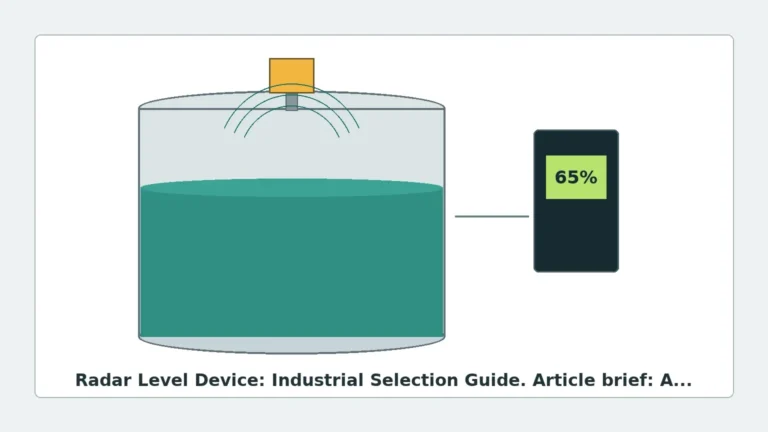
In the landscape of industrial process automation, precise level measurement is fundamental to safety, efficiency, and inventory management. The emerson 3301 radar level transmitter—often categorized under the Rosemount brand—represents a specialized segment of industrial instrumentation known as Guided Wave Radar (GWR). Unlike non-contact Radar Level Meters, which propagate microwaves through the air, GWR technology utilizes a physical probe to direct the signal, offering distinct advantages in challenging process environments.
This guide examines the operating principles, selection criteria, and installation requirements for the 3301 series, providing engineers and procurement specialists with the factual framework necessary to integrate this technology into their systems.
1. Measurement Principles: Time Domain Reflectometry (TDR)
The emerson 3301 radar level transmitter operates on the principle of Time Domain Reflectometry (TDR). This method is analogous to cable testing technology but applied to liquid level detection.
The Signal Path
Low-energy electromagnetic pulses are generated by the transmitter electronics and guided down a probe submerged in the process media. These pulses travel at the speed of light. When the pulse encounters a change in the dielectric constant ($ε_r$)—typically the transition from air or gas to the liquid surface—a portion of the pulse energy is reflected back to the transmitter.
Calculating Distance and Level
The transmitter measures the time interval between the pulse emission and the reception of the reflected signal. Since the speed of the pulse is constant (adjusted for the medium's properties), the distance to the product surface is calculated using the formula:
Distance = (Speed of Light × Time of Flight) / 2
The device then subtracts this distance from the total tank height (the reference gauge point) to determine the level of the material. Because the signal is physically guided, it is less susceptible to interference from vapor, pressure fluctuations, or temperature gradients compared to non-contact radar systems.
2. Technical Overview of the Emerson 3301
The 3301 is a 2-wire level transmitter designed primarily for liquid applications. It is engineered to handle both level and interface measurements (the boundary between two immiscible liquids, such as oil and water).
Key Specifications
* Accuracy: Typically ± 5 mm (0.2 in.) for standard liquid applications.
* Measurement Range: Up to 23.5 meters (approximately 77 feet) depending on probe type.
* Output Protocols: 4-20 mA with HART®, Modbus®, or FOUNDATION™ Fieldbus.
* Housing: Dual-compartment design to protect electronics from moisture and process contaminants.
Dielectric Constant (ε_r) Requirements
The success of a GWR measurement depends heavily on the dielectric constant of the media. The higher the $ε_r$, the stronger the reflection.
* Water: ε_r ≈ 80 (Excellent reflection)
* Oil/Hydrocarbons: ε_r ≈ 1.9 to 2.5 (Weak reflection, requiring sensitive electronics or coaxial probes)
* Minimum Threshold: The 3301 generally requires a minimum $ε_r$ of 1.4.
3. Selecting the Right Probe Configuration
One of the most critical decisions when specifying an emerson 3301 radar level transmitter is the probe selection. The probe must be compatible with the fluid's viscosity, the presence of solids, and the tank's internal geometry.
Selection Table: Probe Types and Applications
| Probe Type | Best For | Advantages | Limitations |
| :— | :— | :— | :— |
| Coaxial | Low dielectric liquids, clean fluids | Highest signal-to-noise ratio; immune to tank obstructions. | Susceptible to clogging; not for viscous or coating fluids. |
| Rigid Twin Lead | Mid-range dielectric, narrow tanks | Stronger signal than single lead; works in confined spaces. | Sensitive to bridging between leads; difficult to clean. |
| Rigid Single Lead | Viscous liquids, slurries, food grade | Easy to clean; handles coating well. | Requires larger nozzle; affected by nearby metal objects. |
| Flexible Single Lead | Tall tanks, silos, heavy liquids | Easy to ship/install in long lengths (up to 23.5m). | Requires weights; must avoid contact with tank walls. |
4. Installation and Engineering Constraints
Correct installation is paramount to ensuring the reliability of Radar Level Meters. For the 3301, several mechanical factors must be addressed during the design phase.
Nozzle Considerations
For single-lead probes, the nozzle diameter and height significantly impact performance. If the nozzle is too narrow or too tall, it can create a "ringing" effect that masks the signal from the actual liquid surface. Generally, a nozzle diameter of 50 mm (2 in.) to 100 mm (4 in.) is preferred, with a height as short as possible.
The Transition Zone (Dead Zones)
There are two areas along the probe where measurements are less accurate or impossible:
1. Upper Transition Zone: The area near the mounting flange where the signal is coupling with the probe. No measurements should be expected in the top 100 mm to 400 mm (depending on probe type).
2. Lower Transition Zone: The area at the very end of the probe. Reflections from the probe end can interfere with the surface signal if the level is too low.
Obstructions and Clearances
While coaxial probes are shielded, single and twin-lead probes require a "clearance zone." Any metal object (ladders, agitators, or pipes) entering this zone will cause a false reflection. For a single-lead probe, a minimum clearance of 300 mm (12 in.) from any metal obstruction is standard practice.
5. Performance Limitations and Application Risks
While GWR is highly robust, it is not a universal solution. Engineers must be aware of the following risks:
* Heavy Coating and Clogging: If the process media is highly viscous and leaves a conductive coating on the probe, the signal may be attenuated or "shorted," leading to false high-level readings. In these cases, single-lead probes are preferred over coaxial or twin-lead designs.
* Turbulence and Foam: While GWR handles turbulence better than non-contact radar, extremely dense foam can absorb the microwave pulse. If the foam is light and airy, the pulse may pass through and detect the liquid level; however, dense, conductive foam may be detected as the surface itself.
* Probe Mechanical Stress: In tanks with high-speed agitators or heavy flow, the lateral force on the probe can cause it to bend or break. In such environments, probe supports or stilling wells are required.
6. International Procurement: A Buyer’s Checklist
When sourcing an emerson 3301 radar level transmitter for international projects, technical documentation and compliance are as important as the hardware itself. Buyers should confirm the following details with the manufacturer or supplier:
1. Hazardous Area Certifications: Ensure the device has the correct ATEX, IECEx, or FM ratings for the specific zone (e.g., Zone 0, 1, or 2).
2. Material Traceability: Request Mill Test Reports (MTRs) for the probe material (e.g., 316L Stainless Steel, Hastelloy, or PTFE coating) to ensure chemical compatibility.
3. Process Connection Standards: Verify if the flange or thread follows ASME, EN/DIN, or JIS standards to avoid mounting mismatches.
4. Configuration Requirements: Determine if the unit requires factory pre-configuration (probe length, dielectric setting, and range) or if the site team has the tools (such as Rosemount Radar Master software) to configure it locally.
5. Interface Measurement Needs: If measuring the boundary between two liquids, the upper liquid must have a lower dielectric constant than the lower liquid, and the upper layer must be at least 100 mm (4 in.) thick for accurate detection.
7. Frequently Asked Questions (FAQs)
Q: Can the 3301 be used for solids or powders?
A: While primarily designed for liquids, the 3301 can be used for some solid applications. However, for heavy bulk solids or powders with high pull-down forces, dedicated solids Radar Level Meters or heavy-duty GWR models are usually recommended to prevent probe damage.
Q: How does the 3301 handle vacuum conditions?
A: GWR is excellent for vacuum applications because the speed of the microwave pulse is unaffected by the lack of air. The primary concern is the pressure rating of the process seal and flange.
Q: Is it possible to cut the probe to length in the field?
A: Yes, many probe types for the 3301 (specifically the flexible cable and rigid single lead) can be shortened in the field. However, the transmitter's software settings must be updated to reflect the new probe length to maintain accuracy.
Q: What is the difference between the 3301 and the 5300 series?
A: The 3301 is a standard-performance transmitter suitable for most general-purpose liquid applications. The 5300 series is a high-performance version offering higher signal sensitivity (Direct Switch Technology), which is better suited for very low dielectric fluids or extremely long ranges.
Conclusion
The emerson 3301 radar level transmitter remains a staple in industrial level measurement due to its reliability in pressurized and varying temperature environments. By understanding the interaction between the probe geometry and the dielectric properties of the media, engineers can implement a solution that minimizes maintenance and maximizes uptime. For applications where a physical probe is not feasible due to corrosive or extremely high-temperature environments, exploring non-contact Radar Level Meters provides a viable alternative. In all cases, a thorough review of the process conditions and installation constraints is the key to successful instrumentation deployment.