Mass Flow Calibration
Mass Flow Calibration
In industrial process control, the accuracy of fluid measurement is fundamental to operational efficiency, safety, and fiscal accountability. While volumetric flow measurement is common, mass flow measurement provides a more direct and reliable assessment of the quantity of material moving through a system, as it is independent of changes in temperature and pressure. To maintain this reliability, mass flow calibration is a critical engineering requirement. This guide examines the principles of mass flow measurement, the methodologies used for calibration, and the practical considerations for engineers and plant managers.
Understanding Mass Flow Measurement Principles
Before addressing calibration procedures, it is essential to understand how mass flow is measured. Unlike volumetric flow, which measures the space a fluid occupies (e.g., liters per minute), mass flow measures the actual weight or molecular count of the fluid (e.g., kilograms per hour). There are several primary technologies used in industrial automation to achieve this.
Coriolis Measurement Principle
Coriolis flow meters are the industry standard for direct mass flow measurement. They operate based on the Coriolis effect: as fluid moves through a vibrating tube, it induces a phase shift in the vibration. This shift is directly proportional to the mass flow rate. Because the measurement is mechanical, it is unaffected by changes in fluid density, viscosity, or flow profile, making it highly accurate but also requiring precise calibration to maintain its performance over time.
Thermal Mass Flow Principle
Thermal mass flow meters utilize the heat-conducting properties of the fluid. Typically, two sensors are placed in the flow stream—one is a reference sensor that measures the fluid temperature, and the other is a heated sensor. The mass flow rate is determined by the amount of heat dissipated into the fluid. As more molecules (mass) pass the sensor, more heat is carried away. This technology is particularly prevalent in gas flow applications.
Compensated Volumetric Measurement
In some systems, mass flow is derived by combining a volumetric flow sensor (such as an ultrasonic or differential pressure meter) with temperature and pressure sensors. By calculating the fluid density in real-time, the system can infer the mass flow. While cost-effective, this "indirect" method introduces more variables and potential points of failure, necessitating a rigorous calibration schedule for all integrated sensors.
Why Mass Flow Calibration is Essential in Industrial Automation
Mass flow calibration is the process of comparing the output of a flow meter against a known reference standard under controlled conditions. In sectors such as chemical processing, oil and gas, and water treatment, even a 1% deviation in flow accuracy can lead to significant financial losses, compromised product quality, or hazardous conditions.
1. Regulatory Compliance: Many industries are subject to strict environmental and safety regulations that mandate periodic verification of measurement accuracy.
2. Custody Transfer: When fluids are sold or transferred between parties, mass flow accuracy ensures that the billing is based on the actual quantity of the product, regardless of environmental fluctuations.
3. Process Optimization: In chemical dosing or blending, precise mass ratios are required to ensure the correct chemical reactions. Calibration prevents waste and ensures batch consistency.
Primary Methods for Mass Flow Calibration
There are three main approaches to mass flow calibration, each offering different levels of uncertainty and practical application.
1. Gravimetric Calibration (The Weight-Based Method)
Gravimetric calibration is considered the most accurate method and is often used in primary calibration laboratories. It involves weighing the fluid that passes through the meter over a specific period.
* Procedure: The fluid is directed through the meter under test into a collection vessel situated on a high-precision scale. The weight of the fluid is compared against the meter’s integrated reading.
* Advantages: It provides the lowest measurement uncertainty because mass and time are fundamental units that can be traced directly to national standards.
2. Master Meter (Transfer Standard) Calibration
In this method, a "Master Meter"—a flow meter that has been calibrated to a very high degree of accuracy (usually 3–4 times better than the meter under test)—is placed in series with the device being calibrated.
* Procedure: The same fluid passes through both meters simultaneously. The readings are compared across various flow rates to determine the deviation.
* Advantages: This method is faster than gravimetric calibration and can often be performed on-site (in-situ) without removing the instrument from the process line.
3. Piston Prover Calibration
Commonly used for gas mass flow calibration, a piston prover uses a precisely machined cylinder and a moving piston to displace a known volume of gas. By measuring the time it takes for the piston to move a specific distance and accounting for the gas temperature and pressure, the mass flow can be calculated with extreme precision.
Selection Criteria for Calibration Standards
Choosing the right calibration method depends on the required accuracy, the fluid type, and the operational environment. The following table provides a comparison of common calibration approaches.
| Feature | Gravimetric Method | Master Meter Method | Piston Prover (Gas) |
| :— | :— | :— | :— |
| Accuracy (Uncertainty) | Very High (±0.01% to 0.05%) | Moderate (±0.1% to 0.5%) | High (±0.05% to 0.1%) |
| Primary Application | Laboratory / Reference | Field Service / Industrial | Gas Flow Standards |
| Fluid Type | Liquids | Liquids & Gases | Gases |
| Cost | High (Infrastructure heavy) | Moderate | High |
| Portability | Low | High | Low to Moderate |
When evaluating instruments for your facility, it is helpful to Review product options and application support to ensure the hardware is compatible with your intended calibration infrastructure.
Installation Considerations for Accurate Calibration
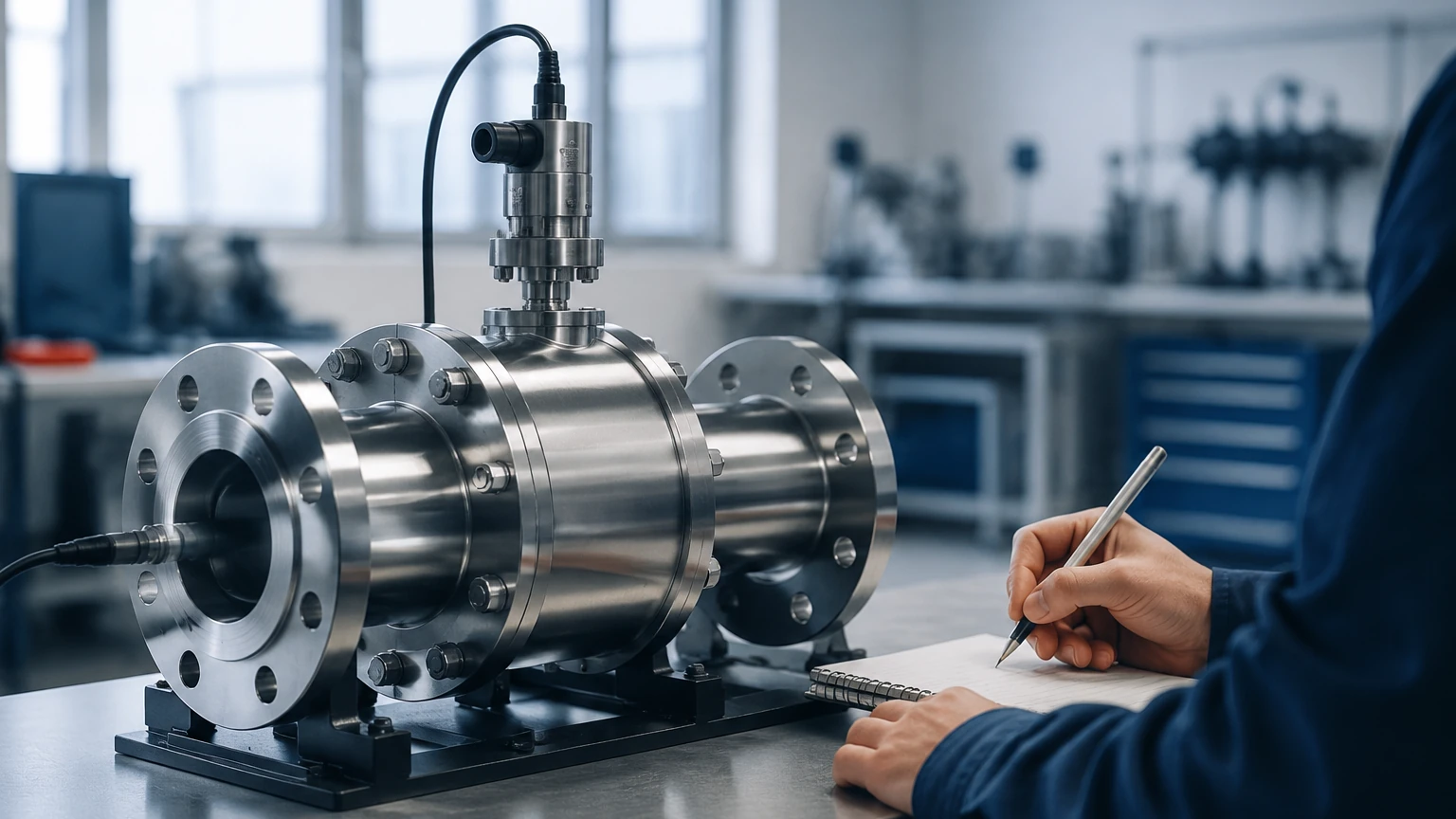
The physical installation of a mass flow meter significantly impacts its calibrated accuracy. Even a perfectly calibrated meter will provide false data if installed incorrectly.
* Straight Pipe Runs: Most flow technologies require a certain length of straight pipe upstream and downstream to eliminate turbulence. For mass flow meters, typically 5 to 10 diameters upstream are recommended, though Coriolis meters are generally less sensitive to flow profiles.
* Vibration Isolation: Coriolis meters are sensitive to external mechanical vibrations. Calibration should be performed in an environment that mimics the vibration profile of the actual plant, or the meter should be installed with flexible couplings and robust supports.
* Orientation: For liquid applications, the meter should be installed such that it remains full of liquid at all times. For gas applications, it should be oriented to prevent condensate build-up. During calibration, the orientation must match the field installation.
* Fluid Properties: Ensure that the calibration fluid’s viscosity and density are as close as possible to the process fluid, especially for thermal mass flow meters where heat transfer is fluid-specific.
Common Risks and Limitations in Flow Calibration
Engineers must be aware of the factors that can degrade the integrity of a mass flow calibration over time.
Sensor Drift
Over time, electronic components and mechanical sensors can experience "drift," where the output gradually shifts away from the true value. This is often caused by extreme temperature cycling, mechanical wear, or electronic aging. Regular calibration intervals (typically 12 to 24 months) are necessary to correct for drift.
Entrained Air and Cavitation
In liquid mass flow measurement, the presence of air bubbles (entrained air) can cause significant errors, particularly in Coriolis meters. Cavitation—the formation of vapor bubbles due to pressure drops—can also damage the internal components and ruin the calibration.
Coating and Scaling
In industries like water treatment or chemical processing, fluids may leave deposits on the internal walls of the flow meter. This changes the internal diameter or the thermal conductivity of the sensors, leading to inaccurate readings. Calibration can identify when cleaning or maintenance is required.
Frequently Asked Questions (FAQ)
Q: How often should I calibrate my mass flow meter?
A: The frequency depends on the criticality of the process and the manufacturer's recommendations. Most industrial applications require annual calibration. If the meter is used for custody transfer, semi-annual or quarterly calibration may be required by law.
Q: Can I calibrate a mass flow meter using water if the process fluid is oil?
A: For Coriolis meters, yes, as they measure mass directly. However, for thermal mass flow meters, the calibration must be adjusted for the specific heat capacity of the fluid. It is always best to calibrate with the actual process fluid or a surrogate with identical properties.
Q: What is the difference between calibration and validation?
A: Calibration is the act of comparing a device to a standard and adjusting it to match. Validation (or verification) is the process of checking the device against a standard to ensure it is still within its specified accuracy limits without necessarily making adjustments.
Q: Does temperature affect mass flow calibration?
A: While mass flow is theoretically independent of temperature, the physical components of the meter (like the tubes in a Coriolis meter) can expand or contract with temperature changes. High-quality meters include internal temperature compensation to account for this.
Conclusion
Mass flow calibration is not merely a maintenance task but a fundamental component of modern industrial engineering. By understanding the underlying principles of Coriolis and thermal measurement, and by selecting the appropriate calibration method—whether gravimetric or transfer standard—operators can ensure their systems remain accurate, efficient, and compliant.
For those seeking reliable instrumentation and technical guidance on integrating these sensors into complex automation environments, visiting the Main Page of a specialized manufacturer like Welk provides access to the necessary specifications and expert support to maintain high-precision measurement standards across all industrial applications.