Industrial Temperature Sensors
Industrial Temperature Sensors
In the landscape of industrial automation and process control, temperature is arguably the most frequently measured physical parameter. From ensuring the safety of chemical reactions to optimizing the efficiency of water treatment facilities, industrial temperature sensors provide the critical data necessary for operational stability. For engineers and project managers, selecting the right sensor involves more than just identifying a temperature range; it requires a deep understanding of measurement principles, environmental constraints, and how temperature data interacts with other process variables, such as level and pressure.
As a professional manufacturer of industrial level measurement instruments, Welk recognizes that temperature measurement is rarely an isolated requirement. In applications involving radar level meters or hydrostatic transmitters, temperature fluctuations can significantly impact the accuracy of level data. Consequently, a holistic approach to process instrumentation is essential. For those seeking integrated solutions, visiting the Main Page allows for a detailed review of product options and application support across the full spectrum of industrial sensing.
Understanding Measurement Principles
Before selecting a specific sensor, it is vital to understand the physics governing how temperature is converted into a measurable electrical signal. Industrial temperature sensors primarily operate on three physical phenomena: changes in electrical resistance, the generation of voltage across dissimilar metals, and the emission of infrared radiation.
Resistance Temperature Detectors (RTDs)
RTDs operate on the principle that the electrical resistance of a metal increases as its temperature rises. This relationship is highly predictable and linear. Most industrial RTDs utilize platinum (Pt) due to its stability and resistance to oxidation. The most common configuration is the Pt100, which has a resistance of 100 ohms at 0°C (32°F).
Thermocouples
Thermocouples function based on the Seebeck effect. When two dissimilar metal wires are joined at one end (the sensing junction) and exposed to a temperature gradient, a small voltage (millivolts) is generated at the other end (the reference junction). This voltage is proportional to the temperature difference between the two junctions. Thermocouples are categorized by "types" (e.g., Type K, J, T, E) based on the metal combinations used.
Thermistors
Thermistors are ceramic-like semiconductors that exhibit a large change in resistance over a relatively small temperature range. Unlike RTDs, most thermistors have a Negative Temperature Coefficient (NTC), meaning resistance decreases as temperature increases. While highly sensitive, they are generally limited to lower temperature ranges compared to thermocouples.
Types of Industrial Temperature Sensors
Choosing between these technologies depends on the specific demands of the industrial environment, including the required accuracy, temperature range, and durability.
1. RTDs (Resistance Temperature Detectors)
RTDs are the gold standard for applications requiring high precision and long-term stability. They are typically used in environments where temperatures range from -200°C to +600°C (-328°F to +1112°F).
* Advantages: High accuracy, excellent repeatability, and low drift over time.
* Limitations: Slower response time than thermocouples, more fragile, and susceptible to self-heating if the excitation current is too high.
2. Thermocouples
Thermocouples are the workhorses of heavy industry, capable of measuring extreme temperatures from -270°C up to +2300°C (+4172°F) depending on the type.
* Advantages: Extremely rugged, fast response times, and capable of measuring very high temperatures.
* Limitations: Lower accuracy than RTDs, prone to aging and drift in harsh environments, and require specialized extension wires to prevent measurement errors.
3. Infrared (IR) Sensors
Infrared sensors measure temperature by detecting the thermal radiation emitted by an object. This is a non-contact method, making it ideal for moving parts or hazardous materials.
* Advantages: Non-contact measurement, extremely fast response, and ideal for high-temperature surfaces.
* Limitations: Accuracy is heavily dependent on the emissivity of the target surface and the clarity of the optical path (dust or steam can interfere).
Selection Criteria for Process Environments
Selecting industrial temperature sensors requires a systematic evaluation of the process conditions. Engineers should use the following criteria to narrow down their choices:
1. Temperature Range: Identify the minimum and maximum expected temperatures, including potential process upsets. RTDs are preferred for mid-range precision, while thermocouples handle extremes.
2. Accuracy and Precision: Determine the allowable margin of error. For billing or custody transfer in oil and gas, high-precision RTDs are mandatory.
3. Response Time: How quickly must the sensor reflect a change in temperature? If the process has rapid thermal cycles, a thin-film RTD or a small-diameter thermocouple is necessary.
4. Chemical Compatibility: The sensor probe or thermowell material must withstand the process media. Stainless steel 316L is standard, but aggressive chemicals may require Hastelloy, Monel, or PTFE coatings.
5. Vibration and Shock: In applications near pumps or agitators, sensors must be vibration-resistant. Thermocouples generally handle mechanical stress better than wire-wound RTDs.
6. Electrical Interference: In plants with large motors or variable frequency drives (VFDs), the millivolt signal of a thermocouple can be distorted. Using a 4-20mA temperature transmitter at the sensor head can mitigate this risk.
Temperature Compensation in Level Measurement
One of the most critical applications for industrial temperature sensors is providing compensation data for level measurement instruments. At Welk, we emphasize the synergy between these two parameters.
Hydrostatic Level Measurement
Hydrostatic level transmitters measure the pressure exerted by a liquid column. However, the density of a liquid changes with its temperature. Without an accurate temperature reading to calculate the actual density, the level measurement will drift as the process warms or cools. Integrated temperature sensors allow the control system to perform real-time density correction.
Ultrasonic Level Sensors
Ultrasonic sensors calculate distance based on the speed of sound. The speed of sound in air or gas is highly dependent on temperature (changing approximately 0.6 m/s per degree Celsius). Most high-quality ultrasonic sensors include a built-in temperature sensor to adjust the calculation, ensuring accuracy across seasonal or process-driven temperature shifts.
Radar Level Meters
While radar signals are generally unaffected by temperature, the physical components of the radar (such as the antenna and seals) must be rated for the process temperature. Furthermore, in high-pressure steam applications, the dielectric constant of the vapor space can change with temperature, necessitating compensation for the highest level of precision.
Installation and Maintenance Best Practices
Proper installation is as important as sensor selection. Even the most accurate sensor will provide false data if it is poorly positioned.
Use of Thermowells
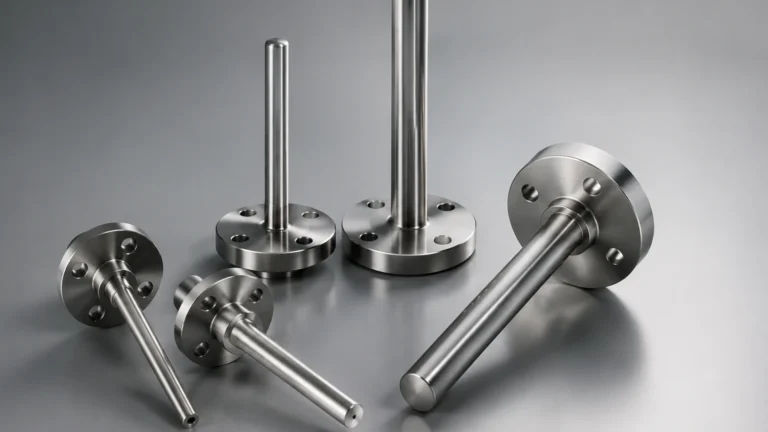
In most industrial B2B applications, temperature sensors should be installed within a thermowell. A thermowell is a pressure-tight receptacle that protects the sensor from the process media and high pressures.
* Maintenance: Thermowells allow the sensor to be removed for calibration or replacement without draining the tank or shutting down the process.
* Heat Transfer: The gap between the sensor probe and the thermowell wall should be minimized, often using a thermal conductive paste, to ensure rapid heat transfer.
Insertion Depth
To avoid "stem conduction" errors—where the ambient temperature outside the pipe travels down the sensor probe and affects the reading—the sensor must be inserted deep enough into the process. A general rule of thumb is an insertion depth of at least 10 times the diameter of the protection tube.
Wiring and Grounding
For thermocouples, always use the correct compensation or extension wire. Using standard copper wire will create new junctions and introduce significant errors. Ensure that shields are grounded at only one end to prevent ground loops, which can introduce noise into the temperature signal.
Practical Selection Table
| Feature | RTD (Pt100) | Thermocouple (Type K) | Infrared (Non-contact) |
| :— | :— | :— | :— |
| Temperature Range | -200°C to +600°C | -200°C to +1260°C | -50°C to +3000°C |
| Accuracy | High (±0.1°C to ±0.5°C) | Medium (±1.1°C to ±2.2°C) | Variable (Emissivity dependent) |
| Stability | Excellent | Fair (Drifts over time) | Good |
| Response Time | Moderate (1 to 50 sec) | Fast (<1 sec) | Very Fast (<0.1 sec) |
| Cost | Higher | Lower | High |
| Common Use Case | Food & Pharma, HVAC | Furnaces, Engines | Moving webs, Molten metal |
Common Risks and Mitigation Strategies
Industrial environments present several challenges that can compromise temperature measurement integrity:
* Calibration Drift: Over time, the physical properties of sensors change. Regular calibration against a traceable standard is required. For critical processes, redundant sensors (2-out-of-3 voting) are recommended.
* Corrosion: Even stainless steel can fail in the presence of chlorides or high-temperature oxidation. Regularly inspect thermowells for thinning or pitting.
* Thermal Lag: In large diameter thermowells, the time taken for the sensor to reach the process temperature can lead to control delays. Use stepped or tapered thermowells to improve response time without sacrificing structural integrity.
* Signal Noise: Long cable runs for low-voltage signals are prone to EMI. Converting the signal to a digital protocol (like HART or Modbus) or a 4-20mA analog signal at the point of measurement is the most effective mitigation strategy.
Frequently Asked Questions (FAQ)
Q: Should I choose a 2-wire, 3-wire, or 4-wire RTD?
A: For industrial applications, 3-wire RTDs are the standard as they compensate for lead wire resistance. 4-wire RTDs provide the highest accuracy by completely eliminating lead wire effects, making them ideal for laboratory or high-precision custody transfer applications. 2-wire RTDs should only be used where the lead wire is very short and accuracy is not critical.
Q: How do I know if my thermocouple has failed?
A: A common failure mode is an "open circuit," where the junction breaks. Most modern transmitters will drive the output to a specific "burnout" value (high or low) to alert the operator. If the sensor is providing erratic but plausible data, it may be due to "green rot" (oxidation) or moisture ingress in the insulation.
Q: Can I use a temperature sensor to detect the presence of liquid?
A: Yes, this is known as a thermal dispersion level switch. It uses a heated sensor and a reference sensor; the rate of heat dissipation changes depending on whether the probe is in air or liquid. While effective, dedicated level switches like those found on the Welk Main Page are typically more robust for level-specific applications.
Conclusion
Industrial temperature sensors are foundational to modern process engineering. Whether you are managing a complex chemical refinery or a municipal water plant, the accuracy of your temperature data dictates the efficiency and safety of your operations. By understanding the strengths and limitations of RTDs, thermocouples, and IR sensors, and by following rigorous installation standards, you can ensure long-term reliability.
Remember that temperature measurement often serves a dual purpose, particularly when integrated with level measurement systems. Ensuring these sensors work in harmony is the key to optimized process control. For further technical specifications on how temperature integration improves level sensing accuracy, consulting with professional manufacturers remains the best path forward for complex industrial projects.